Showing posts sorted by relevance for query answers in genesis. Sort by date Show all posts

Thursday, January 8, 2009

Can Christians Believe in UFOs?

This morning, I read an article over at Answers in Genesis that discussed an idea that I didn't know anyone actually believed: the idea that Christians cannot, and must not, believe in the possibility of alien life in outer space.

This is something I've never understood. The Bible makes no mention of aliens, at all, so why work it into our beliefs?

The fact that they are not mentioned in scripture has caused some to believe that aliens must not be real. As the article puts it:

Even if there were other galaxies with planets very similar to earth, life could only be there if the Creator had fashioned it. If God had done that, and if these beings were going to visit us one day, then He would surely not have left us unenlightened about this. (emphasis mine)

However, the Bible also fails to mention quantum physics, sewing machines, and Antarctica, but those things are certainly real. Most of our world is a mystery and the Bible only tells us about a little of it.

The article also lists numerous reasons why the existence of alien life is dubious and tries to play the part of the paranormal skeptic by decrying UFO sightings as crazy stories. They could be right about that part, maybe there are no aliens, but it has nothing to do with theology and doesn't belong in such an article. It's merely someone's opinion about a hotly debated topic.

The people at Answers in Genesis have gone so far as to say that alien life and the validity of Christianity are mutually exclusive ideas, so if aliens did land they would have to admit that their faith is wrong. That is a very foolish position and it is completely unnecessary.

Believe it or not, the Bible doesn't answer every question. Does it tell us how we can be saved? Certainly, it does.

But, did it warn us about the great depression or explain why Earth's magnetic poles shift? No

It's very unlikely that we will see aliens in our lifetime, even if they do exist, but let's not bog ourselves down with meaningless theology when the work of the Kingdom is to be done.

Monday, February 13, 2012

Valentine's Day, Singleness, & The Church: Part II


A few friends of mine, who grew up in solid Christian environments as children of pastors, mentioned to me they didn't think the Bible said anything about singleness. No doubt exists in my mind that these friends knew, and could easily find, the passages in the Bible that dealt with marriage but the lack of knowledge that the Bible spoke into their lives of singleness seemed a significant issue.

A basic understanding of hermeneutics tells us that one comes to any text with preconceived notions of what it should or does say. The best exegete tries to compensate for this issue but cultural understandings may so influence their thinking that they can't see out of that paradigm.

I propose we do this with marriage when we read the Bible. We put our cultural views--our views that come from our current Christian culture-- into what the Bible actually teaches on marriage and singleness. We tend to believe it is a Biblical mandate to be married except, of course, for those few people who are called to singleness. So we read the Bible accordingly, only seeing those parts that talk of marriage and how it plays a role in our lives and represents our future with Christ. We do not see the parts that talk about singleness.

So, let's take a look starting in Genesis and look at creation with an eye towards singleness. In Genesis 2:18-22 it says:

The Lord God said, 'It is not good for the man to be alone. I will make a companion for him who corresponds to him.' The Lord God formed out of the ground every living animal of the field and every bird of the air. He brought them to the man to see what he would name them, and whatever the man called each living creature, that was its name. So the man named all the animals, the birds of the air, and the living creatures of the field, but for Adam no companion who corresponded to him was found. So the Lord God caused the man to fall into a deep sleep, and while he was asleep, he took part of the man’s side and closed up the place with flesh. Then the Lord God made a woman from the part he had taken out of the man, and he brought her to the man.
 
Many foundational insights exist in these passages of Genesis that tell us who we are as humans and who God created us to be. Most people look to these chapters to tell us about God's mandate for marriage. But take a moment to look at this passage from the perspective of God creating us also to be single--at least for a time.

The passage starts with God stating that it is not good for man to be alone. Of course, God knows that none of the animals are going to be the match for Adam but he still has Adam go through the naming process. Why would God do this? This question persists to be an interesting one with many commentators weighing in but I'd like to look at it from the perspective of singleness for some answers.

During this time of naming the animals Adam was going through a God-ordained period of singleness. Adam was waiting and hoping and expecting a companion to come along. At the very beginning God created this process of singleness in humans. It seems God wanted Adam to go through this. It seems that God wanted Adam to learn and grow during this time.

Singleness then, in some sense, seems to be our natural state. Marriage is something that God created for us while in this life—it doesn't exist in our eternal state. He created marriage as a teaching tool and as a way for us to experience a healthy way to feed our need for real relationships in this world. But, we need not act like being single is wrong. God creates us as singles (everyone is born single), as individuals, and even, as with Adam, requires us to be single for a time period in our lives.

Moving into the New Testament now, Paul says in 1 Corinthians 7:7-9:


I wish that everyone was as I am. But each has his own gift from God, one this way, another that. To the unmarried and widows I say that it is best for them to remain as I am. But if they do not have self-control, let them get married. For it is better to marry than to burn with sexual desire.

Again, in this oft quoted passage on singleness and marriage we tend to put on our 'marriage goggles' and look at it assuming that we should get married, often as quickly as possible. In the context Paul is addressing a question that the church in Corinth asked regarding abstaining from sex altogether. Paul is talking about when it is appropriate and not appropriate to have sex. If you read the previous verses this is clear, but we often just pull out a few verses making it easy to misinterpret the meaning. In 1 Corinthians 7:1-7 the verses right before the verses I quoted above it says:

Now with regard to the issues you wrote about: “It is good for a man not to have sexual relations with a woman.” But because of immoralities, each man should have relations with his own wife and each woman with her own husband....Do not deprive each other, except by mutual agreement for a specified time, so that you may devote yourselves to prayer. Then resume your relationship, so that Satan may not tempt you because of your lack of self-control. I say this as a concession, not as a command. I wish that everyone was as I am. But each has his own gift from God, one this way, another that.

Paul says both engaging in sex and abstinence are appropriate but in the correct contexts. It also seems we may fool ourselves into thinking that when Paul says that those who do not have 'self-control' should get married that he is speaking to anyone who has thoughts about sex and/or desires to have it. Most likely this was not his intent. The culture of that time was rampant with ways to express yourself sexually from temple prostitutes to brothels. If you are participating in those options, it is better to get married and have sexual relations in a marital context but he'd prefer if everyone stayed single as he was.

Obviously the Bible does address singleness through the passages I talked about as well as several others I've not looked at here. I'll continue to look at more Biblical passages on the topic and develop the theology of singleness and marriage more fully in upcoming posts.

Read more in the intro piece to this series:
Valentine's Day, Singleness, & The Church: Part I

.

Wednesday, November 11, 2009

What is the Vatican Doing About Aliens? Surprisingly, a Lot.

While visiting Rome, the wife and I stumbled onto an interesting church that was dedicated to the works of Galileo. I know, I know, everyone says that me and my Southern Baptist buddies declared him a heretic and ostracized him years ago, and that we are still looking for scientists to maim in our never ending bloodlust for thinkers; but there's more to Galileo's story, and, today, the Vatican is looking heavenward on its own.

Sometime after Galileo died, the church realized that attacking a poor astronomer (who had strong Christian convictions) was probably their worst idea since they asked Thomas Aquinas to write a little book about what he believed. Today, near the train station in Rome, you can see this large church that tells the legacy of Galileo and even shows a film of the moon landing. In this video, one of the astronauts mentions Galileo's predictions about gravity on the moon and carries out the experiment that Galileo had always dreamed of. Check it out:


Today, something new and different is going on in Rome. Since life on other planets is a possibility, the Vatican does not want to be caught off guard. It's important to consider the theological ramifications of extra-terrestrials and to consider what the church's role should be if an encounter with alien life took place.

"The questions of life's origins and of whether life exists elsewhere in the universe are very suitable and deserve serious consideration," said the Rev. Jose Gabriel Funes, an astronomer and director of the Vatican Observatory...

...in the interview last year, Funes told Vatican newspaper L'Osservatore Romano that believing the universe may host aliens, even intelligent ones, does not contradict a faith in God.

"How can we rule out that life may have developed elsewhere?" Funes said in that interview.

"Just as there is a multitude of creatures on Earth, there could be other beings, even intelligent ones, created by God. This does not contradict our faith, because we cannot put limits on God's creative freedom."

Funes maintained that if intelligent beings were discovered, they would also be considered "part of creation." (Link)

I agree - nothing about aliens challenges my faith.

However, the writers over at AnswersInGenesis.com do not agree - they maintain that only the Earth can hold intelligent life and that no aliens can exist, and they insist that this can be determined by reading the book of Genesis. That's a remarkable claim - not a single Biblical scholar in history seems to have come to this conclusion, so the folks at Answers in Genesis must be pretty confident in their ability to interpret scripture. (I linked to that article and wrote my opinions about it here.)

At my old job, some co-workers said that if aliens were discovered it would nullify the Christian faith - I wanted to bang my head against the wall. When did Christians get this "anti-E.T." reputation? Let's choose our battles more wisely. Also, I'm going to join the Vatican in watching the skies.

Monday, May 10, 2010

The Biologist and the Bible

I walked past a classroom a few weeks ago and noticed a professor who was talking about the Bible. I leaned in to listen. Was this a theology class, or a course on world religions? No.

It was a biology class.

I knew what I had to do. Grabbing my secret supply kit, I grabbed my Bible in one hand and my Christian apologist tracts in the other. I quickly donned some war paint and entered the room screaming. I'm pretty sure a white light shone about me as I confronted the biology teacher in front of the stunned students.

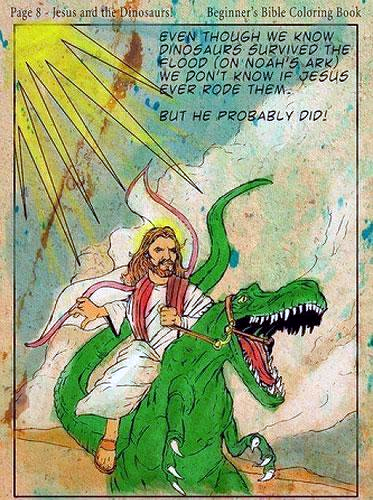
The professor asked me who I was - but I countered by asking him who he was to question God! (I was pretty proud of that one.) Then, using the knowledge I had gained from the 'Answers in Genesis' website, I thoroughly brushed aside all of his arguments for evolution and led the class in singing the old hymn, 'Bringing in the Sheaves.' I even showed the class a picture of Jesus riding a dinosaur to complete my victory.

At this point, the debate was over.

OK, that didn't happen. (Thank goodness.)

Instead, I kept listening. The professor was a nice guy and I assumed he would not bring up religion in a biology class without a good reason. And I was right.

From the hallway I heard him kindly explain that the laboratories were not interested in religion when researching the origins of life. As he pointed out, there are many religions with opposing views of creation, and respecting them as science really doesn't get any work done. However, it was not his intention to challenge anyone's faith or tell anyone if they should believe in God.

The old cliche of the biology teacher opposing Christianity is a favorite in email forwards circa 1999, but that specific type of villainy is not what I saw. I saw a professor respectfully explaining that it was not his goal to push Christianity aside rudely, but to simply focus on the science. I have no problem with that. Reading the Bible doesn't help you understand what's under the microscope. (Although, it may help you understand why it's there.)

Not everyone is comfortable with this, and I understand that, however it is my conviction that whatever is under the microscope was put there by God. Does it appear to reflect evolution? So be it. Does that undermine the Bible? Of course not. If Christianity is true, then nothing in nature could possibly exist in opposition to it. If anything between science and Christianity seems to be in disagreement, I just remember that there is more we have to learn; maybe when we learn more about our world we will see that science and Christianity are not so far apart.

Until that happens, please remember how respectful that biologist was to religion. Fellow Christians, we are to be just as respectful to them if we are to live as Jesus lived.

Monday, September 2, 2013

How I Learned to Love Evolution (Confessions of a Theistic Evolutionist)

After hearing about the "dangers of evolution" for so much of my life, I later learned that I could embrace it, or at least ignore it. I think the church's battle against scientific progress is misled, just as any person of science should not be using their work to campaign against Christians. It's OK with me if we disagree on these things, but I want to tell you how I arrived at this conclusion.

In church, I had always been told that the earth must only be a few thousand years old because The Bible Says So, and anyone who says otherwise is just trying to rebel against God. I wasn't so sure about that last part until I met several people who only promoted evolution as an anti-church message. (I realize, now, that most people who care about science are not fighting the church, but if you're a Christian you'll run into people who want to insult your faith with Darwin's theories. Immature.)

Suddenly, I was caught in a fray. With creationists on one side of me and evolutionists on the other, I had to choose a side. Or, so I thought.

This changed when I attended a lecture by a leading Darwinian scholar. I expected him to trash Christianity, but he didn't. He pointed out that Charles Darwin never thought his ideas were at odds with Christian theology (which he knew better than I realized), despite what I had always been told. I found out that the speaker was leading an effort to end the animosity between churches and scientists, and this gave me great respect for him. Most importantly, I learned that Darwin did not oppose the church - that was fascinating. Also, this was the first time anyone ever explained how Darwin came to his conclusions, and they seemed sensible to me.

I had work to do. Hadn't I been told that the Bible was opposed to evolution? But reading the Scriptures didn't give me any obvious answers. The book of Genesis simply tells us that God made man "out of dirt." That's not very specific. Studying traditional theology didn't help, either. In the fourth century, Augustine said, in his Confessions, that God could have created the world by making a seed and letting that seed grow into the planet we know, over time. The word "evolution" did not exist in those days, but Augustine seemed to have understood it.

But evolution takes millions of years, and the earth isn't that old, right? Again, I looked for proof of this in the Bible and found none. The Bible says God made the universe in six days, but it's not that simple. In those passages, the word used for "day" is the Hebrew word "yom," which can mean anything from a 24-hour period to an indefinite amount of time. (For example, one passage in the Bible uses that word when discussing what will happen in "the day of the Lord," which is certainly not a 24-hour day.) I had no idea how long God spent making the earth.

Of course, I'm no Hebrew scholar - I needed help. So I found as many Hebrew readers as I could. All of
them were fluent in Hebrew and came from conservative Christian churches, and all of them told me the same thing: the book of Genesis does not tell us the age of the earth. In fact, they confirmed that the creation story was written like a song and not a textbook. I was told that I could hold to any view I wanted to about the age of the earth and no one would be able to definitively prove me wrong, since the ancient Hebrew didn't include those details. (Scientific tedium apparently just wasn't important to the author of Genesis.)

Then I attended a lecture about the origin of life given by a biologist who is currently working to fight cancer. He explained that the leading theory was that some sort of tiny organism(s) originated in a primordial ooze on our planet that slowly evolved into something we recognize as a life form. He admitted that this was very speculative, and that little was actually known about the origin of life - but the facts pointed him in this direction. I had no argument. He didn't claim to understand it - he gladly admited that it was a mystery - he was just following the data he had gathered from looking into countless microscopes.

I was reminded, again, of God using dirt to make the first person. The biology teacher was saying that life started from dirt on the ground, and that's exactly what my Bible said. Did He do it by using primordial ooze? Do our scientific instruments point us to the ground as the source of life because that's where we came from when God made us? From this point of view, evolutionary science was only confirming what the Bible said - life began miraculously from the ground.

Of course, I have no idea how the events of Genesis took place, exactly. We're only told the important parts - that the world was made by God so He could have fellowship with us - which leaves a lot for us to fill in with scientific discovery. God made gravity to organize the heavens and keep our planet in orbit around the sun, and maybe He made evolution as a way of ordering nature.

We're left with plenty of questions, as my fellow blogger told us a while back, but there is no view of Christianity that does not leave us with unsolved questions. Young earth creationists are still trying to sell me on the idea that dinosaurs lived with the ancient Romans; as a historian I can tell you that is certainly untrue.

If evolution is someday dismissed by science, then so be it. I have no stake in it. But as long as it's the reigning theory I will have no problem with it. I've left behind the idea that evolution is a threat to the church, and I look forward to a day when the supposed conflict between faith and science is put away.

Friday, June 22, 2012

6 Common Ways Scripture is Abused All the Time

I will admit up front that I've been guilty of some of these abuses on more than one occasion.  Chances are you have, too.  And, by the way, we're not alone: the Bible is probably the most abused book ever written.  So, there's no need for anyone to be defensive here, and hopefully we can have a helpful conversation! :-)

These are the six ways that I see Scripture abused the most commonly.  In particular, I had in mind ways that Scripture is referenced in an abusive manner.  So, yes, we could argue that reading Scripture, then refusing to obey it is a grave abuse, but it's not the sort of abuse I had in mind.  That said, are there any categories you would add?


1) THE "STRETCH" REFERENCE
There is a certain strand of Christian teaching that still insists on seeing the Bible as a big ole book of answers.  Everything you'll ever need to know (or perhaps everything worth knowing) can be found in the Bible.  Either because they embrace this view or because they feel pressure from those that do, many Christian writers, speakers, etc, feel the need to tie everything they say to Scripture somehow.  Often this means backing up everything with a Scripture reference ... whether the reference works, or not.  In my experience, the topics that inspire the most "stretch" references are marriage and finances.


I once read a book on Christian finances that used Genesis 14:21-24 as a reference when talking about credit card debt.  Now if you take the time to read the reference, you'll see that, well, credit card debt really isn't the message there.  The sad thing about "stretch" references is that they are often really good advice, and can stand alone as such.  Do you really need a Bible verse to convince you that being in massive credit card debt isn't a great situation? There's no reason to abuse Scripture to try to justify the advise or prove your credentials to your intended audience.


2) THE "SKETCH" REFERENCE
Christian business are the worst offenders when it comes to this one (though that's not to say that all, or even most, Christian business do this).  Basically it's an attempt to harness the sacred authority of Scripture to support what it is your doing.  The absolute worse example I've seen lately was a Christian dating site.  Quoting verses like "seek and you will find" and "God will grant you the desires of your heart," they went well beyond acceptable bounds.

It would have been fine to say something like, "Look, it's hard to meet other singles, much less other Christian singles.  Come join our online community." (I personally have no problem with online dating sites in theory.)  But instead, they used these Scriptures as part of a larger campaign to guilt and bully people into using their services.  The overall sense of the ad was basically, "Hey, if you don't want to be single, just do what God says in Scripture ... and use our service to help!"


3) THE FLIPPANT REFERENCE
Okay, I bet this would be the category where we would have the most disagreement if we actually tried to start putting Scripture references into these abusive categories.  What I might argue is flippant, you might say is totally harmless, and we might flip flop answers on the next reference.  Basically, these are references to Scripture that don't treat Scripture with the seriousness and sacredness it deserves (the subjectivity of those categories being the reason we probably won't agree across the board on this one very often).

These might range from light offenses (and maybe in your opinion, non-offenses), like a Christian company putting "Your Word is sweeter than honey" on their honey bottles, to (what I hope we would agree) is a grievous offense, like putting Bible verses on toilet paper.  Note that it's not necessarily the motivation for the action that makes the reference flippant, but rather the treatment of Scripture.  The honey peeps may have just been trying to be cute, while the toilet paper peeps may have been trying to evangelize the captive audience of people in public restroom stalls.


4) THE OUT-OF-CONTEXT REFERENCE
Oh my! If we wanted to, we could easily do a 25-year blog series with daily entries on examples where we've seen Bible verses used out of context.  Christians and non-Christians are both guilty of this, and the internet is plagued with these sorts of references! My favorite examples of this particular abuse, though, come from Christian jewelry.  I'll give you an few example.

Has anyone ever seen the friendship necklace that has "May the Lord watch between you and me" engraved across the front, then is cut into two pieces so each friend can carry a piece? Seems kind of sweet, doesn't it? But when you read the actual reference, it's pretty hilarious! It comes from the story of Jacob and his father-in-law, Laban.  Okay, it still seems sweet, though, right?

Well, Jacob and Laban couldn't stand each other.  Worse, they didn't trust each other, not even a little bit.  They had spent the first fourteen years of their relationship tricking and cheating each other as best as they could.  So when it came time to part ways, they created a little stone monument between them and said those "sweet" words on that friendship necklace.  The idea was this: "Look, I can't watch my back 24/7, so I'm trusting God to protect me from your trickery and untrustworthiness."


5) THE IMPOSED-DEFINITION REFERENCE
This is another one that both Christians and non-Christians are guilty of quite frequently.   Basically it's using the Bible to defend your point of view without taking the time to figure out how the Bible defines the terms being used.  People find verses with the words "love," "freedom," "judgment," "authority," etc, and then scream, See? See? The Bible says it, too, so you have to listen to me! Personally, I think "love" is the most abused term in this category.  People know the Bible says "God is love," but don't bother studying how Scripture defines love (especially God's love), so they assume that God automatically approves of anything they are convinced is done out of love.


6) THE -UM-IT-DOESN'T-ACTUALLY-SAY-THAT REFERENCE
For reasons that can only be described as masochistic, I sometimes read through the comment sections on various internet news sites.  I'll often seen non-Christians trying to nail Christians on hypocrisy charges by saying things like "Don't they know that their own Scriptures tell them to __________" or "Jesus taught ____________.  I don't know why his follower can't get that."  The strange thing is that the vast majority of the time, the Bible actually doesn't say that, or Jesus actually didn't teach that.  There are a ton of misunderstandings -- or just plain false claims -- about what the Bible contains out there, and the ease of access and lack of accountability associated with the internet has only exacerbates the problem.  I have heard some truly weird ones in this category from, "The Bible says that Christians have to think of themselves as better than other people; they don't have a choice." to "Baptists drink the blood of babies; their Scriptures tell them to." (I promise I'm not making that last one up!)


What are some of the worst examples you've seen?

What are some of the worst examples you've personally committed?


Wednesday, April 3, 2013

Disappointed with the Bible

When I finally read the entire Bible for myself, I realized that I wasn't going to find what I was looking for.

I thought it would be a detailed explanation of Christianity, containing passages on how the church should be organized and a guide to making perfect decisions, among other things.  I wanted to read about this apocalypse I had heard so much about and to learn exactly how theology was supposed to work.

Instead, I found stuff like this:

Do not give any of your children to be sacrificed to Molek, for you must not profane the name of your God. -Leviticus 18:21

And unto Enoch was born Irad: and Irad begat Mehujael: and Mehujael begat Methusael: and Methusael begat Lamech. And Lamech took unto him two wives: the name of the one was Adah, and the name of the other Zillah.... Genesis 4:18-19

And it keeps getting weirder. But that's just the Old Testament, right? When I finally got to the new testament I was ready for Jesus to explain how things really work. But the New Testament just said stuff like this:

"Blessed are the peacemakers, for they will be called children of God." Matthew 5:9

Religion that God our Father accepts as pure and faultless is this: to look after orphans and widows in their distress and to keep oneself from being polluted by the world. James 1:27

“If you have two coats, give one away,” he said. “Do the same with your food.” Luke 3:11

Not helpful. How is a church supposed to divide it's monetary resources between foreign and domestic missions? Exactly what year was it when Abraham and Sarah visited Egypt? How much should I tithe? Which church denomination should I join? Is there really something "wrong" with rock music? Which words are curse words?

It was frustrating for me to find out that the pages of the Bible didn't answer any of the questions that Christianity had raised for me. But eventually the Bible raised its own questions. I noticed that the Old Testament was a beautiful story of God leading his people through difficult times, and loving them when they were imperfect. It's not supposed to be read as a book of rules, but as a collection of old documents that, as a whole, help us understand who God is.

In the New Testament, a group of Jews who were hoping for a political leader to lead them to freedom were instead visited by a man who taught them to love their enemies and pursue virtue. This wasn't what they expected. If I was disappointed in reading about Jesus, it's because I, too, was looking for something else; I finally understood that I was supposed to be living out Jesus' lessons before asking my own questions. Charity, kindness, and humility became my new priorities, instead of trying to answer every single theological question. (These are lessons that, I'm finding, will take more than a lifetime to learn.)

Am I learning from the Bible's wisdom, or am I still looking for answers to the wrong questions?