Monday, November 29, 2010

A Few Things I've Learned While Working...in the Children's Ministry...

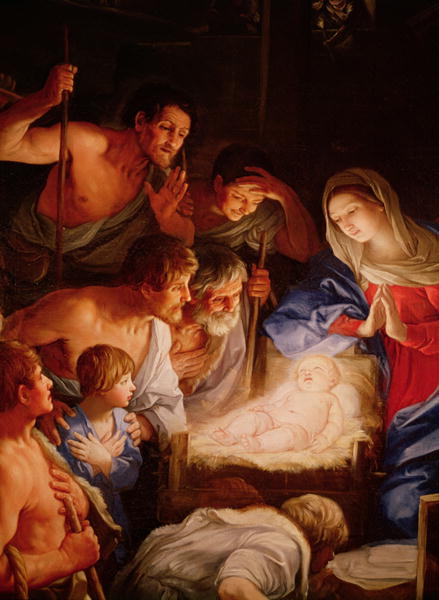
During the month of November I've been helping out in the children's ministry at church.

Those of you who know me may need a minute to take that in.

I'm not into kids.  I love them, but I don't enjoy them the way most people do.  (Right now, half of you are thinking, "Well, Mr. Smarty-Pants, what would you do if you had kids?"  I hear this often, because a lot of people assume that since I don't enjoy being around kids that I would be some kind of an abusive father to my own kids.  That's really not fair.  I don't like U2, but I didn't polish up my shotgun when they were in town.  I take good care of kids when I'm around them, but I am very happy to leave them with their parents as soon as possible.)   I like peace and quiet, nice music, leisurely reading books while drinking Earl Gray, and other relaxing activities that are normally reserved for senior citizens - and children are really good at taking those liberties away.  So, people tend to think that I'd be more likely to join a knitting ministry for old women than help out in the kid's room.  And they're probably right.

However, when I joined the church, our children's minister, Dan, told me that he needed to add people to the list of teachers.  He has to do this in advance rather than asking for volunteers as he needs them, because he puts each worker through a screening process involving background checks and talking to their contacts before they can be allowed in the children's area (as every church ought to do).  He said that he could tell I wasn't really into little kids, but he might need help if he were to get low on volunteers since our church is pretty small.  I agreed, and he told me I would be placed on the bottom of the list to only be called on when absolutely necessary.  I told him that I appreciated that.

Almost two years went by before I had to actually help him.  After some of the Children's Ministry's volunteers moved away unexpectedly Dan was in a bind and needed two competent replacement workers immediately.  He found one.  Then he found me.  I didn't have jury duty or any obvious sickness so I agreed, and that Sunday morning he took me to meet my students.  When the normal children's workers saw me in the kids area they looked concerned and might have sounded some kind of an alarm if Dan hadn't calmed them down and assured them that I was helping out in the 3-4 year old's class.  They seemed skeptical.  So did the students.

"Hey kids, who wants to learn about 5-point Calvinism?  No, really, it's more fun than it sounds!  Do any of you like tulips?  Well, the "t" in tulip stands for Total depravity...hey, don't fall sleep, this is fun!  Now, I don't have to tell you why double-predestination was a problem for Rousseau, so I'll skip straight to the neo-Constantinopolitanists..."

But it wasn't so bad.  I've been thanked by the children's workers many times for volunteering to do something I really didn't want to do, but I had a very easy job, and the regular teachers who are back there more often are the real troopers.  I just kept an eye on them while they played in the playground told them to stop eating paste when I thought they had reached their limit.  Easy stuff.

But I learned a few things.

1 - You Have No Secrets

Your kids tell us everything.  Now, I'm not a gossip, so I don't let it leave the room.  But I hear about things.  It's not unusual for kids to tug on my sleeve and tell me that "Daddy slept on the couch because Mommy needed some 'time alone,'" or to ask us to pray about so-and-so because they failed some class.  We hear it all.  (OK, I exaggerated those examples, but that's because I didn't feel like airing out anyone's dirty laundry.)

2 - I'm Not Good with Kids Because I Always Want to Laugh at Them


I don't respond to problems very well.  For example, when a kid says that they fell down and hurt themselves, my first instinct is to laugh at them.  Then I realize that laughing at a hurt kid is a good way to scar them for life, so I stifle the laugh and try to remember what real grown-ups do when kids are hurt.  Kids have a short attention span, so before I come up with an answer they are usually gone and doing something else.  So, all they get from me is a blank stare.  One of those cardboard cutouts shaped like a person could probably raise a kid as well as I would, which brings me to...

3 - This Experience Has Not Caused Me to Want My Own Kids

After a day of avoiding snot-nosed kids who want hugs (thank goodness for the enormous bottle of hand sanitizer), and telling kids not to throw rocks at each other, someone said, "Working back here will make you want kids of your own!"

Really?  Is that like saying getting hit by a Porsche will make you want your own high-performance vehicle?  I have no idea what these people are talking about, but I agree with them: if you enjoy being a task-master to unsanitary rebels then being a parent is probably right up your alley.

3 - The Workers in Your Children's Ministry Deserve Medals

This most certainly does not apply to me.  Like I said, I did an easy job for four weeks.  Nothing to it.  But the teachers who normally teach these kids have to deal with rebelling children and a revolving door of new diseases each week.  It's as tough as any work the paid ministers do (no offense intended) and it's all volunteer.  They can never be late for Sunday School (anyone else can be late for class - even one they are teaching - and it's laughed off), and they must compose themselves professionally at all times.  And they have very difficult decisions to make; imagine, for example, a sad kids asks you for a hug.  If you hug them, you might make them feel better, but their parents might decide that you were molesting their child.  It's an unfair burden to place on any church volunteer, and, still, these people in your church are doing it every week because it is an important job that needs to be done.

At the very least, you should thank them and let them know how much they are appreciated.

(Also, my spell check insists that "children's" is spelled wrong throughout this entry.  Odd.)

Monday, November 22, 2010

Pope Benedict's Interesting Statement on Condoms

Let's cut to the chase.  The Pope says that maybe it's OK to use condoms.  If you're trying to avoid getting AIDs.  And you're a gay prostitute.


There may be a basis in the case of some individuals, as perhaps when a male prostitute uses a condom, where this can be a first step in the direction of a moralization, a first assumption of responsibility, on the way toward recovering an awareness that not everything is allowed and that one cannot do whatever one wants.  But it is not really the way to deal with the evil of HIV infection. That can really lie only in a humanization of sexuality.


Of course, I like that last part. Sex is not a bad thing, but to be irresponsible with it is to flirt with disaster.  I know that people think it's uncultured for me to say that people should be cautious and reserved with their sexuality, but as long as diseases like AIDs are out to get us I will continue to give that advice.

But, back to the subject at hand, I find the Pope's statement interesting.  And odd.  According to his theology (and not mine), every sperm is precious, but that doesn't mean a condom is a bad thing if it's not preventing sperm from fertilizing an egg.  It's interesting that he is wise enough to make this distinction.

But this is a very strange thing to say.  The Catholic church is embroiled in sex scandals and Pope Benedict, himself, if often seen (probably unfairly) as a representation of this movement of pedophilia in the church.  It sounds like he is saying that gay male prostitution is OK when he makes a statement like this, and that might not be an image he wants to be associated with.

(Note: I realize that homosexuals are not necessarily pedophiles.  Before any of you accuse me of sexual bigotry, understand that I am saying that a religious man who is supposed to be chaste does not appear to be very holy when he aligns himself with the justification of any kind of prostitution.  This seemingly weakens any effort on his part to say that he is serious about the church's stance on sexuality.)

Since the church (obviously) doesn't approve of homosexual prostitution, I find it odd for the Pope to comment on the practices therein.  Then again, if it stops the transmission of AIDs, how can we recommend anything else?  I have to admit, this is an issue I've never thought about.

Thursday, November 18, 2010

Is Jesus a Republican or a Democrat?

Since I'm a historian (sort of), sometimes people like to ask me if certain historical figures would have been like today's Republicans or Democrats.  When Charlemagne ordered fewer supplies for soldiers in order to fund schools, was that like creating government programs the way Democrats do?  Was Alfred the Great's military ingenuity a sign that he would support the troops like modern day Republicans?  Was Constantine's method of growing the Roman empire similar to modern Libertarian economic models?  (OK, no one but me has ever asked that last one.)

I could make a grand case displaying that these great minds were in the same political tradition as myself, and, in doing so, seemingly strengthen the dignity of my position.  (Believe me, many students in the humanities are busy doing this.  They will lucky to get work at a community college after they graduate.)  But this sort of comparison doesn't really work.

Even today, most people don't adhere completely to their party line (most Democrats I know are against abortion, and the Republicans I know hate seeing the government take land via eminent domain rulings) and historical figures rarely fit into our current two-party system.  Furthermore, if you look just a little ways back in American History you'll see that the Republicans and Democrats of the old days were very different from their modern-day counter parts, so you can't even make that comparison without finding problems.  Naturally, if you try to attach a historical figure to your political agenda, you'll find that you will have to fill in the blanks in most areas (just how would Edward I make decisions about red light cameras?) and the few things we can know about these people just won't fit into any convenient political party's pattern.

So, when it comes to the King of Kings, things are even more complex.  Jesus didn't comment on how a nation ought to be run, but on how a person ought to run their own life.  He did ask us to obey the government, even a government that was going to kill him, but he didn't give us his opinion on the Roman political system or the cumbersome centralized method of ruling that was in place until the reforms of Diocletian which gave people little representation outside of the big cities.  He could have discussed a lot of injustices in the government of His day, but, instead, He told his followers to love their neighbors and honor His Father.

Would this man be a Democrat or a Republican?  Thankfully, the Bible leaves all of that out in place of spiritual guidance.  We can fill in the blanks all we want, but in doing so we are missing out on the point of the Scriptures.


"Look, he's holding up three fingers!  He wants us to support proposition 3!"


What is even worse is the way people will hate each other through this.  It is absolutely unacceptable to look down on someone and say that Jesus wouldn't have voted as they did.  A person who does this is using Jesus Christ as a weapon in their own political mudslinging, and that is a depressing misunderstanding of God.  (More on that, here.)

It is best for us to avoid trying to place any historical figure into our own narrative.  Such moves always oversimplify the truth of that person and keep us from understanding who they were.  I've heard plenty of historians try to compare medieval Europeans and Muslims to Republicans and Democrats (respectively); this method will always tell me a lot about the speaker, but very little, if anything, about medieval history. 

Let's allow these people to live in their own time while we live in ours.

Tuesday, November 16, 2010

Being a Christian in Grad School

I've been working on my first graduate degree for a few years, and I've had the luxury (due to the cross-disciplinary nature of my degree) to be a part of many different courses.  I've been in history classes, sociology panels, English seminars, and I've taken classes at the on-campus seminary where conservative Christians are as common as athiests and followers of so-called "post-modern" belief systems. (Don't worry - they don't know what it means, either.)  It's been an interesting experience with a variety of people - and I am normally the only Believer in the crowd.

You may not realize it, but history majors and English majors are very different people ("Dickens wasn't writing about the Cold War!  He never saw such a thing!"  "The author is dead, old man, this unlocks the 'being' of the text!  Haven't you read Levinas?" "Who's Levinas?")  Every group has it's own idiosyncrasies, but all of them have the same prejudices that are universally accepted at all levels: they all hate Christians.

Most of my teachers are fine.  Even if they have strong negative feelings toward Christians, most of them are far too professional to bring that prejudice into the classroom.  Good professors can teach without bringing their beliefs into the curriculum.  (Unless the class is titled 'Professor So-and-so's Thoughts on the Tea Party Movement,' this is to be expected.)  But the students are another matter (and, some professors are jerks, too).

In grad school we mostly attend seminar classes.  Unlike traditional lecture courses, seminar classes involve 5-10 students sitting around a table discussing the work with their professor.  It's more challenging then it sounds.  (Imagine, for example, you only skimmed John of Cross' 'Dark Night of the Soul' and the professor asks you to compare it to the other interior mystics of Spain based on passages of ascension.  I found myself in this situation and begging for a fire drill.  No such luck)  But with those students having so much authority to speak, their own political and religious thoughts come out.  And it can get nasty.

I have not been to a seminar class in two years in which a student (or professor) did not insult protestant Christianity.  The seminary students, the historians, and the English majors all think it is fine to talk about Believers like they are idiots.  Even when I have mentioned my own faith and my regular church attendance, these insults still come.  I would never say an insulting thing about another religious group (especially if someone in the room belonged to that group), but my fellow grad students think nothing of insulting me this way.  This is something I simply must put up with in every class.

As I said, the professors are the good ones and they usually steer the conversation back to the subject at hand, but it doesn't stop me from feeling bullied.  No one ever says that these students shouldn't be so rude or that personal religious fights don't belong in the classroom, as I'm sure I would be told if I decided to campaign against their beliefs.

What's ironic is that these people become guilty of the very thing they attempt to decry.  They lecture the class on how "preachy" Christians are without realizing that they are the ones giving sermons in class while the resident Christian is actually being respectful.  I am told that followers of my religion are rude, even though I'm not the one insulting anyone's belief.  It's frustrating.

Anyone with an axe to grind against Christianity will proudly present papers that make all Christians look bad and will do so with the approving laughter of their peers.  These people heroically think of themselves as "deconstructionists" who have "moved beyond" religion and can freely criticize any modern religious person as someone clinging to an outdated and uncultured tradition.  However, if I were to present a paper intended to show that Christianity is not such a bad thing I would be accused of favoritism.

And that's how it goes in my classes.  I defend respected church leaders of the past from baseless allegations of pedophilia.  I explain that the inquisition punished Galileo, but the Pope and most of the church had no problem with him and that the church was mostly proud of his work.  And I have to correct people who's ideas on the history of Christianity are the same ridiculous ideas that are found in 'The DaVinci Code.'  I shouldn't have to correct grad students (and sometimes professors) on these sorts of elementary mistakes, but since hating Christianity is so popular no one does responsible research on it.  Fallacies and historical inaccuracies about the church abound freely and sometimes I feel like I'm the only person trying to get the facts straight.  In a world that is supposed to be filled with scholars and academics, I find most people are only there to fuel their agendas and turn a blind eye to the facts.  Meanwhile, I attempt to remain completely objective in my research, but I have been told that being objective is wrong and that a scholar must use their work to affect people's opinions!  Obviously, only the popular opinions can win out, so these people are using this abusive approach to scholarship to create a culture that agrees with their own religion and politics.  A horrifying trend for our scholars to follow.

I love scholarship and being a medievalist really makes me happy.  But it's not easy.   The work is hard, the hours are long, and, if you are a Christian, it can be lonely.

Wednesday, November 10, 2010

The E-Readers and Me

I love books.  Just take a look at all of the books in my apartment:

She always does that.  Sheesh.

OK, it appears that I don't have a proper picture of my reading area, but in the largest part of our apartment the wife and I set up books that wrap around the room.  There are thousands, and we love them all.

So, I really don't need an e-reader.  But, being a geek, I couldn't resist looking into these neat devices to see if one of them would work out for me.

The Kindle came first.  I remember sitting in a history seminar class on Abelard and Heloise when a student whipped a Kindle to look up a passage (much to the oohs and ahhs of our classamtes).  He punched in 'Abelard and Heloise' and waited. 

And Kindle didn't have it.

This was fun, for me, because it was obvious that he hadn't read the book at all (or he would have known that it wasn't available) and he got frustrated saying that he thought everything was on the Kindle.  (My copy of the book was around $5.  The Kindle is going for $140, right now, but it was much more back then.)

The next one I saw (personally) was the iPad's application for reading books.  (I know, the Nook was first.  I'll get to it.)  Starting at $500 (and going beyond $800) this was a very expensive solution.  I already have a laptop that was not only less than half of that price, but it is actually smaller than an iPad.  And with Google Books and other online e-book options I've got a lot of online reading I can already do.  (In fact, last week I forgot my copy of Hawking's 'Brief History of Time' and found a free e-book online that I used during class.)  The iPad certainly makes many customers happy with its many applications, but I can't justify that kind of an expenditure for a device that I don't need.

Lastly, I finally got around to seeing Barnes & Nobles' Nook.  And I liked it.  It's small and light, and it's really easy to read.  It is a lot cheaper than an iPad and can actually fit in a jacket pocket.  Not bad, but what can I read on it?  The sample one in the store had 'The Girl with the Dragon Tattoo' pulled up, but that's not what I would use an e-reader for.  I typed in a search for "Peter Brown" and waited.  And waited.  It took a while, but the Nook finally told me that my search turned up no results.

Nothing by Peter Brown?  He's the most famous historian of late antiquity!  This confirmed what I had been hearing: these fun e-readers are no good for the academic.  I can read novels on them, sure, but novels are 50 cents at the local bookstore, and I would have to buy a LOT of those before anyone's e-reader every paid for itself.  Also, I can't take notes on the pages.  (Not that it matters, since academic books are in short supply on those things.)  Of course, I've only mentioned three of the many e-readers out there, but I think I learned what I needed to learn.

I'm sure the e-reader is right for plenty of people, but, as for me, I'll sit by my fireplace and read my old books in my favorite chair.  And I'll mark in them all I want (except for the antiques).

Monday, November 8, 2010

The Five People You Meet on the Internet

1 - The Pundit

"Those morons at CNN/FoxNews have screwed it up again.  They report that the Republicans/Democrats are trying to enact a spending cap on congress, but we all know that the Republicans/Democrats are idiots and the FoxNews/CNN has it right when they say that the Democrats/Republicans are always right...stay tuned..."

This person is an unpaid spin doctor for their political party and, as far as they are concerned, social networking exists so that they can beat you over the head with their ideas.  (Mind you, everyone talks about politics, from time to time, this only refers to certain extreme types.)  This can be a very difficult sort of person to deal with.  My wife and I once met an interesting person at a party and we both got to know her on Facebook.  I quickly got rid of her, because her nice facade turned into scathing political rants aimed against me when she found out who I was voting for.  I don't miss her.  Lately, your "pundit-ish" freinds have either been telling you that the Tea Party is full of crazy circus freaks, or that the Democratic party is full of Joseph Stalin clones.

It's nothing like this.

2 - The Exibitionist

"brkfst - creal/mlk hav2hrrytday #breakfastinahurry"
"drove in2 mailbx lol"
"tking shower #imintheshower"

When Twitter became popular it brought us many forgettable trends (that, unfortunately, found their way onto my Facebook wall).  This involved uploaded pictures of breakfast foods and documenting the length of one's facial hair every day.  All day.  Sometimes forty pictures a day of nothing but what the person ate and the state of their desk at work.  Boring.  The worst part is that my friends with interesting things to say were being covered up by posts about what show someone was watching every half hour.  (Until I cleaned house.)

These days, tweets (I cringe at saying that) are followed by hash tags like "#ihatehashtages" or "#pleasepayattentiontome."  This is done so that someone can filter messages out and find messages that appeal to them.  But do people really go to Twitter and search for tweets labeled "BoredAtTheAirport" or "FastFoodDilemma?"

3 - The Builder

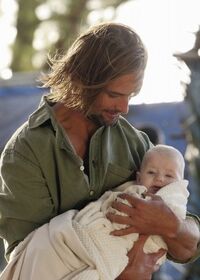
It's not certain what compels them.  It's not money, or fame, but something more intrinsic that awakens in certain people a desire to contribute something creative and unique to the world through the internet.   Bloggers, website builders, and wiki contributors are building the internet that the rest of us are using.  When you google "Goths in Heat" you find this website about kids wearing goth clothes in the summer.  Why?  Because someone decided that there should be a place for this sort of data on the internet.  The person who writes about Sawyer on Lostpedia may not benefit from doing so in any real sense, but now we all know that Sawyer was the only character to have his picture on the back of all six of the LOST DVD cases.  Is this information important?  Not really.

Thankfully, the baby is too young to be scarred by season 6...

Will future generations laud our internet writing as we do the literature of Hugo and Thoreau?  Probably not.  But the internet is there because of the builders.

Of course, I identify with this group.  And, for my trouble, it's brought me a whopping $6.00 in revenue and hardly any visitors. (Not to mention, quite a lot of death threats from an old post that I had to delete.) Why do I waste my time?  Why do cats purr?  We may never know.

 Even my cats know that I'm lame (and aren't afraid to let me know).

4 - The Spectator

This person isn't writing a blog, they rarely update their Facebook status (to the dismay of those who are addicted to social networking...er, or so I'm told), and they don't know how to contribute to a wiki.  However, they do know your Facebook status, they read your blog, and they've seen all of the pictures that you have uploaded.  The people aren't stalkers (unless they are) because this is the sort of data you put on there for people to see.  However, they're not interacting - they're just on the sidelines.  If it were up to them, the internet would be empty, but, thankfully, the other groups are here to create an experience for them.  This is good; it takes all kinds, and without the spectators in the stands there wouldn't be any room on the field.

5 - The Mime

According to the dictionary, a meme is a "cultural unit (an idea or value or pattern of behavior) that is passed from one person to another by non-genetic means (as by imitation)."  It's not a word I had to know before the internet.  However, not long after social networking became a big thing, some genius found a picture of a goofy looking cat and wrote the words "I can haz cheezeburger" over it.


I don't get it, but it spawned a trend of captioning cat pictures with adorable phrases.  Some of these pictures are clumsy attempts that have no humor in them, but others are well done.


Anyway, just like some kids at school run around finding out "what's cool" and mimicking it, some internet users only live to imitate the latest memes.  Sometimes a new meme pops up and everyone rushes to claim that they were the first person to draw Robocop on a unicorn or caption sad pictures of Keanu Reeves.  It's a race to see who can influence the underside of the internet the most.  Many internet users never see these things.  They are the lucky ones.

Who did I leave out?  And who are you?

Thursday, November 4, 2010

Why (Christian) Movies are Lame

Most people hear the phrase "Christian movie" and roll their eyes.  I know I do.  Maybe I shouldn't, but I've seen what Christian filmmakers have to offer and it normally ends up being fodder for a Mystery Science Theater 3000 sort of experience

Mike Nelson realizes that he has to watch Facing the Giants.

Relevant magazine has some useful things to say, here:

Even with successes (Bella, Facing the Giants), we are on the outside looking in. You can have the huge budget, skilled and experienced technical crew and a firmly executed marketing plan, but if you film a pedantic script with summer-stock-reject actors, your better-looking product is simply lipstick on a pig. Throw in Christian film’s inherently agenda-driven plots and dialogue and you have lipstick on a preachy pig...Christians are not the only audience trained to not expect quality. Audiences in general have had their tastes dumbed down to accept the pitiful, disposable paradise of the corporate cinema. We simply are not taught the Arts in this society.


I completely agree.  Christian films might be lame, but every film is lame, these days.  I hardly ever watch a movie that requires me to use more than 1% of my brain to follow the plot and understand the dialog.  (Recent exceptions to this include Sherlock Holmes and Toy Story 3.)

And don't get me started on music. Very little is happening in the music industry that is worth listening to, and it's very telling that classic rock, oldies, and 80s retro stations are more common than stations playing anything new.  My radio allows for twelve station presents, and even though I've got a jazz station and a classical music station in there, I don't have any new music stations programmed in.  I used to, but after a few years of bad music I decided it was time to let them go.

That last sentence from Relevant really sums it up: we are not taught to appreciate arts.  No one is pushing upward toward higher quality film and music because we've accepted the status quo.  When churches began making films we saw that art took a back seat to preachiness and religious agenda; it's easy to see how this led to such poor filmwork.  But now everyone has decided to ignore art while working on creative projects.

At least, now, church films are only as bad as everyone else's movies.

Pictured: Epic film about a falling baby elephant that is more entertaining than Avatar.

Tuesday, November 2, 2010

How To Support Our Music

Many of you have told me that you would like to support the music that my wife and I play, and this is your chance (it is simple).  We perform at different venues in the Dallas/Fort Worth area, and we are excited about finally recording our newer music.

If you want to help, we have a Facebook fan page that I would ask you to "like."  When we release songs the people who know us on Facebook will be the first to know and will end up getting access to any free copies of the songs we give out (which might happen a lot).  You can also visit the main website for more information.

Furthermore, you can subscribe to our YouTube channel, where you can see videos like this one (which was taken with my Aunt's iPhone).


These simple things really do help us out, a lot, so if you've ever wanted to lend us a hand this is your time.