Thursday, January 31, 2013

What the Portland church needs

Portland vs. Dallas
I grew up in Portland, Oregon.  When I moved to Dallas, Texas and told people I was a Christian from Portland the response was often, with some amazement, "What's it like being a Christian there?"  I never knew how to respond.  The question arose from oft-quoted statements that the Portland area is the most unchurched place in the country.  Portland's paper, The Oregonian, ran a story "Sorry, Oregon, you're no longer the most 'unchurched'" when we apparently lost the title to the New England area.  In Oregon we like being known known for random things.

http://upload.wikimedia.org/wikipedia/commons/thumb/9/90/Portland_State_University_sign%2C_Portland%2C_OR_2012.JPG/256px-Portland_State_University_sign%2C_Portland%2C_OR_2012.JPG
Portland State's motto is, "Let knowledge serve the city."


What's it like to live in an unchurched area?  For the most part, the same as living in a churched area.  I always had a hard time responding to the question.  I landed on the answer that I really didn't feel like there were more or less practicing Christians in either area but did feel a large difference between the baseline knowledge of the faith between the Bible Belt and the Pacific Northwest.

As soon as I moved to Dallas and started talking to any Christian, or really most anyone, I noticed they knew far more about the study and practice of Christianity than I did.  They would talk about Calvinism, about authors and a variety of ministries, none of which I'd heard anything about.  I grew up in a good church in Portland where seminary professors were leading the church so was confused why I had so little knowledge.

Once I moved back to Portland after graduating seminary I noticed the difference again.  I started going to a good church with many highly educated, lifelong Christians and seminary graduates as leaders.  I still noticed a striking difference in the general knowledge of Christianity of the church attendees between Portland and Dallas.  No longer could I go to my church group and discuss the same topics I studied in my advanced seminary classes with my friends at my church.  I was lucky if more than one person had even heard of the authors or theories I was talking about, let alone having an in-depth discussion.

What's unchurched mean?

In the Aris 2008 survey (pdf) referenced in The Oregonian article above the question for the survey that was asked was, "What is your religion, if any?" and left open ended.  Those that said something along the lines of 'none' were defined as unchurched.  On the not-so-open ended side the Barna Group defines unchurched as, "not having attended a Christian church service, other than for a holiday service, such as Christmas or Easter, or for special events such as a wedding or funeral, at any time in the past six months."   
In the 2008 Aris survey 15% of the US population falls under the unchurched (none) category. According to Barna's 2007 data 33% of the population is unchurched.  It's clear based on their definitions why there is an 18% discrepancy. 

Barna numbers are quoted often and are useful if you understand their definition of unchurched. In a more recent Barna article they state, "Several interesting insights define the self-identified Christians among the unchurched.... Close to one out of every five (18%) can be considered to be “born again”...."  I contend that while a rising number of people would never attend church, more than we think do identify with a church and would go if they found somewhere that overcame many of their issues.

Education

I did a survey myself.  It may not be as statistically accurate and formal as the ones above for the unchurched data but I feel it's representative.  I looked at 14 church websites in the Portland area and 14 in the Dallas area.  All were mid to large-sized churches and of an evangelical persuasion.  What I looked for was any documentation for the education of the head pastor of the church. 

Overwhelmingly in Dallas education was noted and in Portland not. Nine of the 14 churches listed the education of their pastor and I found the education of all the other pastors by a quick Google search.  Six hold doctorates, three a Master of Theology, three a Master of Divinity, one a Bachelor of Arts in Bible and only one doesn't have a degree. 

Only two churches in Portland listed the education of their pastor.  By searching online I was able to find the education of five other pastors.  Four pastors of the ones I found hold a doctorate, two a Master of Divnity and one a Bachelor of Arts. I would assume the others, or at least most of them, don't hold a degree.  That's 50% of the pastors in my survey of Portland that don't hold any degree, let alone one related to Christianity.  More of them could hold degrees and I just couldn't find the information anywhere.  That may be true, and it's where my informal research is flawed.  But, with my experience in the Christian community in Portland I think the number is accurate.

According to the 2010 Census the percent of people in the Dallas-Fort Worth area (Dallas and Tarrant counties) with a bachelor's degree or higher is 28.5%.  The percent in the Portland metro area (Multnomah, Clackamas and Washington counties) is 36.5%.  This is a large enough discrepancy to really make me wonder.  Portland does value education and knowledge but for some reason has left it out of their church culture.

Children's games and drive-thrus

Ever play telephone when you were younger (or older)?  The first person starts with a word or phrase and whispers it to the next person and so on.  The game is fun when the person at the end says what they think the first person said.  It's never right and always amusing.

Usually the first person who hears the word has it correct.  Perhaps because it hasn't passed along enough down the chain to get too mixed up?  Or it may be that the person often sitting next to the first person knows them and is used to hearing how they talk.  Hearing how they pronounce and enunciate words and therefore can more easily understand what is being said.

I worked at a drive-thru Starbucks.  Sometimes people would order a Diet Coke even though Starbucks doesn't sell soda.  None of us could ever understand what was being ordered at the speaker.  We all knew the words "Diet Coke" but it was out of the realm of what we were used to hearing for orders and thus we had to ask the person to repeat it several times before we could understand.

I do not believe everyone has to go to seminary or bible college.  I think if you want to be a pastor or are taking a leadership role on in the church you need to get some training.  Seminary is a great and logical way to do so.  But this training can take different forms.  It does need to be serious training from a good source. I know it's not a magic potion that will make everything better, but it won't make anything worse. Just like in the game of telephone the further down the line the knowledge goes the more likely it will be misinterpreted or misunderstood.

Summary

This misinterpretation and misunderstanding of Christianity by many attendees and leaders in Portland I believe is a key reason many people here don't attend church.  I'm not claiming everyone teaches heresy.  I'm claiming that when a Portlander with a master's degree in their field starts asking intelligent questions of their leaders or fellow church attendees they get poor answers.  Even if the pastor can answer the questions many find it hard to keep attending church when everyone else around them doesn't know or seem to care about the answer.  Most non-Christians I meet around Portland know far more about the Bible than people I meet in church.

What's all this mean?  Portland is a smart city with many well-educated individuals, formally and informally.  I see a huge disparity between the general education in Portland and the education of Christians toward a Christian worldview in Portland.  In Dallas where eight percent fewer people hold a bachelor's degree or higher, the culture of the church clearly promotes much more Christian education.

Will solving the education disparity here magically get everyone to go to church?  No.  I do believe it will go a long way to bringing many back to the church and show that Christians take themselves seriously and value education toward understanding Christinaity just as we do for any other area of our lives.

In many ways knowledge is power, as the saying goes, and that power gives people the ability to be more secure in their faith and beliefs and therefore to overcome judgmental attitudes and ultimately to speak out toward the Truth clearly and effectively.

Monday, January 28, 2013

Reflections on Post-Christian Europe


I recently returned from a two-week trip to Germany where I visited the major university centers of Freiburg, Heidelberg and Tübingen. These cities, dating back to the Middle Ages, each possess remarkable charm, with stunning architecture, cobbled streets and quaint, cottage-like houses. I was particularly struck by the churches and small cathedrals which, as you can imagine, are opulently decorated with stained glass and remarkable stonework.

The Freiburger Münster cathedral (above) is especially spectacular. Begun around 1200 and finally completed in 1330, the Münster features both Romanesque and Gothic characteristics, and to my mind perfectly captures the stereotypical qualities of a mid-sized European cathedral. The interior inspires reverence and solemnity, and my wife and I moved silently through the aisle and trancept while one or two parishioners prayed nearby. It seemed a natural place to seek God.

Diagnosing A Post-Christian Culture

But sadly the reality of the situation in Germany is that very few people seek god, and the majority of these beautifully-crafted churches are empty, perceived now as the irrelevant relics of a backward and unenlightened age. The University of Chicago recently published a study showing that Germany – and especially the eastern half of the now reunified country – ranks among the worlds' most atheistic countries. Once the vanguard of Protestant theology, Christianity is now all but dead in Germany.

As I toured these spectacular churches with these statistics in mind, I couldn't help but reflect on a famous passage from Friedrich Nietzsche's book The Gay Science. Published in 1882, the books contains a section known as the “parable of the madman.” In it, Nietzsche describes a crazed man with a lantern rushing into a crowded marketplace at dawn and yelling, “I seek god! I seek god!” The crowd, being the sophisticated, enlightened atheists that they are, laugh and mock him. The madman, Nietzsche writes, responds:

"Whither is God?" he cried; "I will tell you. We have killed him -- you and I. All of us are his murderers. But how did we do this? How could we drink up the sea? Who gave us the sponge to wipe away the entire horizon? What were we doing when we unchained this earth from its sun? Whither is it moving now? Whither are we moving? Away from all suns? Are we not plunging continually? Backward, sideward, forward, in all directions? Is there still any up or down? Are we not straying, as through an infinite nothing? Do we not feel the breath of empty space? Has it not become colder? Is not night continually closing in on us? Do we not need to light lanterns in the morning? Do we hear nothing as yet of the noise of the gravediggers who are burying God? Do we smell nothing as yet of the divine decomposition? Gods, too, decompose. God is dead. God remains dead. And we have killed him."

The crowd stares bewildered at the crazed man, not knowing how to react. Sensing that they cannot understand the significance of his proclamations, the madman throws down his lantern, a symbol of Promethean insight.

"I have come too early," he said then; "my time is not yet. This tremendous event is still on its way, still wandering; it has not yet reached the ears of men. Lightning and thunder require time; the light of the stars requires time; deeds, though done, still require time to be seen and heard. This deed is still more distant from them than most distant stars – and yet they have done it themselves.”

Nietzsche's point is that while modern culture has abandoned faith in god they nonetheless fail to recognize the significance or implications of a godless universe and continue about their regular lives as though nothing has changed. Despite his many faults, Nietzsche fully grasped the terrible consequences of Darwinism and the secularization of Europe, and wished to provoke a more nuanced, truthful investigation into what it means to be authentically atheistic.

The parable closes with the madman wandering through Europe's empty churches:

"It has been related further that on the same day the madman forced his way into several churches and there struck up his requiem aeternam deo. Led out and called to account, he is said always to have replied nothing but: "What after all are these churches now if they are not the tombs and sepulchers of God?"

The Work Ahead

Europe has yet to accept that their beautiful, empty churches stand as glaring reminders that they have all but eliminated god from their worldview without absorbing the terrible consequences of atheism. Many Germans – as well as Americans – live complacently in absentminded acceptance of the “death” of god while still believing that they can lead normal, ethical lives. It is, as the madman said, still too early for them to recognize that without god we enter into a new, radical stage of human existence, one that necessarily entails unprecedented suffering and hardship.

To facilitate a spiritual reawakening in Europe, I wonder if it is necessary to patiently remind Europeans that without god – the lynchpin of objective moral commands and obligations – we are utterly free to behave as cruelly and irresponsibly as we please. Perhaps Nietzsche, who explored the consequences of atheism more thoroughly than anyone in the modern age, can aid us in this task.

Friday, January 25, 2013

Better Leadership is Needed Where Human Rights are Concerned

I've spent the week hearing about human rights issues, and, as usual, I am left underwhelmed.

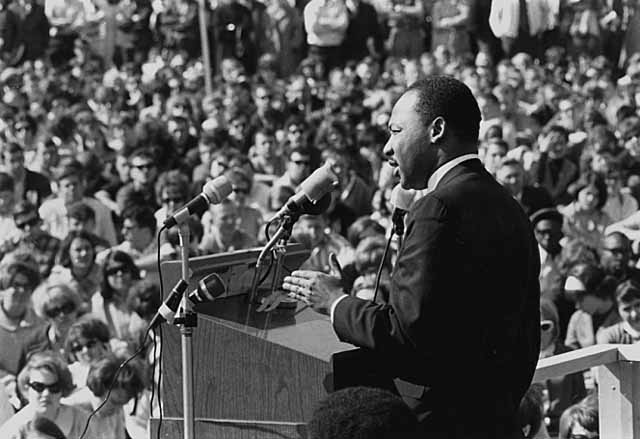
Surely, Martin Luther King Jr. is one of our country's most remarkable heroes, and it's fitting that we discuss human rights issues during the week when we celebrate his life, but I think that our conversations have stopped being useful. All I ever hear is, "we have a long way to go," or "there's still work to do," but nothing specific - and it's been this way my whole life.

I'm 31. I'm not old, and I do not suffer under any illusion that my age makes me wise, but in all of those years I've never heard a civic leader outline what actually needs to be done in the arena of human rights. In older times, our leaders could set out specific goals, such as ensuring that everyone had the right to vote, or that everyone could apply for the same job. Today, it's just pretty, aimless rhetoric.

I'd like to know what we are trying to accomplish in 2013. If there are still problems, then let's discuss them specifically and outline real solutions, instead of vaguely referencing these "serious issues" without naming them or attempting to fix them. If there's still a lot of work to do then we won't make any progress until better leadership comes along to show us the way. (In my more cynical moments, I wonder if some of these people are just making speeches about human rights so they can be on the news and seem relevant.)

It's not possible for us to accomplish anything without a real goal set before us. Will human rights stories always resemble "puff pieces" from the back of a newspaper, or can we change the conversation and make progress, again?

Wednesday, January 23, 2013

Satanist Aren't Actully Supporting Rick Scott (Hard to Believe, I Know.)

Last week, news hit that a group of Satanists was supporting Florida Gov. Rick Scott's proposal to put prayer back in school, claiming that it fit their own agenda as well as that of evangelical Christians. This was reported by every major news network, sometimes in an effort to discredit the governor, but it turned out to be a hoax.

It turns out that that these Satanists are working on a mockumentary, and they were just staging a publicity stunt for their film. The media ate it right up - but they should have known better.

The journalists involved should have been tipped off when these actors began to describe their beliefs. These "Satanists" claimed that they wanted to teach people to see Satan as an angel of wisdom and light, and that God is real but that He is misrepresented by the Christian church. The Temple of Satan that practices its religion in America is actually an atheist religion that does not believe in the existence of God or Satan. (No, I don't know why they're called "Satanists" if they don't believe there is a Satan. I've never understood that.) It's actually very difficult to find anyone who truly says prayers to Satan, despite what were told in the 80s about cult activity.


It was a fun story, while it lasted.

Monday, January 21, 2013

Lessons from Martin Luther King's "Letter from a Birmingham Jail" - Part 2

Yesterday, I shared three lessons people (especially Christians) should learn from Martin Luther King's "Letter from a Birmingham Jail" (You can find that post here).  In celebration of Martin Luther King Day, here are three more important exhortations from Dr. King:

4. Be moderate.
Two of the strongest groups of African-American voices in the Civil Rights movement tended to argue at opposite ends of the spectrum.  On one side were the "do-nothings," who believed that they could never achieve justice in America, and should just let the issue go.  On the other side were those known colloquially as "black nationalists," who argued that African-Americans should stop at nothing to achieve their definition of justice.

Dr. King championed moderation: "I have tried to stand between these two forces, saying that we need emulate neither the "do-nothingism" of the complacent nor the hatred and despair of the black nationalist.  There is a more excellent way of love and nonviolent protest."

In most of our political arguments, there is this "more excellent way."  It demands that we advance our opinions and beliefs not with guns blazing, but in moderation.  No matter what the pundits and politicians tell us, not everything is worth going to political war over.

5. Don't be moderate in everything.
Not everything is worth going to political war over, but some things are.  "I have almost reached the regrettable conclusion," lamented King, "that the Negro's great stumbling block in his stride toward freedom is not the...Ku Klux Klanner, but the white moderate, who is more devoted to "order" than to justice; who prefers a negative peace which is the absence of tension to a positive peace which is the presence of justice."

Some issues cut to the core of human life and dignity, and are clearly spoken about in Scripture.  On those issues, King called for people to abandon the cloak of "moderation," and to fight for truth and justice.  We should identify those issues in our day (and they are few in number), and do likewise.

6. Hold the church accountable...in love.
When the church is in sin (like much of the white Southern church was during the 1960s in regard to its treatment of non-white people), the church needs to be held accountable.  But the church in sin does not need another hateful critic from within; there are plenty of those from without.  It needs a critic who comes to hold it accountable...in love.  Listen to Dr. King, who had far more reasons to criticize the church than most of us do:

"I must honestly reiterate that I have been disappointed with the church.  I do not say this as one of those negative critics who can always find something wrong with the church. I say this as a minister of the gospel, who loves the church...In deep disappointment I have wept over the laxity of the church.  But be assured that my tears have been tears of love.  There can be no disappointment where there is not deep love."

The next time your local church (or any other Christian) does something you believe is unhelpful, ill-conceived, or even flat-out sinful, consider this before you criticize: Do you love the church?  Have you wept over it?  If so, you might just be in the state of mind exemplified by King, and ready to write your own letter.


Sunday, January 20, 2013

Lessons from Martin Luther King's "Letter from a Birmingham Jail" - Part 1


On April 16, 1963, Martin Luther King sat in a jail cell in Birmingham, Alabama.  King had been arrested for taking part in the Birmingham Campaign, a non-violent protest against intense segregation in Birmingham’s government and retail centers.  On April 12, the same day the Birmingham Campaign began, eight white Alabama clergyman (Christian and Jewish) published a public statement in opposition to these protests (you can find that letter here).  Although they agreed that social injustices existed, they also argued that local protesters should not involve leaders from outside “our metropolitan area,” (i.e., King) and should not participate in public civil disobedience.  Instead, they should be patient, and make their case for justice through “the proper channels”: “law enforcement officials” and “courts.”

Although King rarely responded to public criticism (because he received too much of it to directly address), this time, he made an exception.  On April 16, he wrote what has come to be known as one of the great documents of the Civil Rights Movement, and of American History in general: "Letter from a Birmingham Jail." (You can find King's letter here).

There are many lessons in truth we as people (and as Christians) should glean from Dr. King’s letter, particularly in light of our own political conversations and  involvement.  I will share three with you today, and three tomorrow, on Martin Luther King Day.

1. Recognize the good will of those who oppose you
The opening paragraph of King’s letter asserts: “Since I feel that you are men of genuine good will and that your criticisms are sincerely set forth, I want to try to answer your statements in what I hope will be patient and reasonable terms.”

Yes, people are sinners, and often have sinful motives.  But people are also genuine, and generally desire for good things to happen.  Rather than assuming that the person who disagrees with you wants an evil thing, try assuming that they actually want a good thing, but have a different perspective on what “good” looks like.  This will do wonders for creating humility in you and goodwill in your conversations.

2. Sympathize with your opponent before attacking them.
Not only do your opponents generally desire good things like you do, but they also, like you, have experienced pain, disappointment, and suffering in their lives.  Before you attack them or assume the worst, try and sympathize with the difficulties they have endured.

Dr. King urged the white clergyman who opposed his protests to do this.  “Perhaps it is easy for those who have never felt the stinging dark of segregation to say, “Wait.” But when you have seen vicious mobs lynch your mothers and fathers at will and drown your sisters and brothers at whim…then you will understand why we find it difficult to wait.”

3. We are interconnected, whether we like it or not
One of the primary complaints the white clergyman and citizens of Birmingham had was that many Civil Rights leaders (like King) were “outsiders.”  People from outside the state, they argued, had no right or reason to be getting involved in their local affairs.  To this, King responded: “I am cognizant of the interrelatedness of all communities and states.  I cannot sit idly by in Atlanta and not be concerned about what happens in Birmingham.  Injustice anywhere is a threat to justice everywhere.  We are caught in an inescapable network of mutuality, tied in a single garment of destiny.”

Individualism, localism and libertarianism can be good, helpful, and even admirable qualities.  But Christians, of all people, should understand that we are bound together by more than blood or zip codes (see Ephesians 2).  We are bound together by beliefs, ideals, and most importantly, by Christ.  Our individualism (or conservatism) should not be practiced without reference to our connection to others.

Three more lessons in truth from Dr. King tomorrow!  (Read part 2.)


Wednesday, January 16, 2013

Nice vs Kind

Niceness is not a virtue nor a fruit of the Spirit, but we treat it as such in our current cultural climate. Not that this is something new. GK Chesterton and CS Lewis both had much to say about the dangers of the false virtue of niceness decades ago. One of my favorites from Lewis is his novel That Hideous Strength. It's the third and final novel of his space trilogy, but it easily stands on its own. If you like distopian si-fi, you would probably enjoy That Hideous Strength. In it, Lewis centers the plot around the fictional National Institute for Co-ordinated Experiments: N.I.C.E. We learn rather quickly that something sinister lies beneath the building's façade of nicety, but everyone's being too nice, too don't-rock-the-boat, to notice let alone do anything about it. The "nice" things the company is doing for the community blinds people to the evil the company is plotting behind the scenes. Part of the point Lewis is making here is that nice is not always good.

That hideous cover.
Today we call the virtue of nicety tolerance. Traditional tolerance is a virtue in which one tolerates something, or responds with civility toward something that one does not like or agree with. (See also Os Guinness on true vs false civility.) Somehow this has morphed into a definition of tolerance in which one must agree with, or accept, everything, where nothing is wrong. The former type of tolerance is kind; the latter is nice. Both pseudo-tolerance and niceness, or pseudo-kindness, are less-than, mere shadows of virtue. And that they resemble virtue, but fail to actually be virtue is what makes niceness so dangerous. To look at it from the other side of the coin, niceness and tolerance aren't bad by default either, but they need a framework and a telos outside of themselves to be good.

I titled this piece "Nice vs Kind" because kindness is a virtue, a fruit of the Spirit. As we think through Christianity, then, we need to be discerning about the distinction between nice and kind. Here's where I'd like to kick the question out to you: What is kindness? And how does it differ from niceness? Hit up the comment section; I look forward to seeing where the discussion takes us.

Monday, January 14, 2013

Back to Work with Rick Warren

When The Purpose Driven Life by Rick Warren became a huge hit several years ago, my church did a congregation-wide study on it. This was a fruitful study -- every Christian can benefit from learning more about worshiping God, enjoying fellowship within the community of Christian believers, becoming more Christ-like, serving within the church, and sharing the gospel with others (those are the 5 main "purposes" in the book, for those of you who haven't read it -- http://purposedriven.com).

Despite the broad appeal of Warren's main points, however, I was left feeling a little -- well -- purposeless in my daily working life. We spend the majority of our time working -- sometimes in jobs we don't want to do -- and it can be difficult to see a direct connection between those jobs and Warren's 5 purposes.  It is tempting to react like former CEO and President of Adidas, Erich Stamminger, who, after reading The Purpose Driven Life and converting to Christianity, "asked Warren if he should leave his post as the company's head in order to become a pastor" (Read more here). Fortunately, Warren told Stamminger to keep his job, and this conversation forms part of Warren's recent sermon series in which he encourages his congregants in their daily work, saying that work is not a punishment, but part of God's design for man that will continue into heaven.

Cubicles just don't inspire that "purpose-filled" feeling...

When I first came across these words from Warren through the high calling blog (a wonderful resource for figuring out how Christianity and daily work relate to one another), I was relieved. I felt as though a major gap in Purpose Driven Life -- and in evangelical culture at large -- was being slowly filled. Our work -- as work -- matters, and that's simply not a message that gets a lot of pulpit time, despite its extreme relevance to the average church-goer. Christians need to articulate a theology of work that extends beyond the job as a tool for evangelism or as funding for one's "real" church ministry. That's an area where Warren's message has needed a little work. According to the linked Christian Post article above, when Warren advised the Adidas CEO not to quit, Warren told him to find purpose in his work by using his job as a platform for Christianity and by praying for his co-workers. Obviously, these are very good things to do, but they leave the work itself seeming kind of pointless. Now, however, Warren is coming closer to a more complete vision of Christian work in his current sermon series, which stresses that work itself is good, that it pre-dates the Fall, and that it's something that will continue into heaven. That's the kind of message that can give real "purpose" to our daily lives, especially on a cold Monday morning like this one, when getting out of bed and going to work is the last thing I want to do.


Wednesday, January 9, 2013

What Can the Church do About Community Violence? Get Involved.

It says a lot about our culture that we quickly resort to finger-pointing and politicking when faced with something like a school shooting.  People demand simple answers and sweeping, bureaucratic solutions to make things right, but it takes more than a new page in a rulebook to put an end to this sort of thing.

When violence happens at a school, someone is always quick to say that "it happened because we took God out of school."  Well, they're wrong.  Anyone who's familiar with the history of the church should know that the Christian faith will not protect you from violence.

Others think the answer is to outlaw guns, but this will not help the underlying problem - on the same day that Lanza killed 28 people in Connecticut, a man in China entered an elementary school with a knife and injured 22 children before he was apprehended.

Outlawing weapons may help to curb gunshot fatalities (depending on who you ask), but it will not stop angry people from hurting others, and we will still see violence in our communities and wonder what can be done.

When people are angry, scared, or depressed, they become capable of physically lashing out at others.  Sometimes, these people have mental problems that require special care.  Legislation cannot prevent these things from happening, but a community can work together to help troubled people.

How can you help?  Consider how you treat those around you.  Do you shun certain people in your community because of the way they vote?  Do you ignore certain members of your congregation because of the way they dress?  Are you avoiding reaching out to someone in your life because you don't like something about them?  That must stop, because everyone in your life needs help, sometimes.  (Just like you probably need help, sometimes.)

I'm not saying that we can put an end to all violence just by being nice to each other, but we can only help people deal with their problems if we are actively trying to care for them.

Monday, January 7, 2013

How to Fix Christian Art

Ever seen a good Christian movie?  Some of them aren't bad, but have you ever heard of some being artistically impressed with any work of art from Christian culture?  This happens because Christian books, movies, and songs tend to exist for one of two reasons: to encourage the faithful, or to convert the non-believers.

To craft a message with the sole purpose of converting people to your own point of view is, technically, propaganda.  I don't have a problem with Christian themes being in these works, but propaganda can never be great art.  (Is your favorite song a protest song?  Or a political slogan?)

Consider the words of Umberto Eco:

"A narrator should not supply interpretations of his work; otherwise he would not have written a novel, which is a vehicle for generating interpretations."

A good piece of art allows for many interpretations.  For example, as a child I was shown the story of The Tortoise and the Hare, and I was told that the moral of the story was, "slow and steady wins the race."  I disagreed - it was my conviction that the hare would have won if he hadn't gotten cocky, so I learned that one should simply keep their head down and work hard.  (I was a very practical 8-year old.)  The bullies learned that they shouldn't brag about winning until they actually crossed the finish line.  Despite these different interpretations, all of us benefited from the wisdom of the story.

So, we see that even a child's fable can have multiple interpretations, and, as such, the story has a very personal meaning to each of us, because it's a meaning that we teach ourselves.

Can Christians produce these kinds of stories?  Can our songs point to God's beauty without being pushy about our agenda?  Will people ever watch Christian movies without getting the feeling that they're being manipulated into making a decision?  Of course, such artwork may not be what the church wants to see, because allowing multiple interpretations of a story could dilute the intention of it.  

If a Christian film tells a story without leading the viewer toward a specific conviction, will it serve a purpose to the church?  All I know is that the church couldn't get much less relevant than it is, now, so creating genuine art can only help.

Wednesday, January 2, 2013

New Year's Resolutions

I've heard many a sermonette about New Year's resolutions. We should make them, and here are the kinds of "christianly" resolutions Christians make. We shouldn't make them, and here's why they're evil (or at least less-than some sort of similar thing with a "more spiritual" name).

Can I just say... Who cares?

Make New Year's resolutions or don't. Whatever you do, do it for Christ's sake; in his power, by his grace, for his glory. Involve him. You can't go wrong.

Happy New Year everyone. May the Lord bless you.