Wednesday, February 27, 2013

James Randi and the Wonderful Defrocking of a Fraudulent Faith Healer

It's an old story, but a really fun one.

In the 1980s, Peter Popoff ran a successful faith healing "ministry," in which he appeared to heal people of their ailments on live TV. Of course, it was all a lie. In this short clip, James Randi shows us how Popoff was pulling off his "miracles."


But the best part is what the video doesn't tell you. A man once visited Popoff's conference pretending to be an older woman struggling with uterine cancer. Popoff was more than happy to "heal" him without realizing that he was talking to man in drag (who didn't have a uterus).

(If this sounds familiar, it's also the plot of Fletch Lives.)


Monday, February 25, 2013

Seeking God in the Other


In his book The Face of God, Christian philosopher Roger Scruton explores a fascinating problem. In what sense, he asks, can we say that God is present among us? Theologians for centuries have argued that, because God cannot be reduced to physical phenomena, His existence cannot be proven or dismissed by scientific or empirical observation. As science became the dominate way in which humankind comprehended the universe, the faithful were forced to defend God against the new objectivity and certainty provided by the scientific method. As a result, Scruton argues, the Christian theological tradition adopted a theory of God that stressed His physical absence from our lives.

God, Scruton writes, “is not an empirical but a transcendental being; one whose nature and being place him outside the world of empirical particulars, sustaining that world in some way, but not in the way that a pillar holds up a beam or in the way that a mother supports her child.” The problem then becomes that we seem “to be forever and irremediably cut off from him – he becomes the deus absconditus, the hidden God, as Aquinas described him. And how can we relate to such a God: how can we love him or know that he loves us in return?”

Scruton attempts to resolve the problem by demonstrating that God is still present among us through our relation to others, especially the body of believers. “I shall argue,” he writes, “that we can reconcile the God of the philosophers with the God who is worshiped and prayed to by the ordinary believer, provided we see that this God is understood not through metaphysical speculations concerning the ground of being, but through communication with our fellow humans.”

Developing upon a theme explored extensively by the French philosopher Emmanuel Levinas in works such as Totality and Infinity, Scruton argues that the face of the Other, of our human companions, opens us up to transcendence by exposing us to accountability and the possibility of love. “The face is therefore not just an object among objects,” he writes. Instead it is emblematic of all that is uniquely human and therefore imposes moral duties upon us who perceive in the Other's face a connection to the infinite.

“So what and where is the face of God for the ones who believe in his real presence among us?” Scruton asks. The answer, he concludes, “is that we encounter this presence everywhere, in all that suffers and renounces for another's sake.” Altruism can only be properly understood as an acknowledgment of the eternal significance of the Other's face, of a connection between the created and the Creator that compels selfless sacrifice. “In the moment of sacrifice” Scruton claims, “people come face to face with God, who is present too in those places where sorrow has left its mark or 'prayer has been valid.'” The face of the human is a vista opening out to God's love for us and a reminder that we are created in His image.

Whatever you may think of Scruton's suggestion that God is, strictly speaking, physically absent from us here on Earth, his arguments supporting the importance of fellowship and ethical accountability to the Other are helpful in clarifying our relation to God, I think, and conform to my experience. I am perhaps most aware of God when I witness sacrificial acts of love and compassion, selfless behavior that is inexplicable unless we accept that the human animal is unique and bears the imprint of the Creator. Our love for one another is echoed in Christ's love for us and constitutes a physical reminder of His divinity.

Wednesday, February 20, 2013

How to Use Social Media

Lately every time I log on to Facebook I get more and more annoyed. I wonder... should I give it up? Post status updates letting everyone else know how I feel about their posts? Not be "friends" with anyone on it?  As funny as these questions sound many of us think them on a regular basis.

How can we effectively use social media as a good and even edifying experience for all involved?

Social-media-for-public-relations1reduzidoI started thinking seriously about this topic about fifteen years ago when working for a website. At that time forums and message boards were popular and I found it interesting how posts could both bring people and communities together or pull them apart so easily depending on what was said.

Everyone seeing what we post is a real person. Sometimes we forget that since we don't have someone actually sitting in front of us or talking to us on the phone. Social media is relationship based.

We need to treat social media just as we would communication with another person. It is communication with another person, just through a specific medium. A healthy person looking for healthy relationships can create healthy interactions using social media just as in-person.

Typically social media posts fall into one of four categories: funny/fun, edifying, informational and attention seeking. For instance someone may post a joke, post an encouraging note to a friend, post a link to a blog (like this one?) or post something along the lines of, "I'm so lonely tonight". The first three can and often are used for good, healthy purposes. The last, attention seeking, should always be avoided.

My best advice for how to think through good practices for using social media comes from Henry Cloud and John Townsend from their book, Safe People, even though the book doesn't touch on social media at all.

Before you post or respond to something on social media ask yourself:
  • Does this make me a better person?
  • Does it bring me closer to others?
  • Does it bring me closer to God?
  • Is this being done out of love or brokenness?

If any of your answers are in the negative you should think hard about what you post. With these guidelines opinions and even critiques can still be posted. Just think through the way in which you do it.  It doesn't mean everything has to be lovey-dovey.  It means thinking through the end-reader response and your intentions.

If you want more advice from Cloud and Townsend visit their website at www.cloudtownsend.com. They focus on creating healthy boundaries in relationships.

Monday, February 18, 2013

Myths about George Washington (to celebrate Washington's Birthday / Presidents Day)

Today is a special federal holiday - Washington's Birthday!  Most of us (thanks to endless silhouette crafts in elementary school) know this day more popularly as Presidents Day.

As you may already know, myths about our first President abound in our culture.  Some of these are merely anecdotal, but some actually represent a serious problem for our society's understanding of Washington and his legacy.  Here are six of these myths, and some quick correctives to them.

Myth #1: It's Presidents Day!
Although many Americans celebrate Presidents Day on the third Monday in February, no such federal holiday actually exists.  Instead, the day is officially called Washington's Birthday.  The day has slowly morphed over the decades into its present moniker in order to account for the many traditions in various states and regions which celebrate other presidents, including Abraham Lincoln, Thomas Jefferson, John Adams, and John F. Kennedy.  Rather than supplant the great George Washington, most places simply chose to rename the holiday generally to account for all of their favorite presidents

Myth #2: George Washington had Wooden Teeth
George Washington never had wooden teeth.  He did have a lot of false teeth.  But like all false teeth of his day, they were made of other, more durable materials, including ivory, animal bones, and even human teeth.  These were never terribly comfortable, but they were better than wood.

Myth #3: George Washington Smoked Marijuana
George Washington did not grow or smoke marijuana.  He did grow hemp on his plantation, but this hemp produced no narcotic effects.  Besides, it is clear from his books that he grew hemp to sell for very focused industrial purposes, including the production of paper, fuel, and rope.  Sorry to all of you Colorado pot-smokers: Washington is not your pal.  (Washington did, however, own a very productive distillery, which produced a highly-sought-after whiskey.  You can read about that, and about the recent reproduction of that whiskey from his handwritten recipe here.)

Myth #4: George Washington Chopped Down a Cherry Tree, and could not Tell a Lie
The old myth goes something like this: as a boy, George Washington chopped down a cherry tree.  When confronted with his sin by his father Augustine, Washington promptly confessed, saying something like "I cannot tell a lie."  Well, the truth is that this story never happened.  Instead, it was concocted by a man named Mason Locke Weems, otherwise known as Parson Weems.  In 1800, Weems published a book entitled The Life and Memorable Actions of George Washington.  This book was sold as a biography of Washington, but in truth, it was a book of fables, meant to use the great Father of the United States as an example of moral behavior (and to make alot of money).  He later wrote other moralistic books such as The Drunkard's Glass and God's Revenge Against Dueling.

Myth #5: George Washington said "So Help me God" in his Presidential Oath
Every president must affirm a specific oath, as required by Article Two, Section One, Clause Eight of the Constitution.  It ends with, "I will faithfully execute the Office of President of the United States, and will to the best of my ability, preserve, protect and defend the Constitution of the United States."  It ends there.  Do you feel like something is missing?  If you do, that is because since the early-19th century, presidents have been adding the phrase "So Help me God" to the end of the oath.  The addition of this phrase has always been attributed to - you guessed it - George Washington.  The problem is that there is no evidence that Washington ever said this.  The only sources for this spurious flourish at the end of the oath come from people who wrote later in the 1800s, who had specific religious agendas, and who were not present for Washington's original inauguration.  Hardly trustworthy sources.

Myth #6: George Washington Had a Vision and Prayed at Valley Forge
You have probably seen an image like this one before: Washington on his knees, in the snow, slightly illuminated by light from above, praying.  There are several versions of the same story: General Washington, in the middle of the American Revolution, in deep trouble at Valley Forge in the Winter of 1777-1778, had a religious vision, and retreated to the woods to fall on his knees in prayer.  Guess where this story first showed up - our old friend, Parson Weems.  Weems published an article in The Federalist in 1804 claiming that this happened, but provided no sources, no witnesses, and no explanation.  Now, Washington was certainly a religious man, who belonged to an Episcopal Church most of his life.  He regularly called on "Providence" to aid him, or thanked "Providence" for aid.  He may have even prayed while at Valley Forge.  Americans, including Christians, can thus look to him as an example of dedication, prayerfulness, and possibly even piety.  But if we do so, we should do so based on facts, not on caricatures.  And these paintings of Washington at Valley Forge are just that - caricatures.

Next time someone tries to spread one of these myths, you'll be ready.  Such myths may be fun, interesting, or even helpful to a religious cause, but they're myths nonetheless, and should not be perpetuated by anyone who wants to know or spread the truth.

For great reading on Washington, myths about him, and his times, I recommend:

Edward Lengel, Inventing George Washington: America's Founder, in Myth and Memory
David Hackett Fischer, Washington's Crossing
John Fea, Was America Founded as a Christian Nation? A Historical Introduction

Wednesday, February 13, 2013

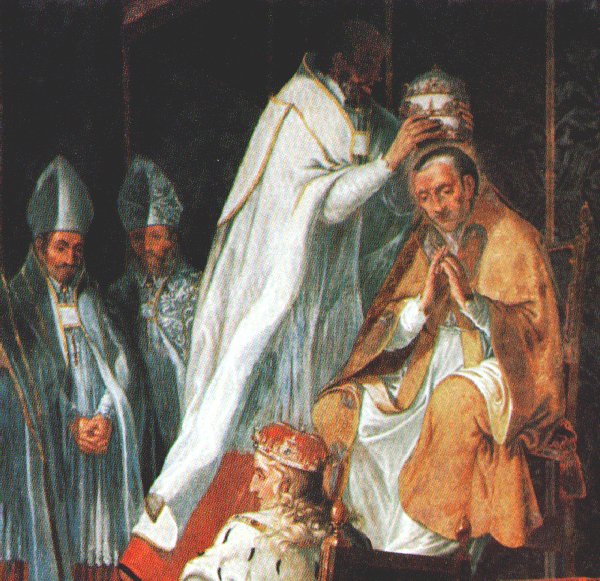
The Interesting Story of Celestine V - The Last Pope Who Tried to Retire


In 1294, while praying in solitude, a hermit named Pietro Angelerio was surrounded by men from the Vatican who told him that he was to be the new pope. He tried to run, but he couldn't escape them, or his fate. The solitary ascetic was forced into a life of bureaucracy and public speaking.

Two years earlier, Pope Nicholas IV died, and there had been no pope during that time. Choosing a new one was very difficult.

The papacy was embroiled in politics more so than any pope of our time could ever be. The possibility of a politically liberal pope is big talk amongst journalists today because of the church's social influence, but in the 13th century the pope's actions affected European countries much more directly. Popes were powerful enough to stop trade shipments, organize armies, or excommunicate your entire country until your king groveled at his feet.

After two years of deliberations, the Vatican received a letter from the hermit Pietro Angelerio, asking them to get on with it and make a decision. And they did. Pietro Angelerio was dragged, kicking and screaming, to the Vatican and forced to be the pope, himself. He would be known as Celestine V.

He was a popular choice, at the time. He had no political affiliations and was respected as a spiritual leader. Unfortunately, that made him a lousy 13th century pope. (He would be a good pope, today, probably.)

After five months, Celestine realized that he was not good at his job, and he resigned. He removed his vestments, took up his walking stick, and went back to the mountains, leaving the Vatican's endless paperwork for someone else to do.

He must have felt like a free man, walking outdoors again after being shut up in the Vatican, managing their interests against his will, but his freedom would not last long. The next Pope, Boniface VIII, wanted to have him imprisoned. Like many others, Boniface believed that it was some sort of treachery to simply resign from the Papacy on your own accord.

Celestine, now going by his old name, Pietro Angelerio, eluded the Vatican by hiding in the woods, but he was eventually found and placed in prison, where he died ten months later.

He wasn't the first Pope to resign - others had done so under duress - but he is the only pope to have done so of his own accord. His decision was very controversial, and it might explain why, in recent years, elderly popes have held on to the position until their death. Our current pope, Benedict XVI, has decided to resign (or, retire) and it signals a big change for future popes. Since Benedict's decision has not met with much resistance, we can assume he will be able to retire without incident and leave the papacy to a younger, healthier leader, and future popes will be able to do the same.

Monday, February 11, 2013

Thoughts on Hospitality

When we hear or use the word hospitality, it conjures a pretty specific picture: (mostly married) women hosting dinner parties, (mostly married) women bringing covered dishes (which is Southern-speak for food that makes for delicious leftovers) to the homes of those who are suffering.

We might get a broader picture when we invoke the phrase Southern hospitality.* This consists of everything from someone offering you a ride in their chicken truck to nearest PepBoys when your car breaks down (true story), to bumming a cigaret to a stranger; from holding the elevator without being asked, to insisting on water breaks for the movers you're paying by the half-second.

These are all good examples of hospitality. The first examples happen mostly among friends and family, the latter between strangers. Both are vital to our development as... human beings.

But these expressions of hospitality are not usually part of our everyday comings and goings. They're generally either extremely planned or extremely unplanned. And, sometimes what we primarily think of as hospitable acts lend themselves toward being extraverted acts.

Proposal: Hospitality is neither for certain sects of people---extraverts and women**---nor is hospitality a once in a while, or "merely polite," venture. Hospitality, in it's most essential form of expression, is ontological (just keep reading; this word will soon make more sense if it's new to you now).

We are most hospitable when we make others feel at home in their own skin. You don't have to own a home or a spacious apartment to do this. Nor do you have to smile at or speak to strangers. You simply have to let people be themselves.

Make being with you a safe place for people to be their true selves. How do we do this?

1. Stop being so judgy.
We all do this. Kicking this nasty habit requires being openminded and refusing to stereotype and categorize people: Fat people are lazy. Nice people are fake. Muslims hate women. Stop. Stop. Stop. People are complex. Get to know someone as the individual he or she is---which will invariably include hopes and passions and insecurities that are deeply human that allow us to connect on a deeply human level.

1b. Let go of what annoys you.
This is not always possible. But sometimes it is and we need to realize that what annoys us is just not that important and we need to get over ourselves. For example, being a rather tight-ass rule-follower, I often find folks who exhibit a general disregard for rules, especially for illogical reasons like "having fun" and "socializing," annoying. Sometimes disregard for rules can be a type of thoughtlessness toward others that really is uncool. But sometimes it's just not that big a deal and I just need to get over myself and my---and this is the key word here---preferences.

2. Keep calm and... you know the rest.
Don't freak out. This is especially important when someone shares an insecurity or a mistake or a life choice you don't approve of (see 1b), or a life choice that really is unhealthy and harmful to his or her true self. Yes, ontological hospitality is really just being the grownup friend to the teenager inside us all. When someone confides in you, be rational while also being emotionally available. In other words, don't freak out and make emotional contact: eye contact, a hand on the shoulder, a gentle word. Make the kind of contact that communicates love and respect, even if also disappointment; make the kind of contact that says, 'You're the only person within 100 miles;' which is to say, 'You're valuable and I want to hear your story.'

3. Encourage the true self.
This is the biggest part of being ontologically hospitable. All the other things we've talked about so far fit into the framework of encouraging others' true selves. What I'm calling the true self can be understood as one's better self, or in Christian-speak, the imago dei. Encouraging someone's better self takes form in two ways.

Firstly, we encourage someone's better self by believing it exists even when we can't see it. We do this by seeing his potential beyond his failings. We do it by recognizing her hurtful words and actions as the masks of the false selves, the lesser selves.

Secondly, we show ontological hospitality by drawing out and being a safe place for the parts of that person she or he has buried because some social structure---family, church, the workplace, society at large---has told her it's abnormal or unacceptable, told him it's weird or wrong. Don't cry, men are supposed to be strong. Don't speak your mind, women are supposed to be nice. As Christians we believe (or we're supposed to believe) that all people are made in the image of God (cue the above Latin) thereby uniquely reflecting God to others. This means we need one another to see God and to gain perspective about ourselves and the world in which we live.

But the world is not a safe place for these unique selves because unique is unpredictable, unmanageable, and unknown. And so we create false selves. Frederick Buechner, one of my favorite writers, describes this hiding of ourselves best:
[T]he world sets in to making us what the world would like us to be, and because we have to survive after all, we try to make ourselves into something that we hope the world will like better than it apparently did the selves we originally were. That is the story of all our lives, needless to say, and in the process of living out that story, the original, shimmering self gets buried so deep that most of us hardly end up living out of it at all. Instead, we live out all the other selves which we are constantly putting on and taking off like coats and hats against the world’s weather. (Telling Secrets 45)
Whether you believe in God or not, we all know the world is not a safe place to be yourself. Ontological hospitality is being a shelter for the self that's been battered by the world's storm. For those who believe God is a shelter and has a plan to restore everything to its true self, being a refuge for someone's "original shimmering self" is our part in that plan.


_________________________

*Yes, I'm biased. I'm sure them d*mned yankees (bless their hearts) are hospitable too... in their own cold way. --No yankees were harmed during the making of this blog post. I <3 NY--

**Cuz let's be honest, you probably hadn't considered anything in the Southern hospitality list as hospitality, except offering your movers water, until you read it in this list---we associate hospitality with the home; we associate the home with women. When men are hospitable toward women it's chivalry, and when dudes are hospitable toward other dudes, it's the man code, or something.

Thursday, February 7, 2013

Stingy Pastor Apologizes for Whing About Tip

Remember last week when a pastor complained about leaving a tip? (She left a note with the waitress saying that she gave God 10% and didn't understand why she should give an 18% tip to a restaurant.) The story was highly publicized, and it resulted in a recent apology from the pastor who said that it was a "lapse in judgment that has been blown out of proportion." (The apology has not been highly publicized.)

What I find interesting is that the waitress didn't really get stiffed - she actually got a big tip. The pastor left a smaller tip of six dollars on the table and tried to scratch out the 18% gratuity, but she didn't realize that it had already been charged to her credit card. The waitress got the 18% tip and the extra $6.00 of cash. (Of course, that's no excuse for bad manners.)


Monday, February 4, 2013

Why is Lent (and other Catholic Traditions) Becoming Popular with Evangelicals?

Evangelicals are embracing old ideas of liturgy and medieval Catholic tradition with a passion that is puzzling to the traditionalists. Didn't we endure a (sometimes bloody) reformation in order to free ourselves from archaic observances and man-made rules?

But Evangelicals are starting to look at these old ideas in a new light. It turns out that many of these traditions exist for a good reason, but it's all too easy to conflate them with the corruption that evangelicals once associated with the Vatican.

As a medievalist, I am well aware that the church has many skeletons in its closet. In older days, the leadership of the church was taken away from he faithful and put into the hands of mere politicians. For most of the last two thousand years, this has not been the case (in fact, most of the Popes I have read about were noble men), but those who corrupted the Vatican allowed the rest of us to assume that the Catholic church was a thoroughly crooked institution. Evangelicals like to think that we have thrown aside their traditions in order to avoid the influence of fraudulent leaders.

The truth, as usual, is more complex. Yes, there have been Catholic leaders who abused their power, but that does not mean that every single Catholic tradition is a bad thing. Today's open-minded Evangelicals have learned that many of these traditions were started for good reasons; it turns out that we can learn a lot from our heritage.

As someone who grew up as a Baptist, the tradition of Lent seemed about as foreign to me as eating blood pudding, but when I met other Baptists who observed it I was impressed. To observe Lent, they merely chose something to give up for forty days and replaced it with something that would bolster their devotion. One friend put aside Zeppelin and Journey and only listened to Christian-themed music during those days. His time spent meditating on these songs was meaningful to him. (To some, this might be a loose interpretation of Lent, but it's the devotion that matters.)

Sure, you don't need a tradition like Lent in order to do something like that, but I think the church benefits from being encouraged to do these things. The Evangelicals have also learned that these traditions work well when they are optional, because being forced to do observe tradition doesn't lead to devotion.

There are plenty of old traditions that can be embraced by the non-Catholic churches, and learning to appreciate our historical, Catholic roots might help us remember why we had a reformation in the first place.

Friday, February 1, 2013

Why Are Christians Bad Tippers?

The internet is in an uproar over a pastor who didn't want to tip his waitress, telling her "I give God 10%, why do you get 18?"

I suppose it could be a hoax - people will take any excuse to criticize the faith - but everyone believes it because of the reputation that Believers have earned for themselves in restaurants. Waiters always confirm this behavior when I ask about it, even the ones who go to church.

Christians are known for being bad tippers. I don't know how something like that can happen, but I know that I would like to live in a world where people who go to church are known for their generosity.