Monday, December 30, 2013

Merry Xmas and Happy Holidays! A New Year's Resolution

Remember when folks used to gripe about those secular !$#@&*s literally Xing Christ out from Christmas? I wonder who was the first person to, perhaps sheepishly, point out that in fact, X works quite well as an abbreviation because it's the symbol for "chi" in Greek (the primary language of the New Testament) and is often used (by Christian theologians) as shorthand for Christ. So... even though most folks were likely just abbreviating, to the handful who were intentionally trying to secularize the spelling of Christmas on greeting cards... joke's on them.

Source: Patheos.com "Keep the X in Xmas"

Well, I haven't seen "Merry Xmas" in a long time. I suppose the usage has gone out of fashion. What is in fashion now, of course, is the more pluralistic (and festively alliterative) "Happy holidays!" The implementation of this phrase very well might have been a more widespread intentional attempt to secularize Christmas, or at least de-emphasize Christ and Christianity, as well as an attempt to recognize that Christmas is not the only holiday Americans celebrate this time of year. And while de-emphasizing Christ as an end in itself is something we should mourn and work against in our own traditions and habits, recognizing and honoring "the other" is extremely valuable.

Interestingly enough, the word holiday does the work of pluralism (which in its best form is an others-oriented understanding that Christians are for) better than secularism because the word means "holy day." It's inherently religious. We can certainly "set apart" days for activities we do not consider religious or spiritual, but as Christians we believe people are spiritual beings and our habits and traditions and holidays, whether candlelight services and family prayers or shopping and football, all shape and form us spiritually (for good or for ill... including hard-hearted church goers and feel-God's-pleasure football players).

In other words, as Christians, we believe everything is spiritual and secularization is a farce---a powerful deception perhaps, but a farce nonetheless. That being the case, it is our job to fight the farce not the fooled:
We’re not waging war against enemies of flesh and blood alone. No, this fight is against tyrants, against authorities, against supernatural powers and demon princes that slither in the darkness of this world, and against wicked spiritual armies that lurk about in heavenly places. (Ephesians 6:12 The Voice)
How do we work to undo the unseen? Well... not by huffing and puffing so to blow happy holidays down. If we keep reading in Ephesians, Paul has some very anti-hot-air tips that include proclaiming peace and begin and end with "Pray always."

Jesus says when we proclaim that the Kingdom of Peace has come, we're not to blow the trumpet (that comes later) or let out a battle cry, we're to work behind the scenes where the real enemy is: "You’re going to be like sheep running through a wolf pack, so don’t call attention to yourselves. Be as cunning as a snake, inoffensive as a dove" (Matthew 10:16 The Message).

So when it comes to the fight against the very real agenda of secularizing... well, everything, we might do better to be the hands and feet of Christ to neighbors and strangers, embodying the love-joy-peace (patience, kindness, goodness, self control) of Christ(mas) in the corners of the world we inhabit.

Every time I hear some well-meaning Christian bluster a vehement, pointed "Merry Christmas," usually to other Christians they assume agree that "Happy holidays" is inexcusable, I think, Mmmm, yes, that's the Christmas spirit. (I think this video from The Skit Guys pretty much sums it up: "Stuff Christians Say on Xmas.")

I realize Christmas was last week and this is mostly a moot point (until this time next year), but what if we prayerfully make it our New Year's resolution to take Ephesians 6 and Matthew 10 seriously? What if we reconsidered the so-called Culture Wars in general, from "Happy Holidays!" to Duck Dynasty, in the light of these passages? What would it look like to value wisdom and discernment over shouting matches and taking sides?

Let's keep Christ in Christmas, and in our hearts, by being everyday messengers of peace on earth, good will toward men (Luke 2:14 King James Version).

Thursday, December 26, 2013

Christmas: Fear Not

On Christmas Eve, my mom and I went to the candlelight service at Christ Church Plano, where I regularly attend. It was beautiful, as always. Of the music that evening, my two favorites were Christina Rosetti's "Christmas Eve" (enjoy this performance by the choir and orchestra at First United Methodist in Denton) and the soprano soloist who sang the Wexford Carol. Divine. 


Can't beat this rendition by Alison Krauss and Yo-Yo Ma.

The music, however, is not what I primarily wanted to share with you (though I couldn't help linking to videos of those ancient hymns). Classical choral music is a favorite of mine in general, and especially when it comes to Christmas music, so it's no surprise that I found the music from that evening impactful. 

Even more impactful for me that night was Father David's sermon; I found it fresh and refreshing, which is no small thing for a Christmas message. The text was familiar, Luke 2:8-14, where angels announce the birth of the Savior to lowly shepherds (imagine if when the 'Royal Baby' arrived the first birth announcements Kate and William sent went out to construction workers). "Fear not" are the first words proclaiming the birth of Jesus, and that's what Fr David focused on in his message. 

It was powerful. I'd never associated that particular instance of those words, "Fear not," with Jesus. Angles, far from being cute, must be terrifying because they always have to assure the recipients of their messages that they need not fear. So since angles are always saying something along the lines of "Fear not," I've never really thought anything of it; in this instance in Luke, I've always (accurately) associated those words with the messengers, but the (now obvious) connection to the Message, Jesus, never crossed my mind before.

"Fear not" was a beautiful message for me this Christmas Eve. I'm not an especially fearful person by nature, but Christmas is not my most favorite time of the year; this year in particular has asked a lot of this introvert. In addition to the socially and emotionally taxing elements of the holiday, Christmas has, in my view, never quite been able to stand up to the power of Easter. I have a difficult time really understanding the point of Christmas, which is terrible, I know... and probably has more to do with the family drama that can often surround my holiday season more than anything else.

Well, all that is to say, "Fear not" is a good Christmastide message for me, but it is also a good reminder of the anti-fear Life Christ came to bring to those who cry out to him for Peace any day of the year.

For these reasons I wanted to share this message with you all... on the off chance that I'm not alone in my reason-for-the-season struggle.

(Click here for HD.)

Merry Christmas season---Peace on Earth.

Tuesday, December 24, 2013

How I Found the Christmas Spirit, Again

Last week, while I sat at the piano practicing music for church, I was already getting tired of Christmas.
Actually, it's not Christmas, itself, but the people who make every holiday season such a battlefield.

I've been hearing news stories from angry people about the color of Santa's skin. Apparently, that's worth fighting about. And there are people who loudly complain about the holiday because they want to discredit Christianity, not realizing that their complaints are exactly what makes it hard to enjoy this time of year. Instead of wishing for peace on earth, it seems like everyone around me is trying to find a reason to gripe at someone.

Then, the band started the next song. I played the notes like I was supposed to and focused on the tempo and the music. Normally, I don't notice the lyrics while I'm just playing an instrument, but one line of the song stood out, as it always does:

"In His name, all oppression shall cease."

This is what Christmas is all about. In a dirty barn there was a child born, a child named Jesus who was the Son of God. And in His name, all oppression shall cease. All oppression.

Look at what's burdening our terrible world. Poverty. Criminal warlords. Child soldiers dying for corrupt leaders. In our hearts we all know that these things are wrong, and at Christmas time we remember that it will pass away while working to solve the problem as well as we can on our own.

What about our own lives - what oppresses you? Physical pain? Bills? Loneliness? Bullies? It's not going to go on forever.

What about me? I wonder if I'm living up to my potential after the mistakes I've made. I can't seem to fix all of the problems around me. Issues from my past still haunt me. Our culture is divided by people who look for excuses to say hateful things about each other, and it makes me feel useless that I can only stand by and watch. I am told that I am "what's wrong with the world" because I refuse to take sides and be spiteful to people I disagree with. I'm getting used to the idea of spending my life being hated by people on both sides of every debate. But in His name, all oppression shall cease.

This is why Christmas matters. I love giving presents to my family, drinking cider, and decorating with greenery, but that stuff is just for fun. (And there's nothing wrong with that.) The real miracle is remembering that our broken world will be redeemed.

Blessed is he whose help is the God of Jacob,
whose hope is in the Lord his God...
...who executes justice for the oppressed,
who gives food to the hungry. 
The Lord sets the prisoners free;
the Lord opens the eyes of the blind.
The Lord lifts up those who are bowed down;
the Lord loves the righteous.
The Lord watches over the sojourners;
he upholds the widow and the fatherless,
but the way of the wicked he brings to ruin. -Psalm 146


Friday, December 20, 2013

Something to Think About Before Getting Angry at A&E

I don't enjoy much of what's on TV.  I watch the Cowboys about sixteen times a season (I'm not exactly sure how much I enjoy that), and that's nearly half of the TV time I put in for an entire year. I've never had cable in my home. (I'm not counting Netflix.)

But I do know that there's a show about bearded guys called Duck Dynasty and that they've managed to be the most popular cable show in the history of TV. I can't avoid reading that in the news. And I certainly can't avoid hearing about one of the actors from the show getting canned for saying homosexuality makes no sense to him because he likes vaginas more than anuses. His crass (but honest) words offended enough people that A&E decided to part ways with him.

I haven't watched A&E since the Colombo marathons of my childhood at my grandparent's house, but I'm not surprised that, like every other station, they've learned that "reality" TV (filming scripted shows with cheap equipment and little rehearsal) is more profitable than older forms of entertainment. People latch on to those characters and connect with them in a deep way, so firing a show's star can be taken very personally by the fans. It feels, to them, like it happened to a friend or a real person instead of an actor who is independently wealthy.

But all of us would do the same thing to an employee. Imagine if you paid someone to work for you and found them saying offensive things to customers. If you are a Christian, imagine running a faith-based television station; would you want someone to work for you if they publicly promoted atheism? Christians already do this sort of thing when they do business exclusively with other Believers. There are towns where your business will tank of the locals find out that you don't go to church - how is that different from A&E firing Phil Robertson over a philosophical disagreement? A lot of people in the business world can tell you stories about missing out on a sale only because they didn't go to the same church as the potential customer.

You might think it's tacky for A&E to do this, but it's no different than the decisions we make all the time to fraternize with people who are similar to us. If this sort of thing makes you upset, I recommend you start your own TV station and hire Robertson to be on a new reality show. It would probably be a hit, and if one of your actors promoted Baal worship you could fire them.

Thursday, December 19, 2013

The Reason for the Season


The reason for the season is a variety of holidays from many cultures and religions over many weeks. The reason for the season is that these are the darkest and dreariest days of the year for the 90% of the world population living in the Northern Hemisphere and our souls search for ways to make it cheery and bright.  The reason for the season is a common worldwide community bond through respect for each other's holidays.

Often we're told how Christmas is co-opted from the pagan holidays.  Often we're told how commercialism is overriding the "true meaning" of Christmas.  Often we're told to keep "Christ in Christmas."

Seriously?

What would Jesus do if someone asked him to celebrate Fesitvus?  What would Jesus do if he 'had to' buy presents for all of his friends and family?  What would Jesus do if he were sitting on the couch watching television and someone told him He was "the reason for the season"?

I can assume a few things...
Jesus wouldn't spend more money on his friends and family than he gave to the poor.
Jesus wouldn't deny spending time with sinners or saints because they call a Christmas tree a Holiday tree. 
Jesus wouldn't focus His attention so much on keeping Himself in Christmas but keeping Himself in Easter.

Jesus would point us to Easter.  And to The Father.  And to the Holy Spirit.  He would focus not on only His birth but His death, burial and resurrection for the redemption of our souls.

Monday, December 16, 2013

Five Christmas Albums to Check Out in 2013

I love listening to Christmas music throughout the year.  It's joyful, hopeful, and comforting, and that sort of music deserves more than one month of listening!

Last year, I told you about my five favorite Christmas albums. Here are five more albums I recommend to you this year.

1. Sara Groves, "O Holy Night"
You can't go wrong with Sara Groves's music.  She writes so powerfully, so poignantly, and yet, so simply.  This album is no exception.  And for anyone who has almost gone crazy extracting a kid's gift from the package, the new song "Toy Packaging" will make you laugh, and make you remember when you wanted to weep in defeat as you tried to open it.


2. Sufjan Stevens, "Silver and Gold"
No one mixes pure talent, fun, and quirkiness like Sufjan Stevens.  His "Songs for Christmas" collection is one of my absolute favorite Christmas albums.  He followed this up last year with this new collection.  Listen, laugh, and enjoy.  You can download a sample of the album for free here.


3. We Three Kings, "The 12 Songs of Christmas"

This album is a fresh mix of bluegrass, Southern, Appalachian, and Irish-dance, complete with  mandolins, fiddles, and mouth harps.  Yes, I said mouth harps.  When's the last time you heard that in Christmas music?!  And an added bonus: all of the proceeds for this album go support some folks doing great charitable work in Honduras.


4. Folk Angel, "Christmas Songs" (5 volumes)
No surprise here.  Classic and new Christmas songs in a neo-classic folk style.  And it's really great stuff.  They've released five EPs (which you can find at the link above).  You can also download a sampler EP here.


5. Paste Magazine, "Holiday Sampler 2013"
Paste Magazine is a great place to keep up with the latest in music, movies, books, and contemporary culture.  This year they have released this Holiday sampler album.  There are contributions from 14 artists, including some veterans like Nick Lowe and Sufjan Stevens, and some of my favorite new discoveries like The Last Bison and Micah Dalton.


 Enjoy, and Merry Christmas!

Friday, December 13, 2013

This is How We Should Read the Christmas Story

Think about this for a moment:
  • A miracle baby is born to a couple too old to have children.
  • A son is born as a sign that God's people will be redeemed.
  • Someone named Yeshua will lead God's people into enjoyment of the blessings promised to Abraham.
  • A shepherd-king comes out of Bethlehem.
  • A wicked king tries to kill all the male babies, but one escapes: the one through whom redemption will come to God's people.
  • God speaks through dreams to a man named Joseph, the son of Jacob, who comes to Egypt for the redemption of God's people.
You may recognize these as the stories of Zechariah and Elizabeth and John the Baptist; of Mary and Jesus (in Hebrew, Yeshua); of the birth of Jesus in Bethlehem; of the escape from king Herod to Egypt; and of Joseph, the son of Jacob and husband of Mary.

These are also the stories of Abraham and Sarah and Isaac; of Isaiah; of Joshua (also Yeshua in Hebrew); of king David; of Pharaoh and Moses; and of Joseph the son of Jacob and grandson of Isaac.

The characters in the Christmas story recorded in the early chapters of Matthew and Luke re-live the stories of the redemption of God's people.  In this way we see a confirmation that all the old stories were pointing to this story.  This is how we need to see Christmas: as the beginning of the climax of a long history of redemption, which begins with Adam and leads all the way to Mary.

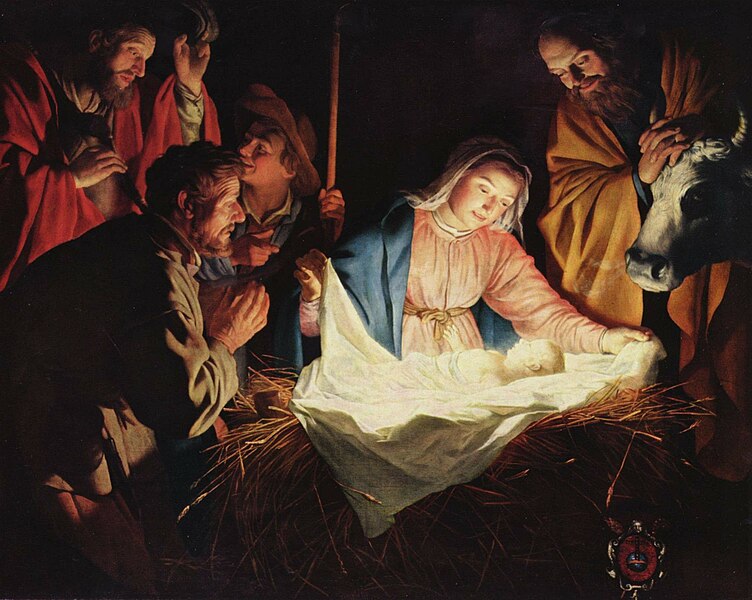
Wait; this picture's not accurate!  They left out the little drummer boy!
(from Abraham Hondius, 1663)
Of course, a story that has been going on for a couple of millennia will have a climax that lasts a few years.  It lasts about thirty, in fact, and the other end of it is captured in two other holidays: Good Friday and Easter, where some of the other stories of redemption are re-lived:
  • The seed of the woman defeats Satan—the story of Eve, and the story of Mary.
  • A holy God must punish sin, but people can be saved through the wooden way God provides—the story of Noah's ark, and the story of the Cross.
  • God tells his people how a lamb may die in their place for their sin—the story of the Passover, and the story of the Cross.
  • A prophet is in darkness for three days.  His message is a light to the Gentiles, a preaching of repentance and forgiveness of sins for them—the story of Jonah, and the story of the death, burial, and resurrection of Jesus Christ.
The last prophet to hail the coming of the Christ sums it all up nicely: John the Baptist:

"Behold the lamb of God, which taketh away the sin of the world!"

Thursday, December 12, 2013

Thoughtful Christian Discussion on Atheism

Below is a link to a Chapel video from Dallas Theological Seminary video called The New Atheism. The discussion is thoughtful and level-minded.  I find the advice for Christians, starting around the 20 minute mark, particularly interesting, as I am guilty of mean-spirited engagement with Atheist ideas.


I think the main take-away for Christians from this discussion should be a willingness to listen to other points of view, Atheist or otherwise, without arrogance or condescension.  I’ve found it difficult to express Jesus’ love while engaging in last-word contests.  


Monday, December 9, 2013

Snow Day Sabbath

Here in Dallas, we've been iced-in since Thursday. Say what you will about how silly it is that Texans shut down at the first sign of freezing temps and heavy-looking clouds and how if we were up North we would have to drive to work up-hill both ways in bare feet through a blizzard without complaining, but here in Texas, shutting down during a winter storm is a safety necessity.

Now, everyone loves a snow day, but my favorite thing about it isn't just the chance to wear pajamas all day while snuggling with my cats.

But seriously, don't you want to snuggle up with this fuzzy, adorable creature?

As great as the sleeping-in and cocoa-drinking is, my favorite thing about a snow day is that it somehow imposes Sabbath on me in a way that an ordinary weekend or ordinary free time just doesn't do. Snow days aren't only a much-needed break; they're permission to rest. They're the answer to that wish I've whispered in frustration when I've been overwhelmed by deadlines and responsibilities -- I wish the world could just stop for a day. And on a snow day in Texas, that's exactly what happens. 

Now this particular ice storm (what the locals are affectionately referring to as "Icepocalypse 2013") hasn't been all 'walking in a winter wonderland' and 'chestnuts roasting on an open fire.' Many have lost power and those who have had to brave the icy roads have faced deadly conditions. But for those of us lucky enough to stay warm at home, this weekend spent inside has provided an opportunity for real rest -- for reading a book just for fun, for catching up on that netflix queue, for cooking and eating meals around the family table without the distractions of a loud and crowded restaurant, and for being still and quiet in the midst of a holiday season that is all too busy. In our society, the Christmas season is inaugurated by manic Black Friday sales that begin ever earlier; this year many stores were open on Thanksgiving Day. Instead of Advent being a period of restful waiting, it is more often a season of stressful bustling. But on a Texas snow day some of us are literally stuck at home, leaving nothing to do but rest. 

So laugh at us if you need to, Northerners; I'm thankful for an enforced Sabbath in my life this Advent season.

Friday, December 6, 2013

Now I know what "Round Yon Virgin" Means

When we sing Silent Night at church, I always think "Round yon virgin" is a strange phrase. I also think it's a boring song that seems to take seven hours to finish, but that's not the point. Mental Floss tells us what that phrase means:

The “round” in “Silent Night” might call up imagery of the soft, maternal kind, but in the phrase “round yon virgin,” it simply means “around.” “Yon” is an antiquated word for “that one” or “over there.”

This is what I always suspected but hoped wasn't true: we're just saying, "The virgin mother's over there." Deep stuff.

There's more decrypting of odd Christmas song lyrics ("Troll the ancient Yuletide carol," for example) over at Mental Floss.

Tuesday, December 3, 2013

There's Nothing More Traditional than a Woman Who Brings Home the Bacon

People love to throw around the phrase "traditional family" when defending what they think is a long-standing practice of a single income family, but this household pattern is not as historically sound as is widely believed. There's nobility in sacrificing one's career to be a homemaker, but history tells us that there's nothing necessarily "traditional" about this.

(Before you get excited or angry you should know that I'm not pushing anyone's political agenda. Just the facts.)

After the first world war the U.S. economy was booming. One person could make enough money to feed an entire family, which sounds pretty great. Sadly, those days are long gone and many of today's families need both spouses, and maybe the kids, to get a job if they're going to pay the bills. (My wife and I have four jobs between the two of us, and we're not exactly shopping at fancy stores.)

This nostalgia we have for the 1950s has sometimes led us to think that these were better, simpler days, and if we returned to doing things that way then we would all be happier. I love nostalgia as much as anyone. (I study medieval history. For fun.) However, we can't depend on our love for the past to guide us through life. The truth is that the "Leave it to Beaver" family model isn't how things were always done.

I just read the life story of Margery Kempe, a medieval document that is probably the first English autobiography. Even though it's mostly about her spiritual life and her world travels, it also tells us a lot about the way women lived in the fifteenth century. While she was married, Margery invested her money in a brewery and a mill and ran those two businesses on her own. She managed her finances separately from her husband's and even bailed him out when he was in debt. Did I mention that they had fourteen children during all of this?

It's true that Western culture has been a Patriarchal one, but the idea of keeping women from working is not how it has worked. Until recent times, the idea of "going to work" would not have made sense. Work was part of your life if you wanted to eat, and it didn't involve going to an office. Women and men worked together to make ends meet throughout each day. That is traditional.

This might explain some things about the ideal woman who is described in the Bible. She manages finances, dispenses wisdom and instruction, and decides which land the family will invest in without the need to consult a husband. She is a decision maker as well as a caregiver.

The idea of "traditional" gender roles in marriage is a romantic ideal for many people, but it's not an accurate depiction of our culture's history. The past is filled with women who led armies and wrote important books with full support from the men in their lives. Plenty of families have benefited from having a stay at home spouse, but we should never assume that everyone is required to live that way. Following tradition means spouses working together to provide for a family, not blindly following nostalgia.