Showing posts with label hermeneutics. Show all posts

Friday, January 10, 2014

Ancient-Future Biblical Authority

TheOoze.com is, or rather was, a sort of website for postmodern Christianity and/or for the emergent church. Since my bachelor's thesis at Dallas Baptist University was about postmodernism and on biblical inerrancy, it is only fitting that I would eventually have something published at The Ooze.

The ideal opportunity came when Kurt Willems wrote a piece on "Postmodern Biblical Authority?" for The Ooze. The Ooze published my reply, "Ancient-Future Biblical Authority," in July 2009.

The Ooze is no longer online, however, and my article is nowhere to be found. But it ought to be somewhere. So now it can be here. My full article is copied below. (I have updated the link in the second footnote, and added some pictures.)
________________________________________

ANCIENT-FUTURE BIBLICAL AUTHORITY: A REPLY TO KURT WILLEMS1
by Mark J. Boone

WILLEMS' TIMELY PIECE

Kurt Willems' article "Postmodern Biblical Authority?"2 is engaging, well-researched, and timely. Willems asks the right question: What account of Biblical authority is appropriate for the post-modern era? He answers that Biblical Christianity and postmodernism can converge on the Biblical narrative's authority in the lives of believers. The believer must immerse himself or herself in the Biblical narrative, let his or her life become the application, expression, and continuation of the narrative.

Willems is also right to criticize what he calls fundamentalism for its hyper-literal reading of Scripture and its attempt to justify Scripture on wholly objective, universal, and non-Biblical grounds, a move that risks setting up Reason as an authority over Scripture. But Willems leaves huge stones unturned, for he gives no account of that "traditional biblical authority" which the Enlightenment tried to do away with. A pre-modern account yields different, but compatible, answers to the question of Biblical authority. It also answers a question of interest in any era but especially important to the postmodern: Where is the meaning of the Biblical text?


Willems' remarks suggest the legitimacy of looking to the pre-moderns. Postmodernism conceived as Lyotard's "incredulity toward metanarratives"3 is specifically a rejection of the modern metanarrative. If we are serious about rejecting modernism, we are within our rights to consider pre-modernism a live option; at the least, we owe the pre-moderns and their insights a fair hearing. Some of these insights are common to postmodernity; some are uncommon, but commensurable.

ANCIENT HERMENEUTICS
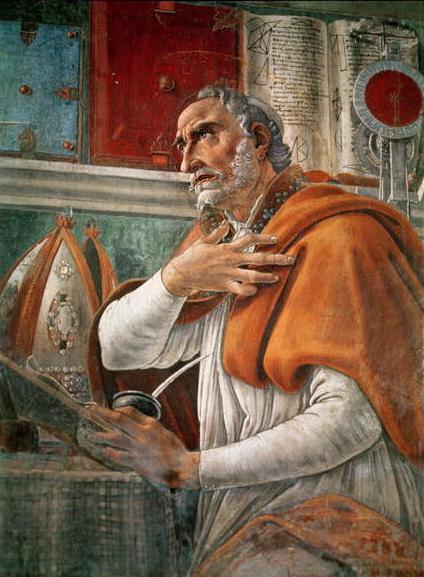
Where better to start than Saint Augustine: philosopher, theologian, mystic, and priest—at once among the last Church fathers and the first medievals? Let's take a look at four elements of the patristic hermeneutics represented by Augustine in his Teaching Christianity4 and in Book XII of his Confessions.5 This hermeneutics ties together Biblical meaning, authority, and application, both the human-composed elements of the text and those written by God, those characteristics of the Bible loved by fundamentalists and those loved by postmoderns.

Saint Augustine
First, the most basic kind of Biblical authority extends to the text's original meaning; it is the authority of the Bible's human authors, who always speak truly: "let all those depart from me who deem that Moses spoke things that are false" (Confessions XII, chapter 23); "let us so honor this same servant of yours, dispenser of this Scripture and filled with your spirit, as to believe that when he wrote these words by your inspiration he intended that sense in them which supremely excels both in the light of truth and in the fruit of profit" (chapter 30). The authority of the Biblical authors gives us the rule of faith: the command to love God and neighbor (Teaching Christianity Book I, chapter 35) and the tenets of basic orthodoxy—truths given in Scripture and acknowledged by the Church as fundamental for Christian faith (Book III, chapter 2).

Second, the meaning of Scripture transcends what its human authors intend, meaning no less than what its divine author intends. Thus Augustine prays: "while every man tries to understand in Holy Scripture what the author understood therein, what wrong is there if anyone understand what you, O light of all truthful minds, reveal to him as true, even if the author he reads did not understand this . . . ?" (Confessions XII, chapter 18).

Third, what the human authors say is our guide in exploring whatever Scripture says beyond their words. The rule of faith guides our interpretion of Scripture; when we encounter a passage whose full meaning we do not understand, we must look in it for an expression of the rule of faith (Teaching Christianity, Book II, chapter 9). We don't go searching for meaning in the sacred text without keeping the original meaning on hand as a compass.

Fourth, the truth in Scripture must be lived. John J. O'Keefe and R. R. Reno explain how important it was to the early Church to live Scripture; The rule of faith "has a behavioral as well as doctrinal component"6 and "was a rule for life as well as a rule for reading Scripture and interpreting its meaning."7 The sacred meaning of Scripture cries out to be lived. As Willems says, the Biblical narrative has authority in the life of the believer.

This hermeneutics acknowledges the authority of the Bible's original meaning, but it is open to meaning that transcends it and emphasizes the relationship between the two. It is also swift to apply the meaning of Scripture in the life of the Church. But Scriptural authority in its most basic sense safeguards our participation in the Biblical narrative. Without the authority of the human authors of Scripture, "faith will start tottering," "charity itself also begins to sicken," the authority of the Biblical narrative over the lives of believers is undermined, and the life goes out of the Church (Teaching Christianity Book I, chapter 37).

ANCIENT AND POST-MODERN HERMENEUTICS

This hermeneutics achieves several postmodern desiderata. First, the entire world of the Church becomes, in a somewhat Derridean fashion, the interpretation of the text. There is no external referent to which the Biblical text refers and upon reaching which interpretation ceases. The life of the believer is immersed in the text. The very life of the Church is its ongoing act of interpretation.

Second, the Biblical narrative will not be made to fit inside our minds or be justified by our intellects. Merold Westphal in Overcoming Onto-theology explains that two of the reasons the Christian narrative is distinct from the modern meta-narrative are that it does not seek to be legitimized by science and that its origins are in revelation rather than autonomous reason.8 Augustine's hermeneutics likewise begins with the Biblical text. It sends reason on a mission to understand what is learned by faith, rather than prove faith in the court of reason as a prerequisite for belief.

Jean-Luc Marion (picture from http://en.wikipedia.org/wiki/Jean-Luc_Marion)
Third, the sense of the Bible is not limited to the intent of its human authors. Jean-Luc Marion, the preeminent voice on Christianity's relation to postmodern philosophers such as Heidegger, Derridas, and Levinas, says that the Biblical text "escapes the ownership of its literary producers in order to be inspired, so to speak, by the Word" (Christ).9 Biblical meaning transcends that of its human authors. Marion and Augustine both remind us that only God knows the full meaning of the text.

"FUNDAMENTALISTS" AND POSTMODERN CHRISTIANS: ESTRANGED BRETHREN

In acknowledging the authority of the original meaning of Scripture, this ancient hermeneutics also satisfies a major concern of the "fundamentalists" Willems mentions, for it relies on the fundamental authority of the authors of Scripture. The doctrine of Biblical inerrancy seeks to preserve this authority. The central thrust of The Chicago Statement on Biblical Inerrancy is the attribution of infallible authority to the intent of its human authors.10

In other words, the first element of patristic hermeneutics is an overriding goal for the inerrantist, and postmodern Christians emphasize its second and fourth elements. The hermeneutics of the Church fathers unites these elements together with the third. The original meaning of Scripture and that which transcends it are meant to be pursued and lived together.

The Biblical narrative's authority over the life of the Church is real, and Willems does well to acknowledge it; it is also well to acknowledge the authority of Scripture's original meaning; it is best to acknowledge the unity of both regions of authority. In this process there is room for friendship between postmodern Christians and fundamentalists, estranged Christian brethren whose reconciliation is long overdue. Reconciliation will not be easy, but we both share in the hermeneutical heritage of the Church fathers, and a way forward together is possible if we listen to them.

NOTES

1. The title "Ancient-Future Biblical Authority" is influenced by Robert E. Webber, especially his Ancient-Future Faith: Rethinking Evangelicalism for a Postmodern World (Grand Rapids: Baker Books, 1999). 

2. Kurt Willems, "Postmodern Biblical Authority," TheOoze: Conversation for the Journey, http://www.patheos.com/blogs/thepangeablog/articles/unpublished-papers/postmodern-biblical-authority/ (October 29, 2008).

3. Jean-François Lyotard, Introduction to The Postmodern Condition: a Report on Knowledge, translated by Geoff Bennington and Brian Massumi (Minneapolis: University of Minnesota Press, 1984), xxiv.

4. Augustine, Teaching Christianity, translated by Edmund Hill (New York: New City Press, 1996).

5. Augustine, The Confessions of St. Augustine, translated by John K. Ryan (New York: Doubleday, 1960).

6. John J. O'Keefe and R. R. Reno, The Sanctified Vision: an Introduction to Early Christian Interpretation of the Bible (Baltimore: Johns Hopkins University Press, 2005), 124.

7. Ibid., 128.

8. Merold Westphal, Introduction to Overcoming Onto-theology: Toward a Postmodern Christian Faith (New York: Fordham University Press, 2001), xiii-xv.

9. Jean-Luc Marion, God Without Being, translated by Thomas A. Carlson (Chicago: University of Chicago Press, 1991), 156.

10. The International Council on Biblical Inerrancy, The Chicago Statement on Biblical Inerrancy (Chicago: 1978).

Friday, December 13, 2013

This is How We Should Read the Christmas Story

Think about this for a moment:
  • A miracle baby is born to a couple too old to have children.
  • A son is born as a sign that God's people will be redeemed.
  • Someone named Yeshua will lead God's people into enjoyment of the blessings promised to Abraham.
  • A shepherd-king comes out of Bethlehem.
  • A wicked king tries to kill all the male babies, but one escapes: the one through whom redemption will come to God's people.
  • God speaks through dreams to a man named Joseph, the son of Jacob, who comes to Egypt for the redemption of God's people.
You may recognize these as the stories of Zechariah and Elizabeth and John the Baptist; of Mary and Jesus (in Hebrew, Yeshua); of the birth of Jesus in Bethlehem; of the escape from king Herod to Egypt; and of Joseph, the son of Jacob and husband of Mary.

These are also the stories of Abraham and Sarah and Isaac; of Isaiah; of Joshua (also Yeshua in Hebrew); of king David; of Pharaoh and Moses; and of Joseph the son of Jacob and grandson of Isaac.

The characters in the Christmas story recorded in the early chapters of Matthew and Luke re-live the stories of the redemption of God's people.  In this way we see a confirmation that all the old stories were pointing to this story.  This is how we need to see Christmas: as the beginning of the climax of a long history of redemption, which begins with Adam and leads all the way to Mary.

Wait; this picture's not accurate!  They left out the little drummer boy!
(from Abraham Hondius, 1663)
Of course, a story that has been going on for a couple of millennia will have a climax that lasts a few years.  It lasts about thirty, in fact, and the other end of it is captured in two other holidays: Good Friday and Easter, where some of the other stories of redemption are re-lived:
  • The seed of the woman defeats Satan—the story of Eve, and the story of Mary.
  • A holy God must punish sin, but people can be saved through the wooden way God provides—the story of Noah's ark, and the story of the Cross.
  • God tells his people how a lamb may die in their place for their sin—the story of the Passover, and the story of the Cross.
  • A prophet is in darkness for three days.  His message is a light to the Gentiles, a preaching of repentance and forgiveness of sins for them—the story of Jonah, and the story of the death, burial, and resurrection of Jesus Christ.
The last prophet to hail the coming of the Christ sums it all up nicely: John the Baptist:

"Behold the lamb of God, which taketh away the sin of the world!"

Saturday, June 9, 2012

Slaves, Women & Homosexuals: The Gender Debate and Biblical Interpretation

As Christine mentioned, Rachel Held Evans is dedicating her blog to egalitarianism (or mutuality) this week, and we here at Thinking through Christianity are eager to chime in on (both sides! of) this important discussion.


Egalitarianism and complementarianism are the two major players in the contemporary debate about biblical gender roles and gender differences. [For a refresher of terms, revisit Evan's site and the resources she links to.] The root of the different approaches is the method with which each group interprets Scripture. That being the case, the most helpful book for me on the issue has been William J. Webb's Slaves, Women & Homosexuals: Exploring the Hermeneutics of Cultural Analysis. Webb is an adjunct professor of New Testament and Biblical Studies at Tyndale Seminary (semi-retired might be more accurate, for he does quite a bit of writing and speaking), and is the author of a number of books, but is most known for Slaves, Women & Homosexuals (http://redemptivechristianity.com/?page_id=2 (Webb's site)).

As the subtitle implies, Slaves, Women & Homosexuals is a hermeneutics book. Hermeneutics is a big fancy word to describe how we do interpretation, and it usually refers specifically to biblical interpretation. Webb is interested in answering the question: Which passages of Scripture are still applicable to modern Christians "exactly as they are articulated 'on the page'" and which are not (13)? And how do we decide? Answering the how question requires a good hermeneutic: a logical, consistent, Bible-honoring method of interpretation.

Growing up in a complementarian church, I was always bothered and confused about why they considered passages about women's attire in church... hair, makeup, hats... "culturally bound" (no longer applicable today) but stuck strictly to the mandate that women should not teach men (in church or in a spiritual capacity), believing that verse to be universal---applicable as articulated on the page to all cultures in every era. No one could ever give me a satisfactory hermeneutic, and so I never could bring myself to hold that position, but I didn't have a good hermeneutic for why either. When I read Slaves, Women & Homosexuals, it was as if someone had finally put into words what I had always felt. It was like Webb put muscle on my bones so I could stand.

In his book, Webb outlines his method of interpretation, describing it as a "redemptive-movement approach" which posits a "trajectory of redemption" that applies to the whole of Scripture and is particularly helpful when thinking through the Bible's more difficult pronouncements on cultural matters such as slavery, patriarchy, and homosexuality.

Besides being a handy hermeneutic, that God reveals himself to us through a trajectory of redemption absolutely jives with how we experience God's gracious work in our lives! God doesn’t require that we clean our lives up before we come to him. He doesn’t even require that we get everything sparkly clean immediately after we come to him. Hebrews 10:10-14, a favorite of mine, notes that we both have been made perfect (through Christ’s atonement---salvation) and at the same time are being made perfect (through the continued work of Christ’s redemption through the Holy Spirit---sanctification). We are on a path toward redemption.

So what is a redemptive-movement hermeneutic (RMH)? Essentially, it is a method of interpretation that accounts for the way in which God, in his infinite grace, meets his people where they are, revealing himself and his kingdom ethos to us in baby steps (well, you know; one small step for God; one giant step for humankind). By aligning ourselves with God's Word as it is revealed to us through the Holy Spirit, we put ourselves---and the cultures we impact---on a trajectory, or path, toward ultimate redemption. [You can find a more detailed overview of the RMH on Webb's site, here.]

To better show what this looks like, allow me to quote extensively from Webb:
[An] example comes from those Scriptural passages that speak of taking female virgins as spoils of war. [...] In defense of the biblical text, we should note that Deuteronomy 21:10-14 is at least somewhat redemptive relative to the original culture... After all, the Israelite male had to wait one month, marry the girl, and in the case of divorce he could not sell her or treat her as a slave (cf. Num 31:32-35; Judg 5:30; 21:11-12, 15-23). Compared to the horrible rape scenes that often accompanied ancient warfare (not unlike the rape camps of modern Bosnia) these biblical texts are clearly redemptive. [...] One might expect such a redemptive movement, since the core of a biblical ethic is to love God and to love one's neighbor. When compared to the ancient treatment of women in war, the biblical text represents a measure of, or greater movement toward, love and compassion. 
What we should live out in our modern culture, however, is not the isolated words of the text but the redemptive spirit that the text reflects as read against its original culture. In applying the text to our era, we do not want to stay static with the text... Rather, we need to move on, beyond the text, and take the redemptive dimension of those words further.... (32-33, bolded emphasis mine) 
Webb goes on to explain how Western culture (which finds its roots in Judeo-Christian ethics) considers equality and human rights important precisely because God put his people on a path toward a Kingdom ethic with laws and mandates that seem barbaric to us, but which were quite revolutionary for the original audience. Westerners often find the Bible barbaric precisely because of the redemptive movement within the Bible! Here's a helpful picture to illustrate Webb's trajectory of redemption:

(Webb 32)
[Click to enlarge]

Understanding this was such a relief because it synchronized that which had formerly been out of sync with the overarching Message of Scripture and the character of God. When I read through the Bible cover to cover for the first time as a young teen, I was horrified and angry when I read God's laws about rape and slavery---Pay the father a fee and marry her? What the hell kind of justice is that? You’re God for crying out loud! Can’t you do better than that? God can of course. But he condescends to us. Such grace.

So far, complementarians and egalitarians may not disagree much, if at all, with Webb's assessment of the Old Testament texts; however, the tension comes in when deciding which New Testament texts have similar movement. Suffice it to say, Webb generally understands the patriarchal New Testament "women texts" as catalysts of redemptive movement (Webb makes the same conclusion about NT slavery texts, but not about those regarding homosexuality), and he dedicates the bulk of the book, 148 pages, to establishing the 18 different criteria involved in deciding which texts have what kind of movement and why. Throughout, Webb not only outlines and supports his hermeneutical methods, he critically and civilly engages with his complementarian "opponents" (and his fellow egalitarians whose hermeneutic he finds weak or lazy). It's impressive. And I haven't seen anything like it anywhere else (from either camp), nothing so thorough, well-balanced, and convincing. 

So how about a NT example? (After this, you'll just have to pick up the book yourself!)
Throughout church history the traditional interpretation of 1 Timothy 2:14 has been that women are more easily deceived than men. This fits well within the context because it explains why women were to have subordinate teaching roles to men---they were more vulnerable to deception than men. [...] According to this view, men should have the authoritative teaching positions in the church. [...]
The only problem with the traditional interpretation is that most Western Christians today, patriarchalists included, recognize that this perspective is factually incorrect. Women are not inherently (by virtue of their gender alone) more easily deceived than men... it simply does not square with the hard data... (see criterion 18 and appendix C). 
[...]
What Paul was saying to the original audience could have been validated in that particular culture. Women probably were, in general, more easily deceived than men because of gender differences in education, marital age, social exposure, financial vulnerability, etc. (113)
After diving into Paul (and Moses's) cultural context(s) to show such a broad statement about women was in fact validated by culture, Webb concludes his discussion of this passage by positing:
The best solution, then, is not to discount the historical teaching of the church but to say that the social data has changed from Paul's day to ours. [...] So the text was suitable and accurate in its day due to cultural factors of an associative nature. Applying 1 Timothy 2:14 today, however, requres that we move up the ladder of abstraction and work with the underlying transcultural principle: seek teachers and leaders who are not easily deceived. (230)

A neutral illustration picturing the "ladder of abstraction" (53).

Webb wraps up SW&H by suggesting the bulk of the data from the intrascriptural and extrascriptural criteria support egalitarian positions, but readily admits where the weak spots are in his argument and never completely eschews what he calls an "ultra-soft patriarchy" (many of the tenets of which are described quite thoughtfully in TTC's earlier post "Complementarian or Egalitarian? Yes... And No" (which is not to suggest soft patriarchy is the author's position)). I greatly appreciate this about Webb, whose final chapter preceding his conclusion is called, "What If I Am Wrong?" Webb is honest, humble, and extremely serious about the authority of Scripture.

Even before reading Webb, this too was my position; perhaps somewhat ironically, however, Webb's book not only put words (and scholarship) to my thoughts and inclinations about egalitarianism, it also turned my inklings about not eschewing soft patriarchy into convictions. I'm an egalitarian, but I have few qualms with soft complementarianism. We get along... in ways I do not agree with Chris from "A Tale of Three Christians" nor the egalitarians he represents. Slaves, Women & Homosexuals is a scholarly book but it isn't just for scholars. If you pick up this book, and I recommend you do, you'll find Webb engaging and accessible.

Lastly, hat tip to Evans for getting the conversation rolling, to my fellow TTC writers for writing with their brains and their hearts, and to our readers for hanging in there with these frequent and often long posts! It's our hope you've benefited from this discussion as much as we have.