Showing posts with label postmodernism. Show all posts

Friday, January 10, 2014

Ancient-Future Biblical Authority

TheOoze.com is, or rather was, a sort of website for postmodern Christianity and/or for the emergent church. Since my bachelor's thesis at Dallas Baptist University was about postmodernism and on biblical inerrancy, it is only fitting that I would eventually have something published at The Ooze.

The ideal opportunity came when Kurt Willems wrote a piece on "Postmodern Biblical Authority?" for The Ooze. The Ooze published my reply, "Ancient-Future Biblical Authority," in July 2009.

The Ooze is no longer online, however, and my article is nowhere to be found. But it ought to be somewhere. So now it can be here. My full article is copied below. (I have updated the link in the second footnote, and added some pictures.)
________________________________________

ANCIENT-FUTURE BIBLICAL AUTHORITY: A REPLY TO KURT WILLEMS1
by Mark J. Boone

WILLEMS' TIMELY PIECE

Kurt Willems' article "Postmodern Biblical Authority?"2 is engaging, well-researched, and timely. Willems asks the right question: What account of Biblical authority is appropriate for the post-modern era? He answers that Biblical Christianity and postmodernism can converge on the Biblical narrative's authority in the lives of believers. The believer must immerse himself or herself in the Biblical narrative, let his or her life become the application, expression, and continuation of the narrative.

Willems is also right to criticize what he calls fundamentalism for its hyper-literal reading of Scripture and its attempt to justify Scripture on wholly objective, universal, and non-Biblical grounds, a move that risks setting up Reason as an authority over Scripture. But Willems leaves huge stones unturned, for he gives no account of that "traditional biblical authority" which the Enlightenment tried to do away with. A pre-modern account yields different, but compatible, answers to the question of Biblical authority. It also answers a question of interest in any era but especially important to the postmodern: Where is the meaning of the Biblical text?


Willems' remarks suggest the legitimacy of looking to the pre-moderns. Postmodernism conceived as Lyotard's "incredulity toward metanarratives"3 is specifically a rejection of the modern metanarrative. If we are serious about rejecting modernism, we are within our rights to consider pre-modernism a live option; at the least, we owe the pre-moderns and their insights a fair hearing. Some of these insights are common to postmodernity; some are uncommon, but commensurable.

ANCIENT HERMENEUTICS
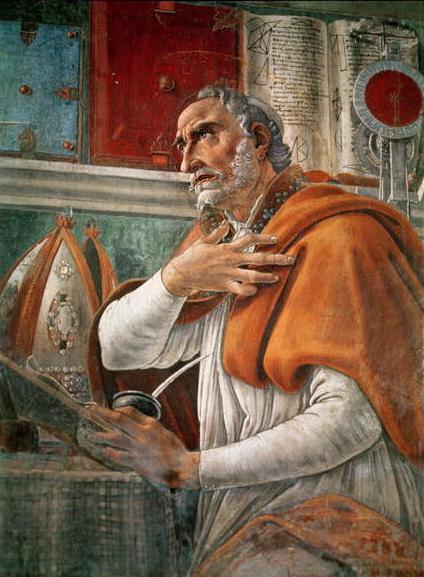
Where better to start than Saint Augustine: philosopher, theologian, mystic, and priest—at once among the last Church fathers and the first medievals? Let's take a look at four elements of the patristic hermeneutics represented by Augustine in his Teaching Christianity4 and in Book XII of his Confessions.5 This hermeneutics ties together Biblical meaning, authority, and application, both the human-composed elements of the text and those written by God, those characteristics of the Bible loved by fundamentalists and those loved by postmoderns.

Saint Augustine
First, the most basic kind of Biblical authority extends to the text's original meaning; it is the authority of the Bible's human authors, who always speak truly: "let all those depart from me who deem that Moses spoke things that are false" (Confessions XII, chapter 23); "let us so honor this same servant of yours, dispenser of this Scripture and filled with your spirit, as to believe that when he wrote these words by your inspiration he intended that sense in them which supremely excels both in the light of truth and in the fruit of profit" (chapter 30). The authority of the Biblical authors gives us the rule of faith: the command to love God and neighbor (Teaching Christianity Book I, chapter 35) and the tenets of basic orthodoxy—truths given in Scripture and acknowledged by the Church as fundamental for Christian faith (Book III, chapter 2).

Second, the meaning of Scripture transcends what its human authors intend, meaning no less than what its divine author intends. Thus Augustine prays: "while every man tries to understand in Holy Scripture what the author understood therein, what wrong is there if anyone understand what you, O light of all truthful minds, reveal to him as true, even if the author he reads did not understand this . . . ?" (Confessions XII, chapter 18).

Third, what the human authors say is our guide in exploring whatever Scripture says beyond their words. The rule of faith guides our interpretion of Scripture; when we encounter a passage whose full meaning we do not understand, we must look in it for an expression of the rule of faith (Teaching Christianity, Book II, chapter 9). We don't go searching for meaning in the sacred text without keeping the original meaning on hand as a compass.

Fourth, the truth in Scripture must be lived. John J. O'Keefe and R. R. Reno explain how important it was to the early Church to live Scripture; The rule of faith "has a behavioral as well as doctrinal component"6 and "was a rule for life as well as a rule for reading Scripture and interpreting its meaning."7 The sacred meaning of Scripture cries out to be lived. As Willems says, the Biblical narrative has authority in the life of the believer.

This hermeneutics acknowledges the authority of the Bible's original meaning, but it is open to meaning that transcends it and emphasizes the relationship between the two. It is also swift to apply the meaning of Scripture in the life of the Church. But Scriptural authority in its most basic sense safeguards our participation in the Biblical narrative. Without the authority of the human authors of Scripture, "faith will start tottering," "charity itself also begins to sicken," the authority of the Biblical narrative over the lives of believers is undermined, and the life goes out of the Church (Teaching Christianity Book I, chapter 37).

ANCIENT AND POST-MODERN HERMENEUTICS

This hermeneutics achieves several postmodern desiderata. First, the entire world of the Church becomes, in a somewhat Derridean fashion, the interpretation of the text. There is no external referent to which the Biblical text refers and upon reaching which interpretation ceases. The life of the believer is immersed in the text. The very life of the Church is its ongoing act of interpretation.

Second, the Biblical narrative will not be made to fit inside our minds or be justified by our intellects. Merold Westphal in Overcoming Onto-theology explains that two of the reasons the Christian narrative is distinct from the modern meta-narrative are that it does not seek to be legitimized by science and that its origins are in revelation rather than autonomous reason.8 Augustine's hermeneutics likewise begins with the Biblical text. It sends reason on a mission to understand what is learned by faith, rather than prove faith in the court of reason as a prerequisite for belief.

Jean-Luc Marion (picture from http://en.wikipedia.org/wiki/Jean-Luc_Marion)
Third, the sense of the Bible is not limited to the intent of its human authors. Jean-Luc Marion, the preeminent voice on Christianity's relation to postmodern philosophers such as Heidegger, Derridas, and Levinas, says that the Biblical text "escapes the ownership of its literary producers in order to be inspired, so to speak, by the Word" (Christ).9 Biblical meaning transcends that of its human authors. Marion and Augustine both remind us that only God knows the full meaning of the text.

"FUNDAMENTALISTS" AND POSTMODERN CHRISTIANS: ESTRANGED BRETHREN

In acknowledging the authority of the original meaning of Scripture, this ancient hermeneutics also satisfies a major concern of the "fundamentalists" Willems mentions, for it relies on the fundamental authority of the authors of Scripture. The doctrine of Biblical inerrancy seeks to preserve this authority. The central thrust of The Chicago Statement on Biblical Inerrancy is the attribution of infallible authority to the intent of its human authors.10

In other words, the first element of patristic hermeneutics is an overriding goal for the inerrantist, and postmodern Christians emphasize its second and fourth elements. The hermeneutics of the Church fathers unites these elements together with the third. The original meaning of Scripture and that which transcends it are meant to be pursued and lived together.

The Biblical narrative's authority over the life of the Church is real, and Willems does well to acknowledge it; it is also well to acknowledge the authority of Scripture's original meaning; it is best to acknowledge the unity of both regions of authority. In this process there is room for friendship between postmodern Christians and fundamentalists, estranged Christian brethren whose reconciliation is long overdue. Reconciliation will not be easy, but we both share in the hermeneutical heritage of the Church fathers, and a way forward together is possible if we listen to them.

NOTES

1. The title "Ancient-Future Biblical Authority" is influenced by Robert E. Webber, especially his Ancient-Future Faith: Rethinking Evangelicalism for a Postmodern World (Grand Rapids: Baker Books, 1999). 

2. Kurt Willems, "Postmodern Biblical Authority," TheOoze: Conversation for the Journey, http://www.patheos.com/blogs/thepangeablog/articles/unpublished-papers/postmodern-biblical-authority/ (October 29, 2008).

3. Jean-François Lyotard, Introduction to The Postmodern Condition: a Report on Knowledge, translated by Geoff Bennington and Brian Massumi (Minneapolis: University of Minnesota Press, 1984), xxiv.

4. Augustine, Teaching Christianity, translated by Edmund Hill (New York: New City Press, 1996).

5. Augustine, The Confessions of St. Augustine, translated by John K. Ryan (New York: Doubleday, 1960).

6. John J. O'Keefe and R. R. Reno, The Sanctified Vision: an Introduction to Early Christian Interpretation of the Bible (Baltimore: Johns Hopkins University Press, 2005), 124.

7. Ibid., 128.

8. Merold Westphal, Introduction to Overcoming Onto-theology: Toward a Postmodern Christian Faith (New York: Fordham University Press, 2001), xiii-xv.

9. Jean-Luc Marion, God Without Being, translated by Thomas A. Carlson (Chicago: University of Chicago Press, 1991), 156.

10. The International Council on Biblical Inerrancy, The Chicago Statement on Biblical Inerrancy (Chicago: 1978).

Wednesday, November 6, 2013

Tell Me a Story


I've been teaching one of my classes this semester about the power of stories in human life. We are reading a collection of short stories and analyzing them to figure out what makes a good story, what makes a story "work," and just what it is that compels humans to tell stories. In my research for the class, I've found some interesting things about the effect of stories on our brains. For example, studies have shown that when we read language that appeals to our senses, it's not just the part of our brain that processes language that responds, but also the parts of our brain that process the various physical elements in the description. In other words, to read is, in a sense, to experience, at least as far as our brains are concerned. In a well-known study by Michael Gazzaniga, who pioneered studies on the split brain, Gazzaniga found that the left hemisphere of the brain is responsible for interpreting information and making it fit into a narrative even where no narrative exists:

In one of Gazzaniga's favourite examples, he flashed the word 'smile' to a patient's right hemisphere and the word 'face' to the left hemisphere, and asked the patient to draw what he'd seen. “His right hand drew a smiling face,” Gazzaniga recalled. “'Why did you do that?' I asked. He said, 'What do you want, a sad face? Who wants a sad face around?'.” The left-brain interpreter, Gazzaniga says, is what everyone uses to seek explanations for events, triage the barrage of incoming information and construct narratives that help to make sense of the world. (http://www.nature.com/news/the-split-brain-a-tale-of-two-halves-1.10213)

The big question, of course, is still why the human brain gets so much stimulus from stories and is, itself, such a story-telling machine. One theory is that story-telling is evolutionarily helpful; by allowing the brain to "experience" a difficult situation without actually having to encounter physical harm, stories help humans to avoid harmful experiences and survive. This explanation makes sense.

As a Christian, the story that filters my view of this phenomenon is, of course, the Christian story -- specifically that the God who chose to become human (The Word made flesh) also chose to speak to his people through stories. Jesus spoke in parables and figures of speech, and God made man in His image as a storyteller. We are designed for stories, and we live in them and through them, as we make decisions based on the stories that shape our lives.

Now we can view these stories as mere neurological and social constructs (see this previous TTC entry for more info. on what a "social construct" is) that enable physical and cultural survival without any link to Truth or Reality.

Or

We can view our brain's propensity for story-telling as a sign that The Story -- the big one -- about a glorious creation, a horrifying fall, a bloody redemption, and a triumphant restoration -- is True. Maybe God made us for story so that we could see the big Story that is playing out all around as, through Christ, all that is broken is made new. Maybe everything is always-already story not because truth is unknowable, but because The Truth is in the story.


Monday, September 9, 2013

Postmodernism is Your Friend

"Postmodernists are just wrong - they say there's no absolute truth!" I said to my friend, Mark.

"I didn't know Postmodernists felt that way." he replied, confused. "Which philosophers have you read that say that?"

"Well...I, uh..." I couldn't think of anything. "I'm sure I've heard that, somewhere. I mean, I think people say that." I suddenly remembered that he was a philosophy major, and I was studying history.

"I disagree with those people," he told me, " I think that is an abuse of postmodernism."

I never forgot those words. I had certainly heard people say that postmodernism is about not believing in any sort of truth, and plenty of people have tried to use it to oppose Christianity, but I discovered that these people were wrong and that the leaders of postmodern philosophy would be the first to disagree with them. So, what is the right way to understand it?

Postmodernism is best defined as follows: incredulity towards meta-narratives.

I know, that probably doesn't help.

The idea is that a postmodern mind does not easily accept any truth. Is the world spiraling into chaos as each generation embraces more rebellious ways? Is science leading us to happier frontiers? Are we living in a more enlightened time than our ancestors, or have we lost something? A postmodernist does not accept any of these over-arching ideas (meta-narratives) and tries to find the truth without using any of these assumptions as a starting point. (Read here if you want more of the philosophical stuff. If you'd like to read a post that explains postmodernism with pictures of kittens then click here.)

Does this sound obscure and useless? Some people think so, and that's fine. It's also harmless to Christianity. In fact, no one learns the truth until they put aside their preconceptions and really question everything they've been told to see if it's really true, and that's at the core of postmodern thought.

Sound familiar?

"Test everything that is said to be sure it is true, and if it is, then accept it." 1 Thessalonains 5:21


Tuesday, August 4, 2009

Christianity vs. Postmodernism

I've been asked to explain why Postmodernism is not in conflict with Christianity - I am more than happy to oblige.

I must start by addressing the issue of postmodernism as a worldview. In my previous posts about this, I have been discussing the philosophical approach known as postmodernism in which we examine our world by questioning absolutes. However, some have developed an entire worldview that denies absolutes - they are taking the postmodern philosophy out of its intended context and using it almost like a religion. (Phrases like, "I don't believe in God/Buddha/Heaven because I am a postmodernist" should not make sense.) This abuse of philosophy goes by the name "postmodernism" and obviously stands in opposition to Christianity; so, when I said that the two could be reconciled I was not talking about this type of postmodernism.

(If you find that last paragraph confusing then take heart - you are on the right track. It is very frustrating that there are TWO things called postmodernism that are not exactly the same; things like this make my life difficult. Who allowed someone to name a worldview postmodernism? Isn't there a consortium of philosophers watching out for this sort of thing?)

So, the approach that we call postmodernism (the one I have been talking about for a few weeks) teaches us not to accept absolutes and truths at face value. This approach causes us to question everything.

Don't think of it as a bad thing. A person of this nature will question the Lordship of Christ and the authority of scripture - but they will also question the philosophy of Nihilsm and modern claims of religious plurality. A non-postmodernist is the type who believes in whatever they hear without giving it any thought and that is very dangerous. Also, since we do not live in the middle ages we should not expect our churches to "strongarm" people into going to church - it's always OK for believers to ask questions.

Remember this?

Test everything.
Hold on to the good.
Avoid every kind of evil.


-1 Thessalonians 5:21-22

I'm not trying to be so audacious as to say that the Bible teaches postmodernism. But, notice that the believer is expected to ask questions about everything. When Thomas claimed that he would not believe in The Resurrection until he touched Jesus' body, he didn't have to wait long before Jesus showed up and invited him to touch his flesh. (This doesn't make him a bad person. Remember, the other apostles weren't too quick to catch on when the ladies arrived to tell them Jesus had risen.)

If postmodernism is a method of learning the truth then it can only point to what is absolutely true. The difficulty comes when we think postmodernism teaches us to deny absolutes - it does not. It specifically teaches us to be incredulous to them - which means that we can come to believe in those absolutes if our observations confirm them. Was there ever an actual believer who did not initially question the truths of the Bible - only to accept them in the end?

Tuesday, July 28, 2009

Answering Your Questions About Postmodernism

I planned on writing more about postmodernism, this week, but the questions I received from my readers were so good that I don't actually have to craft an original post. Here are your questions.

A friend of mine who holds many degrees asked the following (on Facebook):

Your narrative makes it sound as if social constructs are something we just decide to put together, but doesn't the idea of a social construct suggest something larger than us, something we are born or educated or otherwise brought into?

This is absolutely correct and I am sorry if I was unclear on this. In my example of a social construct (there is always a cat on my bed), I came to this knowledge because every time I walk into my room a cat is sitting there; it's not because I wanted it to be that way. (If I could decide my own social constructs they would go something like, "Molly always makes me coffee" or "Desmond never tries to enter the trash can.")

Andrew had this question:

Does being post-modern imply that you favor going against the common metanarrative, or just that you're willing to question it?

Good question. Remember, the definition of post-modernism is that we are incredulous to all metanarratives. When presented with one, a postmodernist should not attempt to tear it down or run from it; instead, they should question it. In questioning the metanarrative a postmodernist thinks they can learn the truth and get out from under the point of view that has been given to them. Thanks, Andrew.

My cat, Desmond, was helping Christine with her homework; later, he asked her out on a date.
His relationship status on Facebook currently says, "It's complicated."


My good friend, Krystal, has this question, which is similar to the last one:

Also...I mostly get what your point was when you said:
"A good postmodernist simply tries to act outside of the influence of the metanarrative rather than insisting upon their own."
But what is really the difference, when one looks at this closely? Or how can you tell?

Some people treat postmodernism as if it were a religion of its own. "I'm a postmodernist," they say, "so I don't believe in God." There's nothing postmodern about that. A true postmodernist might say, "I have been told that God is real; I will question this truth and consider it." This second person, the true postmodernist, will question the Nihilist as well as the Christian until they reach a conclusion - never believing one of these worldviews until they have reason to do so.

However, the most relevant question came from Bruce, who has the question that I am slowly getting to:

My question though concerns your statement that postmodernism is not a problem for my faith. Like you I'm a Christian. While I would disagree with your idea of what postmodernism is I think that on your definition it remains a problem for Christian faith....Why would postmodernism, defined as: "Incredulity to all metanarratives" given the above observations, not be a problem for my faith?

I do not think postmodernism is antithetical to Christianity - but that thought requires its own post which will arrive later in the week. Stay tuned!

(I'm sorry that this blog post came late. It takes longer than normal to post when writing about stuff like this!)

Wednesday, July 22, 2009

Explaining Post-Modernism with Cats


Now that we have discussed What Post-Modernism Is Not - it's time to get our hands dirty and figure out what it is.

The definition of Post-modernism is as follows: Incredulity to all metanarratives.

This is already getting boring - I'm bringing in pictures of my cats so I don't lose you.
Desmond (left) and Molly (right) are going to help us.

But, what is a metanarrative and how can we be incredulous to them? Fortunately, metanarratives are not complicated, it's just an obscure word and the concept can be explained by discussing two other simple things - narratives and social constructs. Here we go!

Narrative - The story of an individual thing, group, concept, etc. Your life has a narrative; so does your cat and your oven and that idea you had to start a business. Here are some examples.

Joe Average grew up in Indiana where he got married and worked in construction while his wife baked pies and their kids sold lemonade; he eventually retired and moved to Florida.

Flabby, the goldfish, was taken from the pet store and placed in a glass bowl in a suburban home. He was flushed 6 months later.

The first line of iPhones was very popular but was discontinued when the next model was manufactured. Some people still have them.

So, a narrative is just a story. Easy .

Narrative - "Desmond spends a lot of time on our bed instead of the cat bed we bought for him."

Social Constructs - Concepts that we develop when we see what these narratives have in common.

Guys are tough - women are pretty.

Goldfish die easily.

iPhones are popular.

Nothing complicated. By looking around us we see themes in our social patterns that we are all familiar with. We may not appreciate these themes but they are part of our society. We all know tough guys who like to wear pink and construction workers who listen to Mozart - but these social constructs are the "norm" based on the majority of the things we see.

Social Construct - "There is always a cat on our bed." Sheesh.

Metanarrative
- The "over-arching story." Combine these social constructs into a single account and you have a single narrative that tells the whole story.

Here's the Wikipedia definition of a metanrrative:

...therefore, a metanarrative is a story about a story,
encompassing and explaining other 'little stories' within totalizing schemes.

Now, working from the narratives and social constructs I just discussed, here is an example of how we might see the metanarrative:

In our world, men marry women and they raise a few kids. At some point, they will buy a gold fish that will die quickly. If any one is cool they will have an iPhone.

Of course, your view of this metanarrative will be different from that of a person in India or someone who is from the future. We develop our view of the metanarrative naturally without stopping to think about it. Uneducated people and scholars all hold to their own views of the over-arching story of mankind.

When Desmond realized that he was only hanging out on our bed because it was the way he had always done things, he opened his mind to new possibilities and started sleeping in the laundry basket. (It also made him more efficient in his task of 'getting cat hair on clean clothes.')

The average person walks through life being inexplicably guided by their view of the metanarrative. We expect our neighbors to have two cars and our children to sell lemonade in the summer. We expect everyone to share our views about eternity.

As kittens, Molly would stand up and pose for a camera. However, as soon as he knew that he was simply following standard procedure, Desmond refused to comply to society's expectations and only scowled at the camera.

The post-modernist, however, is of a different sort. They recognize that they are walking on a path that society has made for them and consider how they can go their own way. When they realize that they are doing what is expected of them, they stop and re-consider the decision. " Is this the right thing to do?" they might ask, "or is it just what I am expected to do?"

By questioning the metanarrative, women suffragists realized that they should be allowed to vote - even though most of society had unquestionably accepted the notion that they should not. In the same way, philosophers, like Plato, decided that beyond the physical world was a world we could not see that, unlike our world, is eternal. By giving important melody parts to the bass guitar, instead of the electric lead guitar, Paul McCartney stepped out of the framework of rock music and recorded the first bass guitar solo on "Paperback Writer." (As you can see, post-modernism is not necessarily new.)

Since everyone knows that "cats don't wear flannel," Molly has decided to embrace post-modernism and put on one of my plaid shirts. Desmond has other plans and insists that wearing this shirt will not make her happy. Their existential struggle continues to this day.

Next time, we will discuss how this interesting view is misused in our time and what its proper context might be. As always, discuss!

"Got it?"

(W0w, I just found out that Mental Floss, one of my favorite stops on the internet, has linked to this! Thanks, Miss C!)

Wednesday, May 13, 2009

Postmodernism Part 1 - What Postmodernism is NOT

I'm preparing a blog series about postmodernism - but first I wanted to discuss what postmodernism is not. This is only a cursory glance at the subject so I don't want to see any comments like "you didn't mention Kierkegard" or "you missed the most important point..." Save those comments for the upcoming posts where I really get into the subject. (And, in general, don't hold back on the comments because this is a great topic to discuss.)

Postmodernism is not a religion

It is not an amalgamative religion that incorporates all beliefs. That's called Universalism and is extremely old. If you want to get laughed at just approach a philosophy major and tell them your religion is called postmodernism - you will look very silly. Can you imagine Descartes saying, "I worship at the church of modernity?" I hope not. Our religious views are influenced by our approach to understanding - but that approach is not a religion in itself.

Likewise, it does not oppose any religion.

Unless you go to The Church of pre-Socratic Zeus Worship than postmodernism is not a problem for your faith. Naturally, you don't get to say that it is incompatible with someone else's faith and act superior to them because you are a precious postmodernist.

It does not prove anything.

You didn't prove Christianity or socialism wrong through postmodernism. It is a point of view and not a science so it can't be used as evidence in an argument.

It does not mean that "nothing is true."

Postmodernism does not translate into "there are no absolute truths." An old friend of mine had a response for anyone who told him "there are no absolutes" - he would ask, "are you absolutely sure?"

"Well - THAT was embarrassing!
Who knew a home-owners association could ban post-modernism?"


It is not infinitely mysterious

Postmodernism is not "one of those things we will never understand." It is a vast subject but not a terribly difficult one. If you want to read about something complicated then read about quantum physics. Compared to the phenomenon of quantum entanglement postmodernism is just peanuts.

Read about Modernism first.

I struggled to understand these things until a good friend explain modernism to me. Suddenly, everything I had heard about postmodernism made sense! It is easier to study the road to contemporary philosophy rather than to tackle it head on.

It is morally ambigious...

Postmodernism is not a good thing. Postmodernism is not a bad thing. It's an approach that has developed in our minds and it shouldn't be decried nor put on a pedestal.

How do you think Post-modernism is already affecting your view on religion? (There are no wrong answers to this question. Just our own observations.)