Thursday, September 27, 2012

The Authority of Scripture and the Age of the Earth

A Tale of Three Christians

(Note: An earlier conversation between Albert, Beth, and Chris took place here.)

Albert gets up on a soapbox and says, "The earth was created in six days and is only several thousand years old, because the book of Genesis says so!"

Albert steps down. Beth steps onto the soapbox and says, "The earth is a few billion years old. The book of Genesis is not entirely clear on this, but science is pretty clear, and science clears up that ambiguity for us."

Beth steps down. Now Chris gets up on the soapbox. He says, "The earth is a few billion years old. The book of Genesis says it isn't, but the book of Genesis is wrong on this point."

The Obvious Agreement

Beth and Chris share an obvious agreement: that the earth is old.

The Obvious Disagreement

Beth and Albert have an obvious disagreement: They disagree on the age of the earth.

The Underrated Disagreement

Beth and Chris disagree on the authority of Scripture. Beth submits to its authority, and Chris does not. This disagreement concerns the importance of the very book on which their religion is based, the Bible. This disagreement is about what a Christian takes to be authoritative. Beth believes Scripture is a sovereign authority. Chris does not.

The Underrated Agreements

Albert and Chris actually agree on what the Bible says. If they were all performing a disinterested analysis of the biblical text, Albert and Chris might well get together to convince Beth that her exegesis of Genesis is poor!

But here is the really important point: Albert and Beth agree on the fundamental issue, the authority of Scripture, and they should treat each other accordingly: with love and respect.

In short, Beth's agreement with Chris runs shallow, but her agreement with Albert runs deep.

Wednesday, September 26, 2012

Insulting Nimrod


“Nimrod” has never been a favorite insult of mine (not that I have a “favorite” insult), but I know what it means. You probably do to.

Or maybe you don’t.

When we hear “Nimrod” we tend to think of a bumbling fool.  (“We” meaning people in America - outside America this definition is not used.) Well, did you know that Nimrod is actually a guy in the Bible – the Old Testament to be specific. You can read his story here  http://www.biblegateway.com/passage/?search=Genesis%2010:8-12&version=NIV.

Go ahead and click there – it’s only 5 sentences.

So when you read that, did the  mighty hunter who established Babylon, Uruk, Akkad, and a host of other places sound like a bumbling fool to you?

No?

So…what’s going on? Why do we use this guy’s name for an insult?  Is there something hidden in the Hebrew that tells a different story?

Well, some commentaries say Nimrod was a bad dude based on one word. The word used for “hunter.” Because this word is used in Jeremiah 16.16 to refer to those who hunt humans some want to say that Nimrod hunted humans. Um, no. If I say I’m going hunting does that mean I only hunt deer? Nope. The item hunted is not contained in the word “hunted.” English and Hebrew are the same here.

So that's not where Nimrod's reputation comes from.

In fact the verse says “a mighty hunter before God.” This actually means he was in good standing before God. The phrase “before God” used in this type of context is a GOOD thing.  Him and God were cool.

Bumbling fools ran from this mighty hunter!


The internet claims that the abuse of the name Nimrod actually comes from the much beloved children’s cartoon Bugs Bunny. Now the funny thing is – if you google this you can find several people talking about it – but no one actually provides hard evidence. According to internet claims an episode made in the 40s started the confusion. Everyone’s favorite bumbling hunter – Elmer Fudd – was, again, no match for Bugs Bunny. Well, Bugs Bunny  - using SARCASM  - calls Elmer “Nimrod.” Sarcasm. 


Uh, Nimrod, I'm over here.

Problem….those without a working knowledge of Genesis 10 thought it was a new word that meant a bumbling fool. They completely missed the sarcasm!

Now the problem is that I cannot find any actual evidence of this cartoon. (Youtube has failed me.) Some internet links even  point to an episode that does not use the word nimrod! On a side note – providing a citation that is false does not help your claim.

Now I was able to find a later Looney Toons Cartoon in which Daffy Duck calls Elmer Fudd a “Nimrod.” I had wanted to post a link to a youtube clip of it – but it was taken down for copyright infringement – so you’ll just have to take my word for it that such a clip exists.

 Was Looney Tunes really the first to use this word sarcastically and the first to be misunderstood about it? The vast majority of the internet say yes. However, a wiktionary article cites a 1933 dictionary where "nimrod" is defined as a "fool." This predates the mysteriously absent Bugs Bunny episode (http://en.wiktionary.org/wiki/nimrod). So maybe the cartoonists meant it sarcastically, or  maybe they already took it to mean a "bumbling fool."

Wherever it was first misused, I highly suspect misunderstood sarcasm is to blame. 


So what did we learn today? Three things. 
1) Some people don’t get sarcasm.
2) Nimrod was actually a pretty cool guy who was close to God.
3) Every time you call a bumbling fool a “nimrod” you are actually insulting the real Nimrod.


Monday, September 24, 2012

Your Favorite Analogy for the Trinity May Be Heretical

The doctrine of the Trinity states that there is one God, but three persons who are God.

Ultimately, no analogy will help us comprehend this doctrine. It transcends reason.

(By the way, transcending reason is not the same thing as being contrary to reason. What is contrary to reason falls within the jurisdiction of reason and is condemned by reason. What transcends reason is outside the jurisdiction of reason altogether.)

Now, I think some analogies are helpful. Augustine, for example, develops a good psychological analogy for the Trinity. But the analogies you've probably heard the most of are not very good. One of the most common analogies is water: Water is one thing, but it takes three forms: liquid water, water vapor, and ice.

Another common analogy is that of a person with several different roles: For example, a woman who is a mother, a daughter, and a wife all at the same time.


The Trinity is simple. God is like this pizza. There's a crust, cheese, and tomatoes. Now listen, this is gonna blow your mind: It's ALL THE SAME PIZZA! See, God is just like that.

Unfortunately, these analogies don't portray orthodox Trinitarianism so much as the heresy of modalism

Modalism, also called Sabellianism after the guy who promoted this error in the early church, is the view that there is one God who reveals himself to human beings in three different roles, or three different modes: the mode of Father, the mode of Son, and the mode of Holy Spirit.

Since these analogies show how one thing can also be three things, I think they are not completely useless. The problem is that they don't show how one thing can also be three persons. The analogy of the water shows how the same substance, water, takes three forms, or appears in three modes. The analogy of the person with three roles shows how one person can have three roles; this is a perfect illustration for modalism, but not for orthodox Trinitarianism.

It's understandable that people would want to affirm modalism. It is easy to make sense of it--a little too easy. It reduces the mystery of the orthodox doctrine to a comfortable, easily understood concept.

Of course, there's nothing wrong with easily understood views. Most of the best views, I tend to think, are quite easily understood if we only read the right books (e.g., C. S. Lewis. The problem with this view is simply that it isn't the correct view of the Trinity. It recognizes one God, but that's not the whole doctrine. It doesn't recognize three persons; it actually denies them.

For more on this, try listening to about 40 minutes of William E. Bell. The relevant lecture is available here. (But I cannot confirm that Bell is legally available here; I don't know who owns the copyright to his lectures, or whether that person gave permission for them to be on this particular website.)

Wednesday, September 19, 2012

My Back Pages

I was so much older then; I'm younger than that, now.  -Bob Dylan

I heard about man who met another man on a train.  After some discussion they found that they had something in common - they were both long-time members of the Baptist church.  Further discussion revealed that they were from the Northern Baptist movement and, to their glee, they both came from the same local chapter.  While reveling in their new found camaraderie the first man pointed out that his church had adopted the Northern Baptist charter of 1795.  The second man stood up,  put on his hat, and said, "My church uses the charter of 1823, you heretic.  I hope you burn in Hell."

(That story is probably not true.)

Sometimes, our churches teach that exclusion is a virtue.  We'll proudly push people aside who don't vote like we do, or we'll pester our church members about every single theological issue until we know if they agree with us about every little thing.  If there's disagreement on any issue - no matter how obscure or harmless - we'll split from them and start a better church which will surely stand as a shining beacon of Truth for the whole world...until the members start to disagree over the theological implications of church pews vs folding chairs.  (You probably think that last part is a joke, but it happens.)

But there's a better way.  I'm no longer interested in whether or not the people seated near me at church share my views on apocolyptic themes or political decisions.  We come together to do something more important that all of that.


Although, this happens at my church to people who aren't Cowboys fans.  You've been warned.


In older times, the church was at its best when Christians were encouraged to allow a variety of beliefs to co-exist within their walls as long as everyone could agree to some basics.  (It wouldn't do to have Christians who prayed to dragons and didn't believe in God, for example.)  As we all know, at one point the church left this sort of wisdom behind and began to persecute everyone who didn't line up with their exact ideas.  This was the church at its worst.

I've learned that my faith is more rewarding when I don't exclude people over trivial matters. If I had kept doing things the old way I would have eventually pushed the whole world away while I stood alone.  And that's no way to do church.

Monday, September 17, 2012

Is it a sin to be an introvert?

Is it a sin to be an introvert?

The short answer to that question is, of course, no. But it’s amazing how often I’ve gotten the distinct impression from various pastors and leaders throughout my life that my predilection toward introversion was sinful. “Go knock on that stranger’s door and invite them to our revival/concert/community event” says the energetic youth pastor; “Talk to someone you’ve never talked to before” says the pastor; “Turn to your neighbor and say (fill in the blank with rather personal information);” says the well-meaning Sunday school teacher; or better yet, “Give your neighbor a hug or a handshake” says whichever pastor is leading ‘greeting time’ each Sunday morning. There’s nothing wrong with any of these activities, but they are activities geared almost exclusively toward extroverts, and with no alternatives available to them, many introverts end up feeling that if they don’t follow the leading of their pastoral staff in these social niceties, they must not be doing what God wants them to do. I’ve heard many sermons on the golden rule in which whoever was doing the preaching indicated that “doing unto others as you would have them do unto you” meant talking to people you didn’t know -- assuming that everyone wants to be accosted with small-talk by people they’ve never met in an already uncomfortable new social situation.


The Bible tells us to love one another, to have patience and kindness toward each other, to share with those in need, but it doesn’t tell us to go out of our way to be friendly in the sorts of outgoing ways that have come to be expected of most people in American culture. “Friendliness” is not a fruit of the Spirit -- at least not as many of us define “friendly.” Believe it or not, there are ways to demonstrate love and kindness toward others without constantly seeking out people you don’t know and making small talk with them. There are ways to evangelize without knocking on the door of someone you’ve never met or handing out gospel tracts on the street. It is possible to “do unto others as you would have them do unto you” by sitting quietly and respecting someone’s right to privacy.

That’s not to say that an introvert might not, from time to time, need to step out of his or her comfort zone and participate in extroverted activities at the prompting of the Holy Spirit; to ignore such a prompting would, indeed, be a sin. But there are many ways to follow the Bible’s teachings about loving our neighbors that work with different personality types. For me, an introvert, loving others means caring deeply for a very small group of close friends, evangelizing through acts of kindness and through my work and art, and remaining open toward new people by greeting them with a smile or a brief word, but not necessarily with lots of other talk.

It also means that, in order to participate in the social interaction that is expected of me and that may, occasionally be prompted by the Holy Spirit, I have to get lots of alone time in order to “re-charge” so that I will be able to love people in the more overt ways that they often need. Sometimes that means that I need to sit alone and not talk to people. This can be difficult to do at church. One Sunday, when I was feeling particularly overwhelmed by people and needed some recharging time, I had to resort to sitting in the ladies’ room for several minutes. That’s when I learned that the automatic lighting will turn off after a few minutes of inactivity. Even the lighting system was unsympathetic toward my introverted needs!

The point of all of this is not for me to complain about not “getting my needs met” or to justify my discomfort with greeting time (It’s a blessing that my participation in music ministry means I get to play my guitar while everyone else shakes hands; I used to go get a drink of water during greeting time just because I felt so awkward the whole time).  Instead, I hope to shed light on the fact that preferences for extraversion or introversion are culturally-bound, not spiritually grounded. American culture views extraversion as normative, so it is no wonder that American churches do the same. But since the church exists, in part, to transform culture, it might be a good idea to reexamine the tendency to hold up a cultural norm (extraversion) as a spiritual value.


Big Disclaimer: This blog entry merely describes a tendency I've witnessed across the board, not the specific actions of any church or individual.

Wednesday, September 12, 2012

Something For You To Read About Gender Identity

Instead of writing anything of my own, I just want to strongly encourage all of you to read this article about a Christian woman who lived most of her life as a man.  You read that right.  Christians rarely discuss transgender issues and that's a problem because it affects plenty of people who attend church who don't feel like anyone there wants to talk about this stuff with them.  We don't want to be ignorant of this very serious issue. 

Please, go read it.  I realize that some of you have already seen this article (it's a whole day old!), but it's pretty important, so it's worth putting my intended article aside so people will know about it.  (And now I can spend a week spell-checking.)

Monday, September 10, 2012

The freedom to not vote

With every presidential election comes all sorts of pressure to vote, to read up on the candidates and to discuss politics in situations you normally wouldn't. I tend to avoid discussing politics for most of the normal reasons and for a reason I figure most people will take exception to: I choose to not vote.

Several reasons led to this decision. First, the freedom that this country provides is not actually freedom if I am forced to vote. Freedom is the ability to choose if I want to do something or not, not being forced to  choose between a few candidates. Some countries impose fines if people don't vote. Is that freedom?

Voting United States

Second, I am often fine with the choices. Since I have the freedom to choose to vote or not to, during any election or because of any given circumstances I can choose to vote. It's not an all or nothing proposition.

Third, and the kicker for me personally, my (at this moment theoretical) professions lend themselves to not voting to maintain objectivity.

At one point I was a journalist at a major local news outlet, I'm trained to be a pastor and someday hope to be a professor. The first two jobs lend themselves easily to not voting and the third could go either way. (If I teach math it's hard to argue I need to stay objective.)

Many in this country argue, and some on the grounds of Christianity, that voting is a civic duty. I disagree. I think participating in civic activity is a duty but freedom says that different members of society can participate in ways they choose themselves. This does not mean choosing ignorance. Everyone needs to be aware and participate where and how they can but that does not mean necessarily voting.

Journalists try to cover all their topics, and elections especially, with objectivity. Often this works. Some stories are easy to report with 'just the facts' such as the actual vote tallies in an election. Nowadays it takes quite a bit of time to sift through the facts about a candidate because not only is so much true information available online but tons of false information is put out by well-intentioned but ignorant people or by people purposely trying to disparage a candidate.

When I worked as a journalist it struck me as odd how someone would be writing an article or headline about a candidate under the guise of objectivity but at the same time bashing said candidate out loud to me. While people who know the craft of journalism well can still write a reasonably objective piece, I do not believe for one second making the decision of who to vote for so they can vote doesn't taint their view.

This is why some journalists, like former executive editor of The Washington Post Leonard Downie, Jr., decided not to vote. In an online chat he says, “I decided to stop voting when I became the ultimate gatekeeper for what is published in the newspaper. I wanted to keep a completely open mind about everything we covered and not make a decision, even in my own mind or the privacy of the voting booth, about who should be president or mayor, for example.”

Any time you force yourself to make a decision it necessarily eliminates some objectivity. Even mature and humble people that are good at listening to all sides of a debate will still in the end think their side is correct, or else they would change sides.

As a side note, this comes into play with Christianity, too. Christians are not objective about their religion. Neither are Atheists. Both sides have made a choice and will therefore paint their views in light of that decision. Agnostics are the ones that have some objectivity.

What if we as a culture supported a whole segment of society not to vote? Namely journalists, professors, pastors and the such -- the segment of society we let influence our views? What if we knew that they were not telling us who to vote for because they themselves had made a decision to vote for that candidate or new law? What if we could look at a website full of information on the election and not have to wonder if the owners really have an agenda? What if the civic duty allowed to us by freedom was not forced voting but that we participate in meaningful and knowledgeable ways in elections?

It seems that would help increase tremendously the amount of people feeling like they had the knowledge and resources to make an educated decision. Another author on this blog just hit on this issue in her post "I feel ambiguous about voting."
 
I think many people feel the way she does. Many feel forced into voting because of their civic or Christian duty. Please be aware that's not freedom!

Thursday, September 6, 2012

I feel ambiguous about voting.

Christian rhetoric regarding voting is rather one dimensional in my experience: "It's your Christian duty." I understand the argument. As Christians, we are concerned with culture, and in the US we are privileged to participate in the process of culture-shaping policy. That makes sense to me. What often does not make sense to me is policy; or at least, policy is rarely as clear cut as it's made out to be.

I'm an intelligent person, but I feel like a rather incompetent voter... I don't mind making educated guesses, but I feel like my guesses aren't very educated. I find it difficult to find the facts.

Drive-by debates.
I recently had a handsome young politician knock on my door and ask if he could count on my vote.

"Who are you?"

I'm pretty sure that isn't what he wanted to hear... but he began to parse partisan-laden language about one particular platform, which I soon understood was supposed to tell me everything I needed to know because then he asked if I would put his sign in my yard.

Helpful information is scarce, and sifting through rhetoric to actual ideas feels nearly impossible---If a person discusses ideas (in the woods or wherever) and there's no one there to listen, is democracy sound?

There are other concerns and questions I have regarding this issue, but I'm not sure how to articulate them. No one seems to have very much patience with my questions... after all, you don't question your Christian duty.

Tuesday, September 4, 2012

Fastest Growing Religion

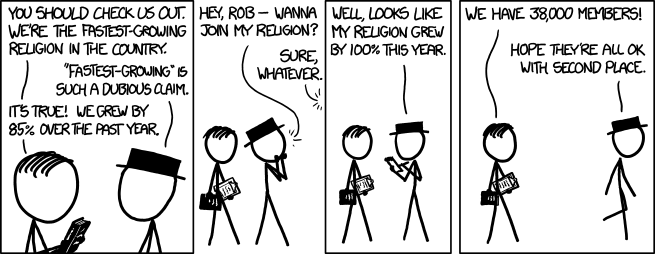
For those of you who missed it, this comic sums up how I feel when people make claims about the future of Christianity by discussing which religions are growing the fastest:

Click on the image if it's too small.

Randall Monroe, the author of the XKCD comic strip, never claims to be religious, at all, so it's a good bet that we wasn't interested in defending or attacking anyone's religion when he drew this.  He was probably just tired of seeing people abuse statistics.  Anyway, it's a good reminder for everyone: don't misuse numbers.