Thursday, October 31, 2013

Halloween Dump. Required Reading.

Concerned about the ethical implications of Halloween? TheResurgance.com isn't, claiming that the holiday is no big deal. I agree.

Still worried? Maybe you've heard that Halloween was a Pagan holiday (or maybe that's what you like about it). Well, the Catholic origin of Halloween is actually very well-documented and you can read an nice explanation of it, here

 Here's the fun part:

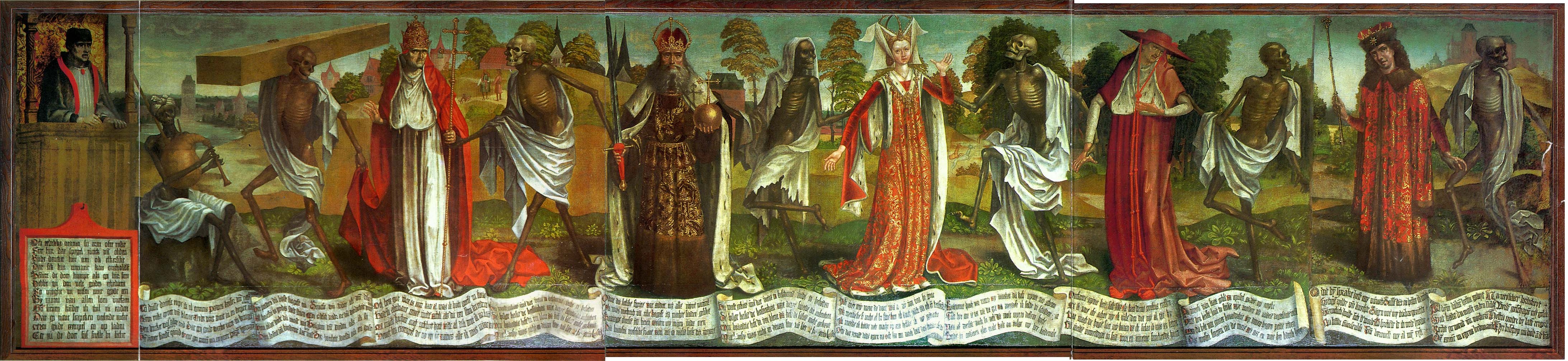
"More Masses were said on All Souls Day, and artistic representations were devised to remind everyone of their own mortality. We know these representations as the “danse macabre”, or “dance of death,” which was commonly painted on the walls of cemeteries and shows the devil leading a daisy chain of people–popes, kings, ladies, knights, monks, peasants, lepers, etc.–into the tomb. Sometimes the dance was presented on All Souls Day itself as a living tableau with people dressed up in the garb of various states of life."

 Halloween. Medieval Church Style.

As a medievalist, let me tell you a simple rule of thumb: if someone says that a modern-day practice dates back to Pagan rituals they are probably wrong. We wrote about this a few years ago.

Witchcraft? Never happened. Read our old post on this subject and rest easy. Witches only existed historically as an accusation thrown at politicians. It dates back to the inquisition, the Templars and the poor Druids.

Like being scared? I do. It's fun. Go to this classic page from Listverse.com and scroll down to #3 where you can listen to a rare recording of an exorcism. Not for the squeamish.

Mental Floss has a good article about why black cats are considered bad luck which includes the story of a monstrous feline called a "Cat Sith." (My wife's cat is all the proof I ever needed.)

And for my fellow losers IT workers, here's a comic detailing appropriate costumes for our profession.

Monday, October 28, 2013

A Halloween Scare for Jesus

There's often discussion on what Christians should or should not do in regards to Halloween but some decisions are easy.  Do not give out Chick Tracts to anyone, let alone children.

The cover of a Chick Tract.
I recently stumbled upon an article titled, Trick or Tract: Satan, Jack Chick and Other Halloween Horrors.  It discusses Christians, Halloween and mostly these tracts.  Over the years I've read several tracts, hell and fire literature and all sorts of really bad nonsense trying to masquerade as Christian theology.  But I've never seen such blatant ridiculousness and destruction before, especially on something that people seem to actually purchase and geared toward children.  (You can by an assortment of tracks at Amazon.com .)

At first glance one might think these tracts are some sort of farce to give someone a good scare for  Halloween but they are not intended to be farcical but accurate. When it comes to Halloween these tracts play up the fear and death angle.  Literally.  Many of the tracts have children dying.  Many include quotes saying that pagan's celebrate Satan's birthday on Halloween and often do this by sacrificing animals and even children.  Later in those tract it clarifies saying it's not Satan's birthday but some people think it is and so still do the sacrifices.

I really apologize if anyone has been exposed to these tracts through trick-or-treating, their church or any other way.  Using lies and awful manipulative tactics to get someone to believe in Jesus is the opposite of what should happen.

I've linked below to several of the most gruesome tracts. Read at your own risk.  Seriously.  If you're looking for a good fright this week, you're in luck.

The Little Princess: http://www.chick.com/reading/tracts/0063/0063_01.asp?Store=True

This tract is about a little girl diagnosed to die within a few days, but her last wish is to go Trick-or-Treating.  Luckily, a family gives her a tract about Jesus.

Happy Halloween: http://www.chick.com/reading/tracts/0032/0032_01.asp?Store=True

In this tract a few kids go to a haunted house even though they were told not to do so.  Then they get so scared  they run away, one of the kids gets hit by a car and dies.  Then we learn how the child that passed away didn't go to heaven but how you can.

The Devil's Night: http://www.chick.com/reading/tracts/1053/1053_01.asp?Store=True

This one has a girl who's teacher hates her because she hates Halloween.  It implies the teacher is an actual witch.  It then goes on to explain that the history of Trick-or-Treating is linked with taking and sacrificing children.


Friday, October 25, 2013

Listen to Caedmon's Old English Hymn

While the monks wrote and sang their hymns Caedmon just listened from the livestock pen where he watched the animals, jealously aware that he did not share their talent for music. All of that changed when he fell asleep in the barn one evening and was visited by an angel who asked him to sing a song about creation. He was doubtful, but as soon as he really tried Caedmon found out that he could write his own music. When he awoke he remembered all of it and he told the monks about his new poem.

The monks took him to the leader of their monastery, the abbess Hilda, and she gave him another assignment - this time he was asked to write a song about theology. (Also, did you know that women could be in charge of men in a medieval monastery? It's true.) Caedmon wrote the song and abbess Hilda approved of it. She decided to make him a monk and bring him into the monastery to write music for the church instead of keeping the livestock. He is the earliest known poet in English history.

Here's his poem in Old English, it's fun to listen to it:


Thanks to MyStanzaChannel for post it.

Monday, October 21, 2013

Is Faith Meritorious?

In Hebrews chapter eleven, faith is defined as “being sure of what we hope for and certain of what we do not see.” The author proceeds to list a series of biblical figures who exhibited extraordinary faith and who were commended by God for their faithfulness. Clearly, faith is understood in this passage as virtuous, as bestowing honor or merit on the person who exercises it. But how exactly do we exercise faith?

We routinely employ faith as another word for belief. For example, we equate faith in God with believing that He exists, or with believing in His promise of salvation. Under this definition, faith is meritorious and commendable in proportion to our belief.

But can we choose what we believe? Could you, for instance, will yourself into believing that you can fly? Surely not: one cannot will oneself to believe what one knows to be false. Rather than consciously choose what we do and do not believe, don’t we instead find ourselves in possession of varying degrees of belief concerning certain propositions? I think so. We can’t choose to believe the moon is made of cheese, or that Star Wars is an historical documentary because a massive constellation of influences, including experiences and knowledge, precondition us to eliminate certain propositions before we can consciously reflect on them. It isn’t at all clear then that belief is volitional.

If belief isn’t volitional, then how can faith be meritorious? We typically think of merit as being something earned, as the product of some virtuous action. But if we can’t choose what we believe, then it seems strange to refer to belief as meritorious. Perhaps faith is not merely a measure of belief, after all.

Christian philosopher William Alston suggests an alternative conception of faith that preserves the notion of merit described in Hebrews without relying on Doxastic Voluntarism, the theory that belief is voluntary. Alston posits assent, not belief, as the meritorious action of faith. While we may not be fully capable of forcing ourselves to immediately believe in the propositions of faith – the resurrection, for instance – we can assent to them and act as though we believe. Acting in accordance with faith propositions is commendable and meritorious, Alston claims, and can lead to the development of deeper belief.

This theory of faith has its own problems, but we can take comfort in the distinction between belief and assent. We all occasionally experience doubts concerning our faith, and I think it’s useful to consider whether these doubts are beyond our control. Faith demands fidelity to God, but only to the extent possible for a fallen human being. Even when plagued by doubts, we can still assent to God's will and give our lives to Him.

Friday, October 18, 2013

They Told Me I Wasn't "Manly" Enough and Gave Me Something to Read

"Read this book - it'll tell you how to be a man!"

Wait...what?

Am I not manly enough? I eat steak. Sundays are incomplete without some football and spicy chilli. My car is a dirty old pick-up. Sure, I watch Once Upon a Time and I really love my cats, but I also like reruns of Highlander and I follow the Bearded Gospel Men Blog. Do people think I need help "being a man?"


I've been handed these sorts of books more than once during someone's effort to teach me Biblical manhood. (Imagine the beating I would receive if I gave a lady a book and said, "This will help you be a real woman.") This common attack on my manhood raises serious questions.

One of these books told me that men should do what they enjoy doing. That wasn't much of a revelation. Are there men out there who host tea parties and watch GLEE, just waiting for a book to give them permission to go camping and stop shaving? I didn't need anyone to tell me that scrapbooking wasn't a good outlet for my feelings. (By the way, if you're a man who likes hair-dressing and Downton Abbey more than hunting and fishing then you're still OK with me.)

Another one of these books encouraged men to be bold and stand up for what's right. (This was pretty much the only argument it contained.) The author was concerned that men were not standing up for justice.

But wait...what does that have to do with men? Shouldn't everyone be doing that? Is there any reason to exclusively give this advice to men? The author gave no indication as to why he wanted to single out the boys. Are men expected to be our culture's only morality police? As far as I was concerned, it was generally good advice for anyone but it had been packaged as advice for men.

So I'm still confused about the whole phenomenon of "manly" Christian books. I suspect this sort of thing is promoted by the part of our culture that wants to see Leave it to Beaver in our homes, and believes that promoting a 1940s domestic life is the same thing as promoting the gospel. It's not.

Wednesday, October 16, 2013

ru’mi-nate: to chew the cud; to muse; to meditate; to think again; to ponder

Here at Thinking through Christianity, we try to be a place that points to good art at the intersection of faith. We do this because imagination is crucial to Christianity and because art speaks to us about the world and ourselves, telling the Truth better than exposition.

Since 2006, our friends at Ruminate Magazine have been a beacon in the darkness that can all too often be Christianity and the Arts---both the fear of and subsequent disdain for contemporary "secular" art and the muck of mediocre "christian" art.

Allow me to let them tell you a little about themselves:
Ruminate is a quarterly magazine of short stories, poetry, creative nonfiction, and visual art that resonate with the complexity and truth of the Christian faith. Each issue is a themed forum for literature and art that speaks to the existence of our daily lives while nudging us toward a greater hope. Because of this, we strive to publish quality work accounting for the grappling pleas, as well as the quiet assurances of an authentic faith. Ruminate Magazine... was created by a group of fellow writers, artists, and believers who wanted a space for the thoughtful expressions of those who are nudged forward, backward, and sideways by faith in God.
Speak. Grapple. Nudge. This is art---life.

The magazine's most recent issue, "In Search of Song," includes a short story from my friend and colleague LaToya Watkins titled, "The Mother." As a means of giving props to LaToya and enticing you to check out the magazine for yourself, here's an excerpt:
The visits done died down a little bit now. Some still come. The rustlers like this on sitting in front of me. They still asking bout Hawk. Bout how he come to call hisself the Messiah. Bout who his daddy is, but I ain't got nothing for them.
I look out the window I keep my chair pulled up next to. Ain't no sun, just cold and still. Banjo lift his head up when he see my eyes on him, but it don't take him long to let it fall back on his paws. He done got his rope a little tangled up. Can't move too much with it like that, but he can breathe and lay down. He alright. I'll go out and work out the knot when I can--when this gal leave.
...
I move my eyes away from the window and put them on the girl. She got a long bird face and her teeth stick out a little too far for her tiny mouth. I can tell by the way the sides of her mouth drooping down, she ain't used to being in a place like mine. I don't want to make her feel more uncomfortable, so I don't say nothing bout the pregnant looking roach crawling slow up the wood-paneled wall behind her head.
"I reckon peoples be just like them trees, you see?" Her face blank. I can tell she don't see. "Everybody got a season to go through being ugly and naked." I laugh a little bit. 
"Yes, ma'am," she say. Then she sigh and let her eyes roll halfway round in the sockets. "We all have problems, but can we--"
"That enough heat on you?" I ask. "Can't never keep this old lean-to warm. That enough heat on you--" I stop myself from calling her "miss". I want to spank the back of my own hand. She younger than me. Probably bout by twenty years or more. Still, I want to make sure that the old electric heater sitting on the cracked and splintered floor near her feet humming is doing what it's supposed to do. Sometimes it blow cold air instead heat like it's supposed to. I want to make sure it ain't freezing her.
She look confused bout my question. Them lines in her head get deeper, and she start shaking her foot a little. She want her story for the paper. Want to find out if I think my son was God like them folks what was following behind him in Abilene. 
Are you hooked yet? Order your copy here.

Monday, October 14, 2013

Skeptical Christianity (And Why Thomas is my Favorite Disciple)

My Meyers-Briggs personality type is the ISTJ - also known as "The Investigator." I would rather use information, not intuition, to make decisions, and I look deeply into issues to make up my mind instead of going with the crowd or just looking at the surface. (Which is why I got in trouble as a child for taking everything apart to see how it worked. I grew up and became a technical consultant, though.) The ISTJ personality is marked by these rigorous investigations, and that is an important part of my faith.

This is how I see myself.

While researching the ISTJ mindset I noticed that it was associated with the Apostle Thomas. Of course, we don't know enough about his personality to make a claim like that, but I have to admit that I've always had a soft spot for Doubting Thomas. I'll tell you why:

After His resurrection, Jesus appeared to his disciples while they were gathered in a room - everyone but Thomas. After Jesus left they found Thomas and told him what had happened, but he was skeptical. Jesus had come back and was walking around talking to people? Thomas famously said that he would not believe it until he saw this miracle for himself.

Poor Thomas has been harshly criticized for this, but I'm not sure why. The other disciples were no better. They didn't believe until Jesus appeared to them, even though they already knew the grave was empty. The first person to see the risen Lord was Mary, a friend of the apostles, and she ran to them immediately to say the Jesus was alive. They went to the tomb and saw it was vacant, but none of them seemed to believe He was walking around in the flesh until they saw it with their own eyes. They were just as skeptical as Thomas. (And why not? If you told me Jesus was having coffee next door I'd probably want to see it for myself.)

This skepticism is healthy for a Christian. How can we know what to believe if we don't question things? Cult leaders gather followers by claiming to be divine even though they have no proof, and those who follow them would be better off if they were more doubtful. The Bible even asks us to be skeptical when people make religious claims so we can use our brains to discern the truth. Being skeptical is how we can be people of faith without being fools who will just believe anything. (If you are in a healthy church, like mine, the leaders are more than happy to hear your questions and concerns, rather than trying to force any beliefs on you.) These questions will take us on journeys, and our faith is strengthened by these journeys.

Back to Thomas. He's unfortunately remembered as a guy who doubted Jesus, but there's more to him than that. When Lazarus died, Jesus told His followers he was going to Judea where Lazarus' sisters were waiting for Him. The disciples reminded Jesus that He had enemies in that town who might try to murder Him, but they couldn't change His mind. It was Thomas who said,  "Let us go, too, that we may die with Him." Thomas' convictions were not paper-thin; he was a noble man who intended to follow through with his beliefs. This is probably why he was so highly revered by the early church.

In our rush to try and feel superior to our predecessors, let's go easy on Thomas and remember to ask questions as we explore issues of faith.

Monday, October 7, 2013

Five Reasons that Being a Pastor is a Really Annoying Job

In order to appreciate another person we have to learn what their life is like and understand their struggles. A local pastor has a rough job, and since it's pastor appreciation month (apparently) we should start by knowing what it's like to lead a church. Here's just a few of the things that can make the job annoying.

1 - The Whining

Being a pastor is sometimes like working in a complaint box. It seems like everyone just knows exactly how the church should be run and is eager to tell the pastor about it. A constant barrage of whining about how it was done in the good ol' days ("Why aren't there more ferns on stage, like in Branson?"), or how the church should adopt more modern methods ("We should sell our church and meet under a bridge, because that would be so real."), is the reality of running a church. The pastor will have no choice but to disappoint most of these people and continue hearing their complaints. Yay.

I'll bet these soldiers don't gripe about how their church is decorated or which hymns they sing.

Furthermore, if immature people in the church don't get along they'll go to the pastor and try to get them on their side. It's like dealing with children.

2 - The Gravity of Failure

When a pastor isn't listening to complaints, he's dealing with our society's most difficult problems. They're counseling people who want to kill themselves, or advising a homeless person who just wandered in and might be dangerous. What happens if the person they help doesn't get better and hurts themselves, or someone else? What if the pastor can't figure out how to help the senior citizen who can't pay their rent? Ministers deal with high stakes issues, and they're expected to always know all the answers. That's a lot of pressure.

3 -The Job is Actually Really Hard

A pastor is expected to be a theological genius, a profound speaker, a comedian, a counselor, and an administrator.  (And a saint.) This is a lot of work in many different disciplines. The amount of hours put into each of these responsibilities taxes a pastor, leaving little time for friends and family. And, for some reason, everyone acts like being a pastor should be easy.

Pastors are expected to drop everything (even their kid's soccer game) to help someone who is upset about losing their job, or to fix a plumbing problem that happened when a child at the church building tried to flush a toy down the toilet. They have responsibilities every day of the week and their own family life is always sacrificed to help everyone else. It's not a one-day-a-week type of job - it's all day, every day.

4 - The Expectations

Pastors aren't perfect, but they're expected to be. I've seen ministers get fired because they were caught looking at pornography, even though nearly every person in their congregation had done the same thing at some point. They can't get upset and lose their temper, even once, or they'll never live it down. It's a constant battle to appear perfect which can make a pastor feel lonely. We have to allow our leaders to be human and not expect them to be flawless public figures.

5 - The Money Problems

People like to think that ministers are highly paid public speakers who live in luxury, raking in money from their poor congregation, but that's not how it works. Most pastors work at small churches and barely manage to get by. They often work a second job and sometimes even depend on welfare to make ends meet. I've even known ministers who couldn't afford to buy themselves food and would have to ignore their own hunger while dealing with their congregation's problems. A pastor can be among the lowest wage earners in a small town, but that won't keep the locals from expecting them to meet all of their needs.

Larger churches can afford to pay their ministers more, of course, but comparing their salaries to similar jobs in the corporate world shows that being a pastor doesn't pay as well as being a CEO. (Unless you're a crook who pretends to be able to heal the sick if they send money to your mansion.) I earn a pretty average salary from my job (for which I'm incredibly thankful - I love my work), and it's higher than the pay of a lot of ministers I've known who, unlike me, were usually providing for a family.

---

There are good things about leading a congregation - it's not all bad - but you can see that your local pastor is under a lot of pressure. Think of a way to let your church leader know they are appreciated, and go easy on them because they have a really tough job.
Friday, October 4, 2013

St. Francis Never Said That

"Preach the gospel at all times, and when necessary use words." -Unknown

That quote has been attributed to St. Francis of Assisi for as long as I can remember, and I'm embarrassed to admit that I only recently found out that he didn't actually say it!

The gospel coalition has the whole story in a well-researched article, here. I'm shocked. I found out this morning because the Catholic Memes website posted this on their Facebook page:


This is just as devastating as the time I realized that Sean Connery's line in Indiana Jones and the Last Crusade about Charlemagne was completely made up. Talk about feeling let down.

Wednesday, October 2, 2013

The Myth of the Word-For-Word Bible Translation. (Languages Don't Work That Way.)

When I was young, people (who should have known better) told me that I should only read Bibles that were translated with a "word for word" method so as to preserve the original meaning of the text. Anything else was unacceptable.

This made sense to me, at the time. Why read a translation that isn't literally the same words as the original? It was a simple concept. Or, so I thought. Later I noticed that in the front of every Bible I owned (I owned a lot of them - and still do) was a section describing the method of translation used by the scholars and none of them claimed to be literal, word-for-word translations. None of them.

Did you know that the old Hebrew and Greek texts didn't contain punctuation? It's all added in by translators. A misplaced comma can change the meaning of an entire paragraph, and in this case they aren't even in the manuscripts. However, punctuation is how languages work, today, so it wouldn't be a proper translation without commas, quotation marks, and the rest.

But anyone who's studied languages, at all, can see a more fundamental problem: languages cannot be
translated with word-for-word methods.

For example, take a simple sentence that we all learn in Spanish class - "Como se llamas." It means, "What's your name" to us, but a word-for-word translation would be "How you are called?" It's not even readable that way, and that's just a simple example. When you apply this method to a very ancient language the problems are much more complicated.

To put it simply: it is impossible to translate anything in a word-for-word manner - especially something written in ancient languages. (To make matters worse, Jesus spoke in Aramaic, but his words were recorded in Greek, so our manuscripts don't even have His original words - they had to be translated into something else to be preserved.) To bring an ancient text to a modern audience the translator must understand the meaning of each sentence and then translate that sentence into contemporary rhetoric. Since language changes with each generation these translations must be updated regularly or they'll stop making sense.

What bugs me the most is that the people who told me to seek out word-for-word translations were ministers who had graduated from conservative, Christian seminaries. How could they make this mistake?