Wednesday, November 27, 2013

Thanksgiving: Some Historical Details

We celebrate Thanksgiving tomorrow.  Below I list a couple interesting links talking about the history of the Thanksgiving holiday.
Sheet music cover for a Thanksgiving hymn.

This article from Indian Country Today explains the first Thanksgiving:

What Really Happened at the First Thanksgiving?  The Wampanoag Side of the Tale

I found this article through Wiconi International which is a Christian ministry organization that promotes spirituality among Native Americans.  I suggest following them on Facebook for all sorts of good info.

Also, this article from USA Today is interesting and goes over the history of Lincoln's and Roosevelt's involvement:

Abraham Lincoln, Father of the Thanksgiving Holiday

Have a great Thanksgiving weekend!

Monday, November 25, 2013

9 Ways to Make Thanksgiving Work


The holidays are stressful for some people. Follow these rules and there's a good chance you won't try to strangle anyone with a chicken bone.

1 - No Politics at the Table

Yes, I know, I'm right about everything. Spewing my Libertarian dogma is not only my right - it's also a service to those around me who are not so enlightened. However, I'll keep my mouth shut during Thanksgiving. Or I'll just keep it filled with pie.

Words of wisdom: no one ever said anything stupid while shoving pumpkin filling into their face.

2 - Calm Down

It's only a meal. We're getting together to eat food - it's not as if it's a meeting of the U.N. This should be a no pressure gig. Sit down, eat, and catch up with the loved ones. Simple, right? Don't make it hard.

3 - Don't Hurt Yourself in the Kitchen

Like I said - no pressure. You don't have to have those perfect DIY mashed potato sculptures shaped like Daleks you saw on Pinterest, and the Thanksgiving police won't show when people find out there's no gluten-free gravy. Chill out. Serve everyone sandwiches if you want - you're not a restaurant.

4 - Thank the Labor Force

If you're not making food (some of us aren't allowed in the kitchen), remember that those who volunteer to spend a few days cooking to provide for thirty minutes of eating deserve a medal. Treat them like it.

5 - Bury the Hatchet (in a Turkey)

You know that family member you don't get along with? (Maybe there are few of them.) When you see them, greet them with a hearty handshake and talk like the two of you have never met. By Christmas, you'll have forgotten why you didn't like each other.

6 - Bring a Friend

One year, my roommate had nowhere to go for Thanksgiving; fortunately, my family didn't mind if he tagged along with me. It was fun having someone new who didn't know all of our stories, and he didn't have to spend the day alone. (Also, everyone will be on their best behavior for a guest.)

7 - Be Thankful

Life is rough, but remember that there's food on your table. Lots of us have very serious problems, but
let's take the time to notice what we have. When life gets tough, this helps. I've been unemployed, but I've never been without the love of a church community or my friends and family. That's not bad.

8 - Help Others.

If you're reading this, you're probably not homeless and you might know where your next meal is coming from. Not everyone is so lucky. Consider a donation to a local charity to help those in need.

When John the Baptist was asked how people should prepare for Jesus' coming, he said, "If you have two coats, give one to someone who doesn’t have any. If you have food, share it with someone else."

As we prepare for the Christmas season let's look for ways to help those around us. Even a small donation of $5 is helpful to your community charities. I give something to this group each month.

9 - Make Others Thankful You Were There

Some people don't bring anything to the holidays besides their whining, and everyone else can't wait for them to leave. Don't be that person.

Tell your stories. Ask everyone how their year has gone. Bring games or movies. Think of something to add to the occasion. (It goes without saying that if you're bringing food you don't have to worry about this one.) A family is special because of the unique thing that everyone brings to the table.

That's it. Enjoy yourself and relax.

Wednesday, November 20, 2013

The First Thanksgiving, or, The First American Protestant Christian Thanksgiving

If you went through elementary school in the United States then you probably know all about The First Thanksgiving.  In 1620, weary Pilgrims set out from the Old World in search of a home: The New World of America.  After a terrible first winter, they established homes, befriended local Indian peoples, and planted their first crops.  By late 1621, the Pilgrims were reaping a bountiful harvest, complete with pumpkins and little hand-traced turkeys decorating the table (at least, that's what I learned).  They invited their Indian neighbors to join in the feast and thank God for the harvest.  The First Thanksgiving.

But it wasn't The First Thanksgiving.

People all over the world had celebrated harvests for centuries, so it wasn't really first.

Indian peoples had been celebrating the fall harvest in America long before the Pilgrims arrived.

Spanish colonists celebrated thanksgiving masses in Florida and Texas for decades before the Pilgrims arrived in Massachusetts.

The Pilgrims weren't even the first Protestants to do this!  That distinction goes to the French Huguenots who held a thanksgiving service and celebration in 1564 near present-day Jacksonville, Florida.

So, what do we call the Pilgrims' feast in 1621?  Robert McKenzie, a professor and chair of the department of history at Wheaton College tongue-in-cheek suggests:


"The First American Protestant Christian Thanksgiving"

Over the last week, I have been reading McKenzie's newest book, The First Thanksgiving: What the Real Story Tells us about Loving God and Learning from History.  It has been fascinating, eye-opening, and challenging to me as a historian, as an American, and as a Christian.

By taking apart this American myth of The First Thanksgiving, he is not trying to ruin the holiday.  It's a great holiday!  We should keep celebrating it, with great thanks!  But McKenzie is calling us not just to thank, but to think.  Think not just about the holiday, but about our myths and assumptions as American Christians when it comes to our past.

What is true?  What purposes do our national myths serve?  Are we remembering stories that are helpful to us, and purposefully forgetting stories that shed light on parts of our history we would like to keep in the dark?

For my part, I will be pondering this over Thanksgiving: What would my life look like if I thought about it as part of a broader context, rather than as just my own?  The Pilgrims were not the first, nor were they alone.  They were part of something bigger than themselves.  If my life belongs not just to me, but to those around me, before me, and after me, then my life will be about more than me.  I will reach out to my neighbors.  I will seek the advice of people older than me.  I will remember the contributions of people different from myself who have made my life possible.  I will be thankful for so much more than Thanksgiving.

NOTE: This blog was wholly inspired by Professor Robert Thomas McKenzie's work.  You can find more in:
- His book: The First Thanksgiving
- His blog: Faith and History: Thinking Christianly about the American Past
- His faculty page at Wheaton College

Monday, November 18, 2013

Tradition is Useless in the Marriage Debate

A local group was accused of "indoctrinating" children with a political bias. They were supposedly visiting schools to tell students about the election process, but parents started to notice that their kids were coming home quoting partisan rhetoric.

When reporters brought this accusation to the groups leaders, they responded with, "We've been doing this outreach program for more than twenty years."

And that was it.

What was that supposed to mean? Am I supposed to trust people just because they've been doing their job for a long time? Unfortunately, it's not unusual for people to reach for tradition when they don't know how to prove their point.

I hear this sort of thing often when people talk about homosexual marriage. One side insists that marriage has traditionally been between a man and a woman, while the other side points out that civilizations in the past have accepted and encouraged gay relationships. Both groups want to have tradition on their side.

For myself, I can't figure out why we're dragging tradition into this. My homeland was set up by rebels who defied cultural and religious traditions to start a new country. As a protestant, my worldview is largely shaped by thinkers who risked their lives to break sacred traditions - some of them involving marriage laws. Since when have I been expected to follow tradition?

Tradition is not sacred, to me, and I think most people feel the same way. Most of the conservatives I know pride themselves on breaking old religious traditions, and the liberals I know usually can't wait to take a "progressive" stance toward society by upsetting cultural norms. However, both of these groups think it's important to be "on the right side of history."

For the record, you'll be hard-pressed to find an older culture that allowed homosexual marriage because, until recent times, the main purpose of marriage was to make children. It used to be a matter of urgency for people to procreate, a town could cease to exist of one generation wasn't fertile enough, but in our modern age of medical science we are able to live longer and populate the globe without even trying. As a result, marriage is something we normally do for our own desires and not because we're running out of employees to work the mill. Marriage has changed since the Roman times of the New Testament. (There's certainly nothing traditional about my childless marriage.)

More on this is an upcoming blog entry, but, for now, I have to ask why both sides of the debate think that they need to be "traditional" when we need to be focused on doing what's right. Am I expected to be a Christian, or a Traditionalist? (They are not the same thing.) Since all of us are so proud of breaking traditions, let's take that out of our arguments and discuss the issue better.

Friday, November 15, 2013

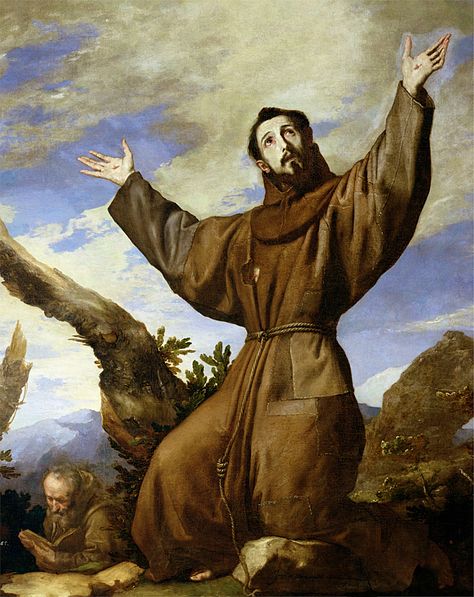
St. Francis and the Things He Didn't Write

Every Fall, when it gets cool enough, I put on my jacket for the first time in many months (it's Texas) and I'm surprised at what I find in the pockets. Sometimes I discover things I've been looking for since the last time it was below 60 degrees outside. On less impressive occasions I find old food. Last week I found a copy of the prayer of St. Francis in the inside pocket of my leather jacket and ever since I've been carrying it around and reading it. Oddly enough, I can't recall where I got it.

I was reminded that in all of my time as a medievalist I've never come across this prayer as a historical artifact. It's recited all over the world, but never once has it come up in a medieval text or a lecture. Why? Because Francis didn't write it. It's actually from the 20th century.


That was a shock to me. And it comes on the heels of a similar realization I had a few weeks ago - Francis also never said "Preach the gospel at all times, and when necessary use words." That quote has been attributed to him for a long time, but it's origins are unclear. We've really exaggerated Francis.

Also, he caught a fish that big.

It goes on.

What about the hymn, 'All Creatures of Our God and King?' (One of my favorites.) Nope. His name appears in the margins, but that's only because the song references something Francis wrote called Canticle of the Sun.

Francis is said to have been the first person to experience the stigmata, but as far as I can tell he never made that claim - others made it for him.

A famous book called Little Flowers of St. Francis sits on my shelf, but it was written more than century after the Saint's death. Poor Francis has been misquoted a great deal.

That doesn't make the prayer any less potent. I pull it out of my coat pocket on the way to the train and read it, every morning, and it provides quite a challenge:

Lord, make me an instrument of Your peace;
Where there is hatred, let me sow love;
Where there is injury, pardon;
Where there is error, truth;
Where there is doubt, faith;
Where there is despair, hope;
Where there is darkness, light;
And where there is sadness, joy.
O Divine Master, Grant that I may not so much seek
To be consoled as to console;
To be understood as to understand;
To be loved as to love.
For it is in giving that we receive;
It is in pardoning that we are pardoned;
And it is in dying that we are born to eternal life.

Wednesday, November 13, 2013

Help Those in Need

Last week, Typhoon Haiyan - possibly the largest cyclone ever recorded - devastated the Philippines. Thousands were killed and millions are homeless in the aftermath. Few events that take place in our lifetime will devastate so many people at once.

So it's time to help. World Vision has done all the work for us, we just need to make a donation. Click here to do your part.

It doesn't have to be expensive. A small amount is fine, because a lot of us giving a little will certainly add up. I know I can do without a few cups of coffee in the next week in order to get help to those in need.

Monday, November 11, 2013

Why should I get married?

That may seem like a strange question, and perhaps it is, but I'm not the only one asking it. Numerous reports remark upon the trend among young adults toward "delaying" marriage, sometimes indefinitely. Women and men are focusing on their education and establishing their careers before entertaining thoughts of "settling down." For many, including Christians, putting off marriage doesn't feel like a sacrifice since a certain amount of instant gratification comes with their having embraced the false ideal of cohabitation, or worse, the hookup culture. That being said, I realize that as a proponent of marital chastity, the question Why should I get married? is perhaps even stranger.

Here's why I'm asking it. For the last decade or so, we have routinely told one story about marriage: "As iron sharpens iron, so one man sharpens another husband and wife sharpen each other."

We have done this for good reasons. We want to be, and indeed we must be, honest about how difficult married life often is. We don't want to set people up for failure. (Though, perhaps somewhat ironically, there are more failed marriages today than ever before. Not that divorce is the only way to fail a marriage.) In fact, it is, I think, partially in reaction to the climbing divorce rate that we have begun to focus on this "sharpening" aspect of marriage.

We do need to tell this part of the story. But we also need to remember that it is only part of the story. We must guard against overcorrecting and being so laser-focused on marriage as purifying fire that we neglect the rest of the story, thereby developing a truncated view of marriage.

We must discipline ourselves to tell whole truths.

Teenagers and 20-30-somethings listen to sermon after sermon, small group after small group, blog post after blog post, dating book after dating book... declare that "marriage is the number one tool (second only to having children) God uses to make us less selfish and more Christ-like"---while simultaneously watching their parents and friends' parents and peers divorce. And then those same sermons, small groups, blog posts and books turn right around to lecture young adults for delaying marriage, calling them lazy and selfish. Are we insane? (Now, there is certainly some truth to the lazy-and-selfish critique; young adults are, after all, human. But again... not the whole story.)

As a single young 30-something myself, every time I hear this refrain about marriage, a not so small part of me thinks, The Lord's got several sharpening instruments at work in my life, and if that's the main thing marriage does... Why should I get married?* Fortunately there's a part of me that knows better; there's a part of me that reminds the rest of me of the blessings of, for example, companionship. But the world we live in is fast-paced, fragmented, and isolating (and propagates its own narratives about marriage). I need reinforcement! I need whole narratives and complete pictures. Or at least not tragically truncated ones.

As good as it is to communicate the character-building hardships of married life, when we allow this single narrative to dominate our definitions of marriage, we shouldn't be surprised that young adults grow more and more wary of it.

While we should want to be sharpened and disciplined, seldom do we deliberately put ourselves into difficult situations solely so that we can build character. And, in the case of marriage, I'm not sure that's actually good motivation---Darling, will you marry me so that God can use you to make me more spiritual? Lamesauce. Plus, kinda selfish, no?

No. We put painstaking practice into our work and craft because we love. Skateboarding, painting, accounting, teaching, guitar. It's that I-feel-God's-pleasure-when-I-run kind of love. Because we are created to enjoy the triune God and the fullness of life he supplies.

Question: In addition to being a sacrament,** what is marriage? How can we paint a more complete picture?


__________________________________
*Yeah, but I'm sure that nothing in your life is as sanctifying as marriage. It's in the Bible... somewhere. So you really need to stop being a self-centered slacker and get married (and have children!) already. In the meantime don't forget that before you do get married, singles have more time and energy on their hands to devote to the Church, not having any sanctifying relationships like a spouse and kids, so you really ought to spend all of your free time here. Don't worry; if you're doing it right, God will bring someone to you.

** I know we Protestants tend to have a visceral reaction to the word sacrament, but as sanctification is a divine grace, and married life is often a channel of that divine grace...

Friday, November 8, 2013

Breaking from old perceptions

I was fascinated when I saw this headline on npr.org:  'We Hurt A Lot Of People,' Westboro Pastor's Granddaughter Says.

Two people bravely leave a hateful, oppressive, allegedly Christian group, trying to right the wrongs of their past.  This made me think about how I have changed my mind, in a Christian context, regarding attitudes I've harbored in the past towards groups and lifestyles.  While I would not say that the culture of my upbringing even touches that of the Westboro Baptist Church, some sentiments I had in my younger years were distantly related.

Sometimes I wonder if I those attitudes were solely products of my environment and conservative suburban 80's era childhood, and now my new environment has allowed me to overcome those notions.  Perhaps a sillier thought I have is wondering if I am a better or worse Christian for seeing certain "moralities" through a justice-over-written-rule Kohlberg's Sixth Stage lens. 


Given the countless sects and denominations among Christians, and the varying individuals who populate those groups, this negates having only cookie cutter answers or one rigid archetype.  I am just grateful to serve a loving, all-forgiving, all-inclusive God.  

Wednesday, November 6, 2013

Tell Me a Story


I've been teaching one of my classes this semester about the power of stories in human life. We are reading a collection of short stories and analyzing them to figure out what makes a good story, what makes a story "work," and just what it is that compels humans to tell stories. In my research for the class, I've found some interesting things about the effect of stories on our brains. For example, studies have shown that when we read language that appeals to our senses, it's not just the part of our brain that processes language that responds, but also the parts of our brain that process the various physical elements in the description. In other words, to read is, in a sense, to experience, at least as far as our brains are concerned. In a well-known study by Michael Gazzaniga, who pioneered studies on the split brain, Gazzaniga found that the left hemisphere of the brain is responsible for interpreting information and making it fit into a narrative even where no narrative exists:

In one of Gazzaniga's favourite examples, he flashed the word 'smile' to a patient's right hemisphere and the word 'face' to the left hemisphere, and asked the patient to draw what he'd seen. “His right hand drew a smiling face,” Gazzaniga recalled. “'Why did you do that?' I asked. He said, 'What do you want, a sad face? Who wants a sad face around?'.” The left-brain interpreter, Gazzaniga says, is what everyone uses to seek explanations for events, triage the barrage of incoming information and construct narratives that help to make sense of the world. (http://www.nature.com/news/the-split-brain-a-tale-of-two-halves-1.10213)

The big question, of course, is still why the human brain gets so much stimulus from stories and is, itself, such a story-telling machine. One theory is that story-telling is evolutionarily helpful; by allowing the brain to "experience" a difficult situation without actually having to encounter physical harm, stories help humans to avoid harmful experiences and survive. This explanation makes sense.

As a Christian, the story that filters my view of this phenomenon is, of course, the Christian story -- specifically that the God who chose to become human (The Word made flesh) also chose to speak to his people through stories. Jesus spoke in parables and figures of speech, and God made man in His image as a storyteller. We are designed for stories, and we live in them and through them, as we make decisions based on the stories that shape our lives.

Now we can view these stories as mere neurological and social constructs (see this previous TTC entry for more info. on what a "social construct" is) that enable physical and cultural survival without any link to Truth or Reality.

Or

We can view our brain's propensity for story-telling as a sign that The Story -- the big one -- about a glorious creation, a horrifying fall, a bloody redemption, and a triumphant restoration -- is True. Maybe God made us for story so that we could see the big Story that is playing out all around as, through Christ, all that is broken is made new. Maybe everything is always-already story not because truth is unknowable, but because The Truth is in the story.


Monday, November 4, 2013

Are You a Jerk? Answer These Questions and Find Out.

I've noticed that the people who say they don't like bullies and other rude people are usually guilty of doing mean things, themselves, and not knowing it. Are you such a person? You wouldn't know, obviously, so take our test and get in touch with your real self:

  • Do you look down on people because they use Apple products? Or because they don't use Apple products?
  • Are you unlikely to give someone a chance if they seem un-American or un-traditional in some way? Or maybe it's when they're just too American for your cultured sensibilities.
  • Do you scoff when someone tells you their problems, even though they don't have kids and don't know what a real problem is? Or maybe they only have one child and really shouldn't consider themselves parents, just yet.
  • Would you rather not talk to someone if they're wearing designer clothes instead than P.F. Flyers? (Or is it the other way around?)
  • Do you think you're better than people who listen to pop music because you've heard of Béla FLeck and they haven't? (Confession: I'm guilty of this one.)


What? You never listened to the 'We the Vehicles' album by Maritime? Why are we even friends?

  • Do you take pride in proving people wrong? Would you rather win an argument that hold an enlightening conversation?
  • When someone tells you that they enjoy reading Twilight books, would you rather make fun of them than offer your friendship? What if their favorite movie is Battleship?
  • Do you assume that rich people from the nice, big houses are less deserving of your sympathy when they are having a bad day?
  • Are you pretty sure that every [Republican/Democrat] is just plain stupid and that it's OK to look down on them?
  • Do you look the other way when people make racist jabs about president Obama, even though you normally don't stand for that sort of thing? Did you laugh when David Letterman joked about someone raping Sarah Palin's daughter, even if you usually don't tolerate that humor?
Are you guilty of any of these things? If so, what are you prepared to do about it? 

These attitudes are not harmless. When you decide to look down on people for these reasons they will surely notice - no matter how subtle you think you are. Other people can tell when you're giving them a cold shoulder, or ignoring them, and it makes them feel unwanted. Don't contribute to the isolation people feel in our society of hatred. Be the solution.