Showing posts with label history. Show all posts

Monday, May 12, 2014

Charting 125 Years of Christian Change


One of the more interesting tools on the internet is Google's Ngram Viewer.  It allows you to search words and phrases through about 500 years of book history.  You select your phrase, tell it the time-frame you want, and it will search all the books Google has scanned into the system's repertoire.  I decided to put it to the test with some Christian phrases and found a several interesting results.

Going into this I thought I could guess how these would chart, but always ended up wrong. All the charts show a drop in use of Christian terms between about 1930 and 1980.  Before and after those years, there are some significant changes also but nothing so apparent.

A few technical notes to add --  I used the category "English" which combines both British and American sources.  Also, the Ngram Viewer only goes up to the year 2008 so all of the charts are based off of that year, and 125 years back.  I had to shrink down the charts to get them to fit on the blog, so I apologize the years are jumbled at the bottom.  I included above each graph the years that are represented.

I hope you gain some insight.  Please post in the comments anything you see in these charts.

ON HEAVEN AND HELL:

I find it interesting that "heaven" tracks, for most of this chart, higher than "hell" especially since the word "hell" is often used in other phrases or slang sayings.  (For instance the phrase, "go to hell", peaks in the 1930s.) The early 1990s are the only time that "hell" is actually more prevalent than "heaven".

125-year-trend: 1883-2008:
  Zoomed-in to 1970-2008:


ON CHURCH AND JESUS:

You can see two things easily from this chart.  The Ngram Viewer is case-sensitive, so I entered both "church" and "Church".  It makes the results more interesting.  The non-capitalized version of church is now much more prominent than it once was, seemingly representing our more casual writing styles and views of church.

The next thing easily seen is that the term "Jesus" is now as prominent as the word "church".  (Although, if you combine both forms of capitalization "church" still beats Jesus.)  It is hard to see on the chart below but "Jesus" actually was ahead of "church" between 2002 and 2007.  This shows a major shift in our overall thinking of how we view Jesus and church interacting with Christianity.

125-year-trend: 1883-2008:


Zoomed-in to 1958-2008:


THE HOLY SPIRIT VS. THE FATHER

On this graph I pit "the Holy Spirit" against "the Father".  Before charting this I thought that "the Holy Spirit" would grow continually throughout the 20th century since Pentecostalist revivals started early in the century.  Instead we see a decline until about 1940 in both terms and then see some growth.  In the 1970s you see "the Holy Spirit" growing faster than "the Father" which, if I had to guess, would attribute to the growth of the Calvary Chapel and Vineyard movement.

125-year-trend: 1883-2008:
 

Zoomed-in to 1958-2008:


STUDY THE *

Below I've listed charts looking at the phrase "study the *".  The asterisk is a wildcard so the system filled the word in on it's own.  This chart shows a very interesting change in our collective thought process. Only two terms, "study the effect" and "study the history", appear in all the charts when broken into 25-year categories. Check-out the chart at the bottom comparing those terms with rise and fall of "study the Bible".

On the 1933-1958 and 1958-1983 charts "study the Bible" does not appear at all.  On the 1908-1933 chart the phrase starts dropping but then makes a major jump to finish fourth on the 1983-2008 chart.

125-year-trend: 1883-2008:

Zoomed-in to 1883-1908: 

Zoomed-in to 1908-1933: 

Zoomed-in to 1933-1958: 

Zoomed-in to 1958-1983: 

Zoomed-in to 1983-2008:


The top terms:
Only two terms, "study the effect" and "study the history", appear in all the charts.  Here are those terms charted with "study the Bible" for the whole time period from 1883-2008.


----

Those are all the charts I have for now.  Please comment about any trends you catch or why you think some of this happened.  I think the current trends of Christianity are very different than what most of us have seen in our lifetimes.  It will be interesting to do these same charts in another 25 years!


Wednesday, November 27, 2013

Thanksgiving: Some Historical Details

We celebrate Thanksgiving tomorrow.  Below I list a couple interesting links talking about the history of the Thanksgiving holiday.
Sheet music cover for a Thanksgiving hymn.

This article from Indian Country Today explains the first Thanksgiving:

What Really Happened at the First Thanksgiving?  The Wampanoag Side of the Tale

I found this article through Wiconi International which is a Christian ministry organization that promotes spirituality among Native Americans.  I suggest following them on Facebook for all sorts of good info.

Also, this article from USA Today is interesting and goes over the history of Lincoln's and Roosevelt's involvement:

Abraham Lincoln, Father of the Thanksgiving Holiday

Have a great Thanksgiving weekend!

Wednesday, June 12, 2013

"Revisionist" History is a GOOD Thing


I spend lots of my time around Christians and/or self-identifying conservatives or Republicans.  When they find out that I am a historian, one of the most common subjects that comes up is so called "revisionist history" or "revisionism."  Questions and comments usually sounds something like these:

"You don't practice any of that revisionist history, do you?"

"What do you think about all the liberals and their revisionist history?  How do you even function as a Christian in the academy?"

"Why are all these ivy-league/ivory-tower people changing our history?"

Behind all these questions is a common assumption: history, the way this person understands it, is the way it really was.  There is rarely any consideration for the idea that their understanding of history may be incomplete, or even flat-out wrong.

Rather than getting offended or trying to defend all of these phantom historians (who happen to be colleagues, mentors, and pros), I have recently begun practicing a new tactic: embracing the idea of revisionism.  This so-called "revisionist" history a non-issue; it is actually a GOOD thing.  It is a good thing, which all people, including Christians, should embrace.

As Christians interested in history, we should be interested above all in the truth.  We may never be able to get at the whole, complete truth of a particular historical person or event, but that shouldn't stop us from aiming for it.  When one historian makes an attempt at telling a story, it is then the obligation of people following to revise the story, and aim for even more truth.  This would include:

1. Continual discovery of new sources, and re-interpreting events according to them
2. Retelling old stories from new angles, particularly from the point of view of people who have been ignored or marginalized by historians in the past
3. Retelling well-known stories by emphasizing different subjects, people, movements, or sources.

These are all forms of "revising" history, and they are all good.  Again, if we as Christians are interested in getting at as much truth as possible in history, then we should embrace revisionism as an obligation.

I'm not talking about purposefully twisting facts, purposefully ignoring facts which contradict our stories, or purposefully misrepresenting historical actors or ideas.  This isn't revisionism.  It's just a clever form of lying.  If these sorts of historians exist anywhere in the academy, I haven't met them yet.

Unfortunately, the only place I have met such so-called historians is within the walls of the church. Many Christians, well-intentioned or not, have revised history in order to place Christianity at the center of everything, from early American history to present-day politics.  This, my brothers and sisters, is the worst kind of so-called "revisionism."  It's misrepresentation.  It's lying.  Let's dump those selfish practices and embrace "revisionism" in our understanding of history, for the sake of the truth.


P.S. - For another take on "Revisionist" History, check out the blog of Robert Tracy McKenzie, professor and chair of the Department of History at Wheaton College.  McKenzie actually argues that we should get rid of the term "revisionist" altogether,  because it's simply not helpful.


Monday, August 6, 2012

Did Augustine Hate Music?

Simple Answer: No

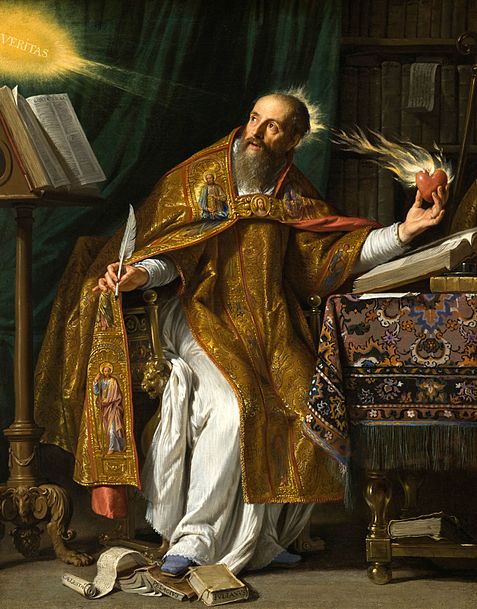
Who:  Augustine was a Bishop/Monk/Philosopher in late antique Africa who wrote so prolifically that he became one of the most influential scholars of all time.  Somewhere, there's a college professor talking about him right now.

Background:  Poor Augustine has been accused of every kind of evil by modern historians, and he's not even around to defend himself!  He died in 430 a.d. after writing millions of words about his Christian faith and a remarkable amount of his work is extant.  The problem is that no one bothers to read his work very well because there's so much of it.  (Or, because they're lazy.)  I've read plenty of "serious" Augustinian scholarship written by authors who clearly didn't know the saint's work very well and were only accusing him of things so they could make a name for themselves.  (That sort of thing is all too common in academia, and Augustine seems to be everyone's favorite punching bag.)


Accusation: In recent years, Augustine has been accused of saying that music was a sin.  Why?  Because he once said that he could enjoy church music so much that he would forget to appreciate God and, instead, just appreciate the music.  Of course, he follows this up by saying that well-performed music is pleasing to God and good for the whole church (he was a much more reasonable person than most scholars will admit), but that's not the part people remember.  (If you don't believe me, just read his Confessions.)  Even though the truth of this is obvious to even the most casual reader, in some circles it's considered common knowledge that Augustine wanted to ban music for good.  That would have been quite a shock to Augustine, who once wrote the following:

But when brethren are assembled in the church, why should not the time be devoted to singing of sacred songs, excepting of course while reading or preaching is going on, or while the presiding minister prays aloud, or the united prayer of the congregation is led by the deacon's voice? At the other intervals not thus occupied, I do not see what could be a more excellent, useful, and holy exercise for a Christian congregation.

So, let's let Augustine off the hook for this one.  He loved music, and he wanted to hear talented musicians making good music in his churches.

(More information about his hymnology can be read here.)

Monday, August 2, 2010

New Research on The Dead Sea Scrolls Reaches Dueling Conclusions

National Geographic recently posted an article titled, Dead Sea Scrolls Mystery Solved? Not because they had any answers, but because it's really good headline.

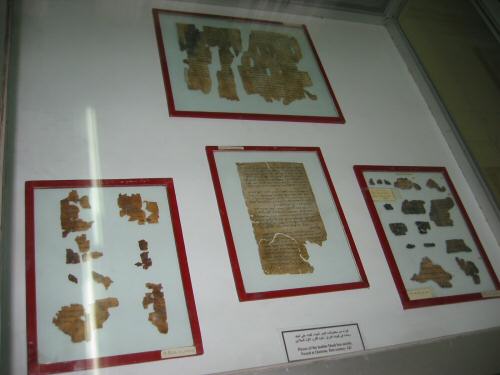
The mystery of the scrolls concerns the writers; we have no idea who made these scrolls.  The reigning theory is that a group of Jews known as the Essenes (famous for baptizing people before Jesus was born) manufactured them, and many efforts have been made to connect this group to John the Baptist.  Such a grand unifying theory is certainly interesting, but it's a theory that still lacks a great deal of proof.

National Geographic's article focuses on some new discoveries:

"...new research suggests many of the Dead Sea Scrolls originated elsewhere and were written by multiple Jewish groups, some fleeing the circa-A.D. 70 Roman siege that destroyed the legendary Temple in Jerusalem..."

Some of this research is based around a cup not connected to the Dead Sea Scrolls at all except for the writing on it that matches the writing on the scrolls.  It is supposed that this means the cup maker was part of the same group as the scroll writers, but all it really proves is a common style of writing.  Of course, Common Style of Writing Found Between Two Jewish Antiques isn't a very good headline.

Meanwhile, scientific research has shed some light on this issue as a group in Italy did some exciting new work on the scrolls.  Discovery.com fills us in:

The researchers bombarded the scroll fragments first with alpha-particles and X-rays from the portable XPIXE device, and then with proton beams produced by a particle accelerator.  The X-rays emitted by the samples showed that all of the fragments contained chlorine and that the ratio of chlorine to bromine within the Temple Scroll fragments was about three times higher than is normally found in sea water. The researchers concluded that the scroll may have been made from the very salty Dead Sea water.

The only problem with the article is that it seems to tell us that all of the documents were made locally - but only one of the 900+ scrolls were tested.  Still, it challenges the notion that the scrolls were collected from all over and held in Qumran merely for storage.  An interesting piece of the puzzle, to be sure, but not yet definitive.

I hate it when I have to choose between Discovery and National Geographic - it's like asking someone to choose between their parents.  And I really hate to admit how often they can resemble cheap journalists rather than researchers.  Either way, the origin of the Dead Sea Scrolls may be beyond all of us - there are some secrets that history just refuses to give up.

Tuesday, February 2, 2010

The Pyramids and the Bible

Brian Dunning's Skeptoid podcast has tackled an issue I've been meaning to bring up for some time: did the Hebrews of the Old Testament build the Pyramids? And the answer is a resounding "no."

Open your Bible and check out the book of Exodus. You'll notice it specifically mentions the Hebrews building supply cities, but does not say anything about pyramids. In fact, no verse in the entire Bible mentions pyramids, and chronologically, it wouldn't make sense if it did mention them as anything but tourist attractions.

The first Egyptian pyramid (I think that the oldest known pyramid is in Malta) was designed by a genius named Imhotep in approximately the 27th century B.C. The concept of pyramid building caught on and the original design was improved by architects and builders who are known to us because they put their names on the pyramids - just like artists sign paintings. (There is generally less mystery then people think that is attributed to the pyramids. Now, the Sphinx on the other hand...) I have a few colleagues who are classical historians, and the idea that the pyramids were built by Hebrew slaves is a good way to make them laugh. The same could be said of any Old Testament historian; this myth just doesn't hold up to simple historical observation.

Let's be honest, half of you didn't know this guy was real.

When did this urban legend start? A long time ago, apparently. Brian Dunning points out that Herodotus, "The Father of History," is to blame. As he puts it:

The story of Jewish slaves building the pyramids originated with Herodotus of Greece in about 450 BCE. He's often called the "Father of History" as he was among the first historians to take the business seriously and thoroughly document his work. Herodotus reported in his Book II of The Histories that the pyramids were built in 30 years by 100,000 Jewish slaves.

Mr. Dunning goes on to deny the historical events of the Exodus, which I think is taking things to far. There is no independent verification of the Exodus, but that doesn't mean it didn't happen. Some doubted the existence of King David until archaeological evidence turned up a slab with his name on it, and this led to a number of retractions. I could tell you a lot of historical records that seemed unlikely until evidence turned up that proved the record was correct, so we have to be careful in how quickly we dismiss something as myth. (Lest I tarnish a good name, I'd like to point out that I enjoy the Skeptoid podcast quite a lot, but I think this part was a stretch.)

So, let's move forward and not perpetuate ancient misunderstandings. The Hebrew slaves didn't build the pyramids, the Egyptians did, and Christians should be the first people to correct this error.