Showing posts with label halloween. Show all posts

Thursday, October 31, 2013

Halloween Dump. Required Reading.

Concerned about the ethical implications of Halloween? TheResurgance.com isn't, claiming that the holiday is no big deal. I agree.

Still worried? Maybe you've heard that Halloween was a Pagan holiday (or maybe that's what you like about it). Well, the Catholic origin of Halloween is actually very well-documented and you can read an nice explanation of it, here. 

 Here's the fun part:

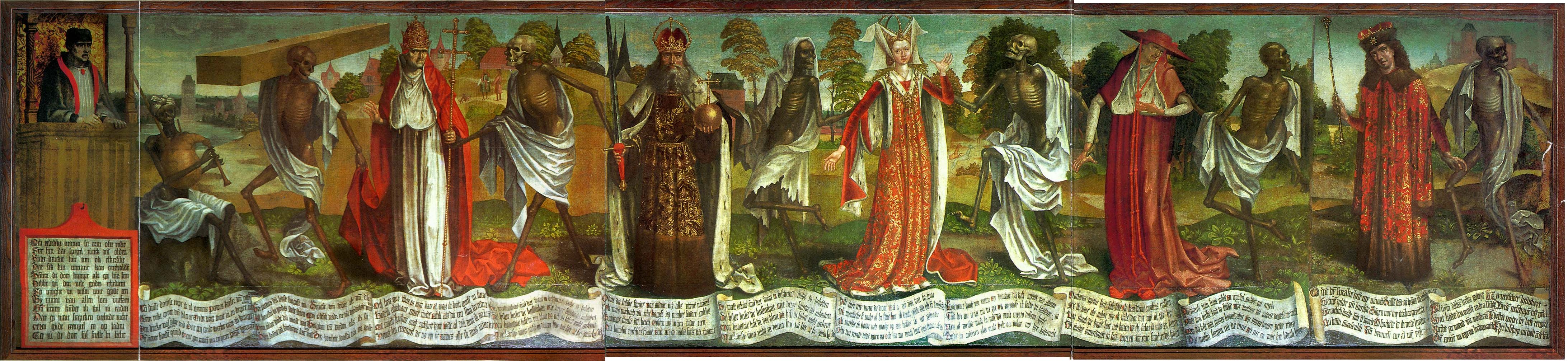
"More Masses were said on All Souls Day, and artistic representations were devised to remind everyone of their own mortality. We know these representations as the “danse macabre”, or “dance of death,” which was commonly painted on the walls of cemeteries and shows the devil leading a daisy chain of people–popes, kings, ladies, knights, monks, peasants, lepers, etc.–into the tomb. Sometimes the dance was presented on All Souls Day itself as a living tableau with people dressed up in the garb of various states of life."

 Halloween. Medieval Church Style.

As a medievalist, let me tell you a simple rule of thumb: if someone says that a modern-day practice dates back to Pagan rituals they are probably wrong. We wrote about this a few years ago.

Witchcraft? Never happened. Read our old post on this subject and rest easy. Witches only existed historically as an accusation thrown at politicians. It dates back to the inquisition, the Templars and the poor Druids.

Like being scared? I do. It's fun. Go to this classic page from Listverse.com and scroll down to #3 where you can listen to a rare recording of an exorcism. Not for the squeamish.

Mental Floss has a good article about why black cats are considered bad luck which includes the story of a monstrous feline called a "Cat Sith." (My wife's cat is all the proof I ever needed.)

And for my fellow losers IT workers, here's a comic detailing appropriate costumes for our profession.

Wednesday, October 31, 2012

Halloween stuff

It's Halloween! Did you know that zombies are theologically significant? They are!
Theologically significant zombies
On this and related matters, see my earlier post at TTC.

And, most importantly, have you seen the Halloween cartoon where Homestar Runner is a Christ figure? (Did the folks who manage HomeStarRunner.com mean him to be a Christ figure? Probably not. But he is one just the same: the dumbest Christ figure ever.)

Friday, October 14, 2011

The Theological Significance of Horror

While some Christians debate the ethics of celebrating Halloween, I think that, if nothing else, the Halloween season is a good time to reflect on the theological significance of horror. I'm not an expert on the subject, but that probably won't matter since most of you probably didn't know until now that there are any experts. But there are. I know of two, Matt Cardin and Kim Paffenroth.

I only know these gentlemen through cyberspace, although Cardin happens to work for my former part-time employer. I haven't had the chance to read any of his stuff yet, but I've read two works of fiction by Paffenroth. He has some nonfiction on the subject which I also haven't read, but I think I have the gist of this Christianity and horror thing figured out. Here's the main idea: Horror fiction illustrates the sinful human condition. This is usually done allegorically, though it doesn't have to be.

I'll illustrate with a few examples.

  • Example #1: Robert Louis Stevenson's The Strange Case of Dr. Jekyll and Mr. Hyde. The Christian rock band Petra figured this one out in their 2003 album Jekyll and Hyde. As they say in the title song, "Sometimes I feel like Jekyll and Hyde. Two men are fighting a war inside." Whether Stevenson intended to or not, he created a terrific allegory for the words of the apostle Paul in Romans 7.


  • Example #2: VeggieTales. This is not your typical horror fiction, but it makes the same point. In Larry-Boy! and the Fib from Outer Space and Larry-Boy and the Rumor Weed, the everyday sins of fibbing and gossiping are personified as hideous monsters with the power to destroy an entire city. At least one of the monsters is capable of eating children; if that's not creepy enough, you should know that it was children who made the monsters grow in the first place. (To be fair to the children, they didn't create them; they just made them grow.) But this is how sin works; we indulge in it for our own interests, and pretty soon it ends up eating us alive. These VeggieTales episodes focus on the sins of lying and spreading rumors. Sin's power to destroy is only more obvious with some other sins: illegal drug use, drunkenness, adultery.


  • Example #3: Paffenroth's Dying to Live: A Novel of Life Among the Undead, a fascinating book that deserves a fuller review (around to writing which I may get someday). Now I'm not recommending you read this book, not only because I don't know who you are but also because this is a book to be handled with care—for several reasons. But there are some people in the world, most of them zombie enthusiasts, who could profit from reading it.


  • I think there are two basic lessons to this book, but I can only cover one of them here. To make a long story short, Paffenroth's book helped me see how zombies portray human sin; they are carnal images of our spiritual condition as described by the Bible. Most zombies suffer from a creepy compulsion to do harm to people. This is what we human beings do to each other on an everyday basis—albeit usually with sarcasm, slander, gossip, a withering look, an unduly critical tone of voice, or something else not so physically violent. We can fight our compulsion to do harm; we can keep it within limits; but it always causes us to misbehave in the end. Were a zombie conscious and reflective, it would agree with the apostle Paul. Romans 7 again:

    "I do not understand what I do. For what I want to do I do not do, but what I hate I do. What a wretched man I am! Who will rescue me from this body of death?" (Romans 7:15 and 7:24, New International Version)


The spiritually dead


Now I am not saying that the Robert Louis Stevenson and other creators of horror fiction are consciously trying to illustrate the sinful human condition. All I am saying is that they frequently succeed.

Thursday, October 13, 2011

Can Christians Participate in Halloween?


Quoth the raven: "Eat my shorts!"

TTC readers, this format is a bit unusual compared to what you're used to here (it's the most common format of blog posts over at my site, Speak What We Feel); but it seemed rather appropriate considering the topic and the timing. Based on her various questions to me over the last several months, it seems Crystal has some well-meaning Christians in her life who generally rely upon legalistic traditions which can't help her navigate the nuances of her real-life circumstances. As a new Christian, Crystal is trying to think through her faith in the world (and in the church).
________________________________________________________________________

Hi Renea,
Its Crystal again and I had another question. So I've been praying for my husband and for God to let me love him more and I think its been helping so thank you very much for your advice. But my question today is: his family LOVES Halloween especially because they throw a lot of parties and like to dress up, would it be okay if I attended to their parties?
Thanks,
C

Hello again!
Good question. There is nothing inherently evil about Halloween. It can be lots of fun! My friends and I always have a party. It's really a matter of how one participates. For example, anything that dabbles in the occult, such as Ouija boards or seances, are out of bounds; people are messing with spiritual realities they generally don't understand. Also, for lots of people, Halloween is just an excuse to dress in a slutty costume and get plastered. Obviously that's uncool too. But these things actually provide Christians the opportunity to participate in Halloween and be a witness to the world by participating in counter-cultural ways: ie, choosing a costume that's fun and creative rather than one that gives away the whole candy shop, drinking responsibly or not at all, and staying away from parties which dabble in the occult---or at least choosing not to participate in those activities.

I think it's especially important for you to go with your husband to his family's party. It's a way you can bond with him and potentially his family as well; and like I said, be a witness through your actions (though obviously not through judgmental words/attitudes/behaviors) if there are goings-on which are unbecoming of a believer in Christ.

I'm glad my previous advice has been helpful.
Thanks for writing. God's peace,
Renea

Thursday, October 28, 2010

Happy Halloween...So, Do You Want to Hear Something Really Scary?

Ever heard of an exorcism?  Of course, everyone has.  But have you ever seen one?  I've never met someone who had been around something like this, and the practice of exorcism is quite suspicious to me, but there are people who will tell you that it's real and that they've seen some frightening things while witnessing such events.

Well, you no longer have to take their word for it.  Corgitz.com has brought a list of exorcism discussions and recordings for the curious.  Check out the exorcism page here, then scroll down to the bottom of the post, past the videos, and click on the Russian exorcism recording.  And wait.

Happy Halloween!

Wednesday, October 27, 2010

Are Christians Still Afraid of Halloween?

I've never been to a church that didn't celebrate Halloween in some way.  Bear in mind, I'm a Southern Baptist, and we are the group that everyone thinks protests things like Halloween.  (We don't, but everyone thinks we do because of a few independent churches who call themselves "Baptists" and make us all look like morons.  But I digress.)

It's well understood that Halloween is a game, and that there's no harm in dressing up as a robot (as I once did as a child) or a fairy (my wife's costume of choice) and goofing around.  In fact, I would have to look long and hard to find a Church that actually had a problem with that sort of thing.  However, the internet has brought these people closer to us.  (Thanks, internet.)

Over at ChristianAnswers.com, we are given the following head-scratcher concerning Halloween:

My family does not celebrate it or participate in it. We do not believe that our children are “missing out,” and neither do they. Other days are used for costumes and parties.

Eh?  It's OK to do Halloween things on any day other than October 31st?  That doesn't make any sense.  The article never gives a reason why someone should abstain from these things from Halloween, but the writer is certainly very proud to be doing so.  The only explanation given goes as follows:

The October 31st holiday that we today know as Halloween has strong roots in paganism and is closely connected with worship of the Enemy of this world, Satan. It is a holiday that generally glorifies the dark things of this world, rather than the light of Jesus Christ, The Truth.

I'm not sure where they studied history, but Halloween has a long and complicated history that changes with each culture.  Throughout these changes, it has never actually been associated with worshiping the Devil.  (In fact, Devil worship is an incredibly rare belief system that one is hard pressed to find before the 20th century.  More on this in a future post.)  Someone needs to tell the folks over at ChristianAnswers.com that you can't cite historical facts like that without quoting a source of some sort.

The Jeremiah Project (I have never heard of them) gives us a lengthy post about the history of Halloween that simply can't get over the fact that Halloween customs are "borrowed from Pagan practices."  This is another historical fallacy that many amateur Christian writers make - the appeal to Paganism.  In antiquity, the Romans labeled non-Christians as Pagans.  It referred to the varied pantheistic and polytheistic views of these people who were not monotheists, and these groups had many different religions amongst them.  A "pagan" may have worshiped at the temple of Isis or to a few of the Norse Gods.  There were different traditions amongst the Pagans and absolutely no solidarity within their ranks.  As such, there's no such thing as Pagan religion or Pagan rituals.  Those are just weasel words used by writers with no historical training.  (A historian who talks about such things will actually name the specific religion and it's ceremonies.)

The same fallacy is used over at DemonBuster.com (I don't make these names up), except this time it's the Druids who are to blame.  As I've said in the past, absolutely nothing is known about the Druids.  All of their records were destroyed by the Romans and almost no mention of them exists in history.  If they had a religion, it is long dead and no one has known its details for a very long time.  Unless the minds behind DemonBusters.com have unearthed some new historical documents and translated them from the Celtic languages of antiquity then we can safely say that this argument is invalid.

GreaterThings.com tells us to have costume parties on some other day, with no explanation as to why these things are OK every other day of the year.  Logical fallacies are abounding.  I can only assume that these people actually think that October 31 is a magical date when demons have access to our world and are made more powerful by the sight of children wearing Transformers costumes.  That is not how Halloween was ever portrayed in history, and that sort of demonic mysticism is not supported by Biblical passages or any occult practices.  That's not how it works in anyone's religion.

I can tell that someone's not a real historian when their ideas could have been inspired by Buffy marathons.

But, remember, that's just the internet.  In the real world, Christians are celebrating Halloween just like everyone else; many churches even set up booths in their parking lots just to give candy out to local trick-or-treaters.  There's nothing wrong with having fun on Halloween, and decent churches know that.