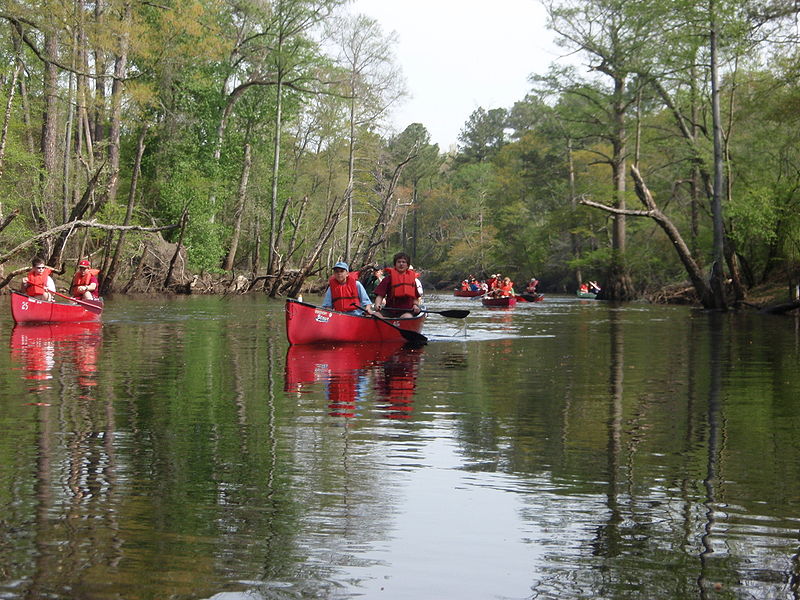
I was a Boy Scout for a few years. People think it's a dorky group, and maybe it is in some ways, but how often do young boys get a chance to build huge fires or make things using knives and axes? Sometimes we just explored the woods and ate burgers that we grilled ourselves. For once, grownups were handing us dangerous tools and telling us to get into trouble (safely). Our leaders encouraged us to meditate on the beauty of the wilderness and find God's truths in it.
 But one thing that didn't come up was our sexual orientation. There's no demographic test for joining the Scouts, and no one ever asked if we preferred the company of men. Why? Because it wasn't relevant to what we were doing. Enforcing this ban means grown ups would have to sit down with kids and ask all of them about their sexuality. Does that seem like something you would want to do? Do you think that local volunteers from you neighborhood have any business asking your adolescent children about their sexual feelings?
That sounds horrifying. Bear in mind that the Boy Scouts also ban atheists and agnostics from joining, but this rule is not enforced and scouts are never required to state their religious beliefs to their superiors. Young people are usually confused about a lot of things, including sexuality and religion, and the Boy Scouts is a place where they can learn life skills and be exposed to Christian teaching - even if they don't have everything in their life figured out.


2 comments:
It's interesting to hear a perspective about the differences between the stated guidelines for the Boy Scouts versus how they're actually practiced. Maybe this new ruling won't change the organization that much since gay kids (or agnostic/atheist kids) weren't being actively banned or weeded out. But I do think it's comparable to the previous Don't Ask, Don't Tell policy in the US Military, though perhaps not enforced in the same way. Having such bans can create an unwelcoming climate and make people fearful of disclosing something that would cause them to be kicked out or otherwise harassed or shunned. You mention that Boy Scouts can be a place for adolescents who don't have everything figured out, which includes religion and sexuality. I like the idea of the organization being a safe space for adolescents to explore their beliefs and identities and learn some skills and character along with that. I think adolescents would feel more free to do so if they know that they're fully included even if they're gay or don't believe in God or are somehow questioning their sexuality or their spiritual beliefs.
Unlike the official disagreement with atheists, the inclusion of open homosexuals does not simply mean that they are no longer going to be uncomfortable.
It means that Boy Scouts can openly date each other. Which raises a handful of other issues, including how you police the appropriate behavior of these boys while in a frequently unsupervised environment, how you arrange tents and tent partners (as it essentially the standard to tent with others) and how you deal with conflicts between scouts over sexual display, flirtation, or discomfort.
Additionally, how efforts to control such behavior can be achieved without violating the recently imposed stricture of non-rejection of homosexuality.
It's actually a far more difficult practical issue than religion... though if the BSA were to drop the religious principle, it would have to drop many other principles as well.
Post a Comment