Showing posts with label Myths about Christianity. Show all posts

Monday, March 18, 2013

Did Christians Once Teach that the Earth is Flat?

Did the church ever teach that the earth was flat? Some armchair historians think so. There are historians who have perpetuated these ideas, and it's something that is often taught in school. Is it true? Does the Bible teach that the world is flat? Not even close.

As a matter of fact, the idea of a flat Earth was never a common Christian teaching. Augustine spoke of a round and spherical Earth in his discussion of antipodes in the fifth century. Pope Sylvester II (who reigned in the year 1000) was an educated man who loved science he taught his students that the earth was round; in his spare time he could be found building spheres out of wood and then painting a map of the Earth on them.

A lot of ancient/medieval Christian scholars describe the earth being spherical, including Origen, Thomas Aquinas, Hildegard, and Bede. (They got this notion from people like Aristotle, Plato, Archimedes, and Ptolyemy who taught the same thing.)  But the idea that Christians are "flat-earthers" persists.
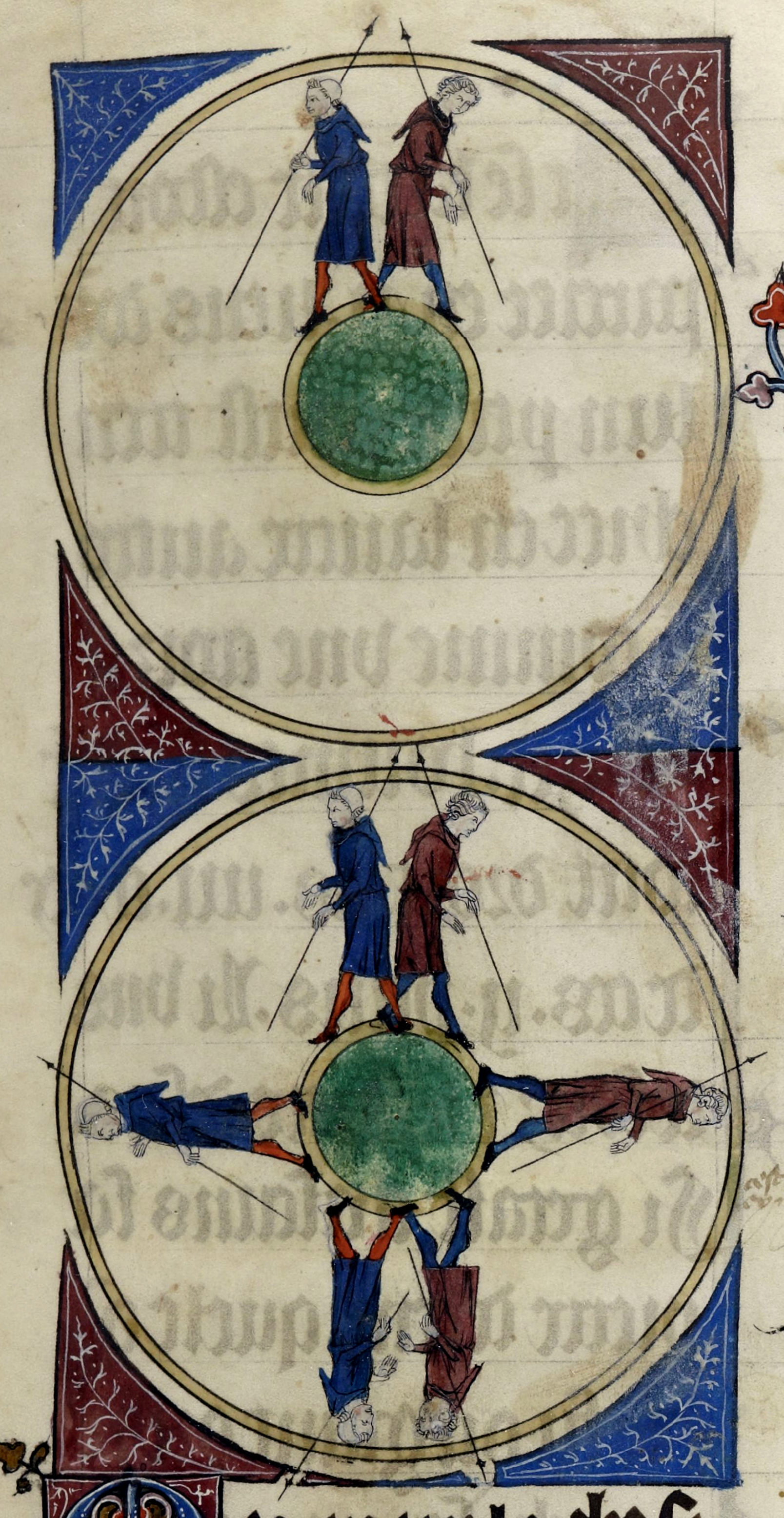
Medieval paintings of the world show it to be round. And if you've ever wanted to read something really interesting from the middle ages you should read Hildegard's 'The Book of the Rewards of Life.' (Liber Vitae Meritorum) from the 12th century - it describes not only a spherical planet, but her idea of how the whole world works.

In the age of the Scholastics, in the latter half of the middle ages, the university as we know it was born, and the leaders of this movement, people like Thomas Aquinas and Albertus Magmus, wrote the textbooks that shaped the intellectual world - and they always described the earth as a sphere.

Remarkably, almost every single important figure in antique/medieval Christianity described the earth as a sphere. The Greeks, who were able to estimate the shape - and even the measurements - of the earth, passed this knowledge to them, and the church never strayed from this ancient wisdom.

(Did anyone in older times deny that the earth was round? Yes. A few. About the same number of people currently think that the moon landing was faked.)

Where did we get the idea, then, that ancient people thought the earth was flat? It's hard to say where that rumor started, but those seeking to discredit the church have gladly latched onto this rumor. Unfortunately, it's a complete lie. Wikipedia has all of the relevant information here, but this quote from James Hannam says it all:

The myth that people in the Middle Ages thought the earth is flat appears to date from the 17th century...it gained currency in the 19th century, thanks to inaccurate histories such as John William Draper's History of the Conflict Between Religion and Science (1874) and Andrew Dickson White's History of the Warfare of Science with Theology in Christendom (1896). Atheists and agnostics championed the conflict thesis for their own purposes, but historical research gradually demonstrated that Draper and White had propagated more fantasy than fact in their efforts to prove that science and religion are locked in eternal conflict.

Saturday, May 9, 2009

Myths About Christianity #1 - "The Bible Has Been Changed!"

This is the greatest misunderstanding concerning Christianity so I'm starting my Myths About Christianity series with it. Usually, someone who believes in this will tell you that a monk may have changed parts of the Bible (accidentally or on purpose) or that some famous ruler ordered changes to be made. As a result, Christians now base their religion on a book that has been changed so many times it has lost its original meaning - making the entire religion futile. It's a big, and important, claim.

This is the most demonstrably false thesis that can be made against Christianity. As a medievalist, I could not be taken seriously by my colleagues if I asked them to believe that the Bible had been changed. Most of the historians/graduate students/professors I meet are not Christians but they know the historical place of the Bible.

Here are some quick points. I could write an entire series on each of them so I won't go into much detail but these are some of the most important talking points for this discussion:

  • If a monk or state ruler had changed the Bible we would be able to observe these changes by comparing newer texts to older manuscripts. Currently, all of our manuscripts match so no changes could have been made. (Unless King so-and-so traveled back in time and changed all of the old manuscripts, too.)
  • The early church writers quoted scripture so much that we can reconstruct the Bible from their quotes - and these quotes match the Bible as we know it today.
  • The Dead Sea scrolls are hundreds of years older than any other copy of the Old Testament. The fact that they are consistent with our previous manuscripts tells us that the Old Testament has also been copied accurately.
  • The copying process - far from being a simple monk with a candle - was so rigid and micro-managed that changing the Bible would have nearly been impossible. (And, as we have seen, if it had happened we would be able to tell by comparing documents.)
The statement that the Bible has been changed is a common one but it is the easiest myth for us to put aside. The person who attacks Christianity this way has not done their research.