Wednesday, May 7, 2014
Majority of Americans are Skeptical about the Big Bang - But I'm Not. Here's Why.
I grew up hearing that the Big bang theory was a threat to Christianity. You might think that this came from white-haired, sanctimonious ministers who shouted anti-science agendas from behind antique pulpits, but you'd be wrong. People who don't agree with my religious views are the ones who insist that science is the enemy of my faith.
I had a classmate in grad school who insisted (loudly) that it is better to understand that the earth is really old than to believe in God. (Apparently, when you're a grad student you can just interrupt the conversation to denounce personal beliefs.) I asked him why an old earth model was incompatible with Christianity and he couldn't give me an answer, he just insisted that it was an affront to religion. I disagree.
Believe it, or not, I was attending a Baptist University when I learned to relax about the Big Bang. My physics professor explained the theory as well as someone could to a group of undergrads, and by the time he was done I realized that I had no reason to criticize it. Why on earth was the Big Bang theory considered a problem?
By all observations, the universe appears to be expanding, so it follows that all of it must have been smaller in the past. How much smaller? I don't know. No one does. But it's easy for me to imagine that the universe began with an explosion that forced space to grow in every direction. If God is all-powerful, then He is certainly allowed to create the universe this way. How about attributing the expanding universe to the God's grand design? Makes sense to me.
You know who else wouldn't be skeptical of the Big Bang? Monseigneur Georges LemaƮtre (d.1966), the first astronomer to theorize that the universe was expanding.
Did I mention that he was a priest? And that his work was approved by the pope?
There's no skepticism of the Big bang in my book. I wasn't around when the universe was created, so I don't know how it happened, but why argue with science?
A few things to remember. 200 Nigerian girls were kidnapped last week by a man who intends to sell them into slavery. The situation in Ukraine is growing more bloody and more hopeless by the day. 260,000 people in my city are living in poverty.
We've got our work cut out for us. Meanwhile, the Big Bang theory isn't hurting anyone.
Friday, March 28, 2014
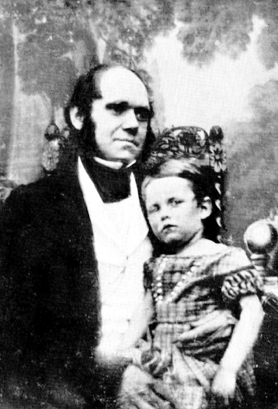
Reports of Darwin's Deathbed Conversion Have Been Greatly Exagerrated
It's an enduring tale that we've all heard: while Charles Darwin laid on his deathbed he threw out his own ideas about evolution and accepted Christianity. It makes for an interesting story, but it's completely false.
The tale was made up by Elizabeth Cotton (also known as "Lady Hope" for some reason). She claimed to have visited Darwin on his deathbed where she saw him reading his Bible and complaining about people taking his theories too seriously. (The story can be read in its original version at Wikipedia.) According to Cotton, Darwin told her that he was wrong about evolution and wanted her to tell his friends and family about Jesus. The story reads like a tall tale, complete with emotional appeals and unrealistic dialogue. And are we really expected to believe that Darwin wanted to discredit all of his life's work and that Elizabeth Cotton was the only person he told?
Darwin's family has always denied the stories of his deathbed conversions. Since many of his family members were Believers they probably would have wanted Cotton's story to be true (at least the part about him finding Christ), but they never supported Elizabeth Cotton's claims and neither have any independent historians.
Charles Darwin is a poorly understood person. He was not an atheist, and he did not consider evolution to be at odds with the church. Plenty of people think his work was pitted against religion (like the people who visit my site and tell me that Darwin "killed God"), but he didn't see it that way. Darwin enjoyed doing science for the sake of understanding the world around him, and he wasn't out to change anyone's religion. Charles Darwin specifically stated that his scientific notions were not a challenge to religion, but people don't like to remember that part.
I've had the pleasure of reading some of his correspondence and discovered among them some rather interesting statements about religion. In a letter to a friend, he says that he attended a presentation of Handel's Messiah and laments that his soul is too "dried up" to appreciate it. In another, his wife wishes he would return to seminary, but understands that he isn't able to go back there. None of these things are explained, at all, but it certainly paints a picture of man who's religious journey was more complex than we like to think.
Wednesday, March 5, 2014
Debating Science is a Waste of Time - Do This Instead
Meanwhile, Christians in the United States were preparing to take center stage in a conflict of their own. Before a world-wide audience, the church was prepared to wrestle with a truly important issue:
"Exactly how old is the earth?"
The debate had the impact I expected. When faced with opposition to our convictions, it's human nature to dig our heels in and stubbornly stick to our agenda. No one changes their minds after this sort of verbal sparring - they only find more reasons to fight. Debates always make people less open to new ideas, and debating religion does not help the skeptic to understand our beliefs.
Meanwhile, there are people in your town who don't have food. There are clothes in your closet that you never wear and families a few blocks away who could use them. Times are rough on a lot of folks, and finding hope is never easy when bills can't be paid. Not to mention, the trials of everyday life make it hard to believe in a loving God.
The church is equipped to help with these problems. We can feed and clothe our neighbors while we remind them of God's grace. We can be a sympathetic ear for the person who has been laid off or a family for the lonely child who has no parents. Our music and preaching can help someone remember why they believed in God, in the first place. We can bring hope.
Or, we can argue about the age of the planet.
I'm not just talking about the well-known debates, because this is a problem that happens in small ways, too. Social media is drowning in religion vs. science arguments that never accomplish anything. I realize that some people use science to criticize the faith, but don't respond to those attacks with angry words. Turn the other cheek, ignore the haters, and don't respond with insults. Every ounce of energy and resources you spend squabbling over scientific scruples should be redirected toward helping your community.
Get out there and show people that Christianity isn't about pointless debates, but a love that comes from God and the hope of what is to come.
Saturday, September 3, 2011
Creation Myth
If you ask a random person on the street what they think about Genesis chapter 1 you’re likely to get one of two responses. Either they believe it is an extremely literal historical account of how God created everything in six days, napping on the seventh; or they think it’s all a fanciful myth with no truth to it. I would like to propose another position. One based on genre.
A common misconception with the Bible is that it was written in the genre of a history book. This is believed by many, both Christians and non-Christians. This is not true. It contains history but is not a history book. Rather, the Bible is composed of numerous types of genre. The Old Testament alone contains narrative, lament poetry, pessimistic wisdom literature, parables, and steaming love poetry, to name just a few. Genesis 1 is no exception. It is not written in the genre of a history book, it is written in the genre of a myth.
Now before some of you attempt to lynch me or others start cheering, please hear me out. Myth here is used in the scholarly sense. By myth genre I refer to a story of the god or gods with no implication of whether or not the story is true. Now, as a Christian I firmly believe that Genesis 1 is a true story of the one true God creating all of creation. But even though I believe it is truth it is still written in a specific genre. You must understand the genre to know how to read it. After all you don’t want to take a modern proverb as a medical textbook, otherwise you’d eat apples when your appendix starts to hurt instead of going to the doctor and having him cut the sucker out.
I believe Genesis 1 was written to convey the truth that God created all creation. But it is also presented in such as way as to serve another purpose. And that is to serve as a polemic against the gods that the surrounding nations worshiped (a common use of the myth genre in the ancient Near East). In other words, it’s a way of saying “My God is bigger and better than all of your gods combined! Nah, nah, nah, boo, boo!” (But with much more decorum than that.)
Within this theory of Genesis 1 there are two trains of thought. One is that it is written in a way to say that God is better than the Egyptian gods. For example, the Egyptians viewed creation as a daily occurrence. Each day’s beginning (rising of the sun) and ending (setting of sun) represents creation with the gods continually working to make it happen. It was a never ending cycle, the gods never truly rested.

Genesis 1 shows the God of the Bible as better than the Egyptian gods because he takes his time in creation, merely has to speak for it to occur, and…he stops.
The second train of thought is that it may also be a polemic against the Mesopotamian gods. One of the reasons for this is that the Mesopotamian gods created humanity to be their slaves, to do all the work so the gods could spend their days sunbathing on the beach and drinking fancy drinks with umbrellas in them.

Genesis 1 stands in sharp contrast to this because the God of the Bible did not create humanity as slaves, but instead he created them to rule with authority (Gen 1.28).
Now all of these issues are much greater than those two short paragraphs could even begin to explain. I’ve only given you a small taste of what may really be going on in Genesis 1.
So what’s the point? Read the bible with an eye on the genre. You may be surprised how understanding genre explains away a lot of problems and perceived contradictions. (Such as perceived contradictions between Genesis 1 and Genesis 2.)
Now, with this information some might be tempted to say, “Ha! Genesis 1 is a myth, which means it’s not true. I now have biblical proof against all those annoying creationist Christians! Booyah!” Um…no. Even if you want to write off Genesis 1 you must deal with Genesis 2. Genesis 2 is written not as a myth genre, but more in lines with the style of a history book, and it clearly states that God created everything.
Some of you may ask if, based on this, God did create in six days. My answer… possibly. God may have created the whole of the universe in six days. It wouldn’t surprise me in the least. But if I find out some day that God created it in an instant or over a length of time greater than six days my faith will not be shaken.
Thursday, January 15, 2009
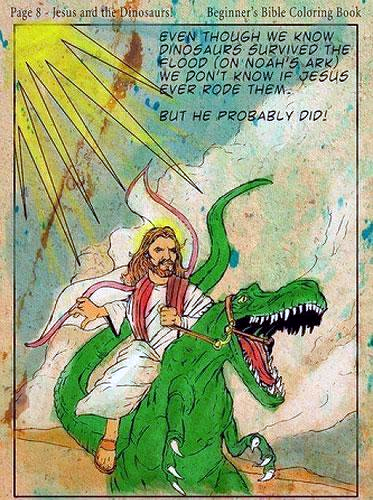
Did Jesus Ride on a Dinosaur? Oh, my...
That question might sound completely ridiculous to some of you, but others among you have heard of this and thought, Wow, those Christians sure are stupid.
And, why shouldn't you think that?
A saddled Triceratops is on display at the Creationist Museum. Why? What does this have to do with Christianity? Wait, it gets better.
Jesus probably rode on a dinosaur? Since when? If Aristotle and other Greeks spent so much time cataloging animals, why didn't they make up a category for the dinosaurs and describe any? If they were around in Jesus' day, why don't we have paintings and descriptions? We have them for every other animal.
OK, now to get my hands really dirty.
Is it possible that man once lived with dinosaurs at some point? I think it's remotely possible in isolated incidents - but that's not saying much . There's a lot we don't know, like why African tribes tell stories of a Brontosaurus, or how a T-Rex managed to have soft tissue in it's bones after 10 million years. Not all of the questions about the universe have been answered.
Is it relevant to my faith? Not really. I don't think being a Christian has much to do with this stuff. Christianity is about my connection to God, not dinosaurs.
Monday, February 18, 2008
An Interesting Film
This film deals with the touchy issue of creation vs. evolution, but, before you run away, let me tell you what this film is and what it is not.
What this film is not:
As far as I can tell from the trailers, this film is not, primarily, a defense of creationism or an attack on evolutionism. While these issues will, at some point, have to be a part of any discussion in this arena, it appears that this film has greater scope than simply feeding this debate.
What this film is:
Why can't anyone believe that God created the universe without being shunned? Why are creationist scientists denied tenure and ridiculed by their peers? Why can't we disagree on this issue and still get along? Ben Stein is investigating the lives of scientists and professors who aren't allowed to think outside the box.
Galileo faced the Inquisition because of his promotion of the Copernican view of the Solar System. Everyone regards this as a terrible crime, so why do non-believers feel they can justify such hatred against their colleagues, today?
There is a certain popular religion (which I will not name at this point) that teaches that the Earth is shaped like a triangle. A primary text from another popular religion (that many world leaders today are using to rule their countries) tells us that Genies populate the Earth. No one is attacking these high-profile religions for their non-scientific claims, but anyone claiming that the Universe was created by someone is completely shunned. How about a little tolerance?