Showing posts with label evolution. Show all posts

Friday, March 28, 2014

Reports of Darwin's Deathbed Conversion Have Been Greatly Exagerrated

Use the plagiarism checker at Grammarly.com, because cheating is for losers.

It's an enduring tale that we've all heard: while Charles Darwin laid on his deathbed he threw out his own ideas about evolution and accepted Christianity. It makes for an interesting story, but it's completely false.

The tale was made up by Elizabeth Cotton (also known as "Lady Hope" for some reason). She claimed to have visited Darwin on his deathbed where she saw him reading his Bible and complaining about people taking his theories too seriously. (The story can be read in its original version at Wikipedia.) According to Cotton, Darwin told her that he was wrong about evolution and wanted her to tell his friends and family about Jesus. The story reads like a tall tale, complete with emotional appeals and unrealistic dialogue. And are we really expected to believe that Darwin wanted to discredit all of his life's work and that Elizabeth Cotton was the only person he told?

Darwin's family has always denied the stories of his deathbed conversions. Since many of his family members were Believers they probably would have wanted Cotton's story to be true (at least the part about him finding Christ), but they never supported Elizabeth Cotton's claims and neither have any independent historians.

Charles Darwin is a poorly understood person. He was not an atheist, and he did not consider evolution to be at odds with the church. Plenty of people think his work was pitted against religion (like the people who visit my site and tell me that Darwin "killed God"), but he didn't see it that way. Darwin enjoyed doing science for the sake of understanding the world around him, and he wasn't out to change anyone's religion. Charles Darwin specifically stated that his scientific notions were not a challenge to religion, but people don't like to remember that part.

I've had the pleasure of reading some of his correspondence and discovered among them some rather interesting statements about religion. In a letter to a friend, he says that he attended a presentation of Handel's Messiah and laments that his soul is too "dried up" to appreciate it. In another, his wife wishes he would return to seminary, but understands that he isn't able to go back there. None of these things are explained, at all, but it certainly paints a picture of man who's religious journey was more complex than we like to think.

Wednesday, March 5, 2014

Debating Science is a Waste of Time - Do This Instead


Last month in Ukraine, Orthodox priests stood between soldiers armed with guns and protesters holding Molotov cocktails, boldly praying - and begging - for peace. They took a stand in freezing weather with weapons pointed at them and publicly asked God for help, because they believe it is that important to find peaceful resolution. (They're risking their lives even though the government has threatened to ban these kinds of prayers.) Read about it here - the pictures are amazing.


Meanwhile, Christians in the United States were preparing to take center stage in a conflict of their own. Before a world-wide audience, the church was prepared to wrestle with a truly important issue:

"Exactly how old is the earth?"

The debate had the impact I expected. When faced with opposition to our convictions, it's human nature to dig our heels in and stubbornly stick to our agenda. No one changes their minds after this sort of verbal sparring - they only find more reasons to fight. Debates always make people less open to new ideas, and debating religion does not help the skeptic to understand our beliefs.

Meanwhile, there are people in your town who don't have food. There are clothes in your closet that you never wear and families a few blocks away who could use them. Times are rough on a lot of folks, and finding hope is never easy when bills can't be paid. Not to mention, the trials of everyday life make it hard to believe in a loving God.

The church is equipped to help with these problems. We can feed and clothe our neighbors while we remind them of God's grace. We can be a sympathetic ear for the person who has been laid off or a family for the lonely child who has no parents. Our music and preaching can help someone remember why they believed in God, in the first place. We can bring hope.

Or, we can argue about the age of the planet.

I'm not just talking about the well-known debates, because this is a problem that happens in small ways, too. Social media is drowning in religion vs. science arguments that never accomplish anything. I realize that some people use science to criticize the faith, but don't respond to those attacks with angry words. Turn the other cheek, ignore the haters, and don't respond with insults. Every ounce of energy and resources you spend squabbling over scientific scruples should be redirected toward helping your community.

Get out there and show people that Christianity isn't about pointless debates, but a love that comes from God and the hope of what is to come.

Friday, August 23, 2013

If you're a theistic evolutionist, . . .

Theistic evolution is the theory that God used evolution to create life on earth as we know it today. If you're a theistic evolutionist, please don't do four things.

1. Don't be a Chris. Be a Beth.

2. Don't toss Adam out of your theology lightly. The New Testament talks about a lot of Old Testament people; a lot of theology in the New Testament depends on these folk: Adam, Eve, Noah, Abraham, Sarah, Melchizedek, Isaac, David, Zerubbabel, etc. Adam appears in passages including Luke 3, Mark 10, and Romans 5.

If you're a theistic evolutionist, then you probably believe that Abraham, David, and Zerubbabel are historical characters, and that the theological points Paul makes in Romans 4 based on the life of Abraham are based on a historical character.

So what is it that Abraham has in Romans 4 but Adam lacks in Romans 5, or that Adam lacks in Luke 3 but Abraham and David have in the same passage?

Not believing in a historical Adam without answering this question is a little careless, at best. At worst, it undermines the authority of Scripture.

(Of course one could believe in a historical Adam and still be a theistic evolutionist. Maybe Adam was just the first person who had evolved to the point where he could make a free and morally significant choice, or the first person God spoke to, or the first person to whom God gave an immortal soul, or something. This approach to Adam is a little bit speculative and impossible to prove from Scripture, but it is possible.)

3. Watch out for deism! Don't have a deistic region in your theology. Understand that God was involved in creation. Chance is not the father of us all. Nor are chance and a set of physical laws set up by God at the beginning of creation the father and mother of us all.

The order and beauty of creation was part of God's plan. How excellent is His name in all the earth!

In other words, it's better to be a theistic evolutionist than simply to be an evolutionist who happens to be a theist.

God made this guinea pig.
 
4. Don't make God responsible for death and suffering. If eons of natural selection preceded the emergence of humans with the power to make a choice, then eons of death and suffering came before any sin had been committed by human beings. Who is guilty for that death and suffering?
(By the way, Alvin Plantinga answers this by saying that the free choice of created beings is responsible for that death and suffering, just not the free choice of human beings. There were other, angelic beings created before humans, and they sinned first.)


Friday, April 19, 2013

Evolution is a poor test for rationality

In my last post, I presented three questions I've heard young people ask--people who think highly of Jesus and even seem to want to become Christians and follow Him, but worry they can't without sacrificing their rationality, their decency, or both.

The first question is: Can I be a Christian and still believe in evolution? They seem to be reasoning that rational people accept evolution, but Christians don't accept evolution, and so Christians are not rational.

As I explained in my last post, Christians can accept evolution, and many do. But there's another problem with this reasoning. Many people have the idea that you must accept evolution if you're a reasonable person who has been properly informed of the evidence for it--that acceptance of evolution is a test for rationality.

But evolution is a very poor test of rationality. Let me explain.

This jacaranda tree has nothing to do with the topic of this post. But it's very pretty, isn't it?

You should know two things.

First, you should know that, in academic society, it is generally considered unacceptable to reject evolution.  Generally, in the academic circles I've traveled across America (admittedly, not that many), it is simply assumed that rational and well educated folk are evolutionists.

Second, you should also know that it is acceptable in academic society to be a theistic evolutionist. You can think God created life and still be considered rational, just as long as you think God used evolution to do it.

Now, one more bit of preliminary observation, and then in the next paragraphs I will finally get to the point. The case for evolution, like the case for most theories in science, is cumulative; you don't argue for it from a single piece of evidence; you argue that it is the best explanation of several different pieces of evidence. Now the evidence for evolution can be divided into two main categories. There is the evidence that life evolved, and there is the evidence that natural processes are sufficient to account for life on earth as we know it today. The first kind of evidence only supports the claim that it happened, while the second kind of evidence supports the claim that it happened in a certain way, that is, by natural causes. The first kind of evidence includes, but is not limited to, the fossil record. The second kind of evidence would include, for example, instances of natural selection at work creating changes in a species.

But therein lies the problem. A theistic evolutionist can believe that God, not natural processes alone, is responsible for the emergence of life on earth as we know it today. In other words, the entire second category of evidence for evolution has not convinced him. (Or else his doctrine of creation has an odd deistic region, since he thinks natural causes acted without guidance from God to create the species on earth today.)

But this leaves him with just the one category of evidence, which on its own is much less powerful than would be the evidence taken as a whole. His confidence in evolution is (or should be) proportionate to the evidence that it happened, not proportionate to the entire cumulative case for the theory of evolution.

These matters should really be discussed over tea.


To sum up: Theistic evolution is thought to be rational. But this means it is rational to reject one category of evidence for evolution, and this means that rejecting evolution itself is rational–or at least it is somewhat less irrational than is commonly thought.

To put it differently: If it really is rational to accept theistic evolution, then, since the evidence for evolution includes a category of evidence which does not convince a theistic evolution, it is rational to reject the overall conclusion that this evidence is supposed to support–or at least is less irrational than is commonly thought.

To put it still differently: If some people can rationally reject the second category of evidence for evolution, I don't see why other people should automatically be considered irrational just because they aren't convinced by the evidence that remains.

And if people who reject the theory of evolution altogether are irrational, then so are all the theistic evolutionists who reject one of the categories of evidence for evolution–or at least they are less rational than is commonly thought.


To sum up this post and my last post:

There are three big questions that keep people away from Christianity.

Question 1 is:

Can I be a Christian and still believe in evolution?

And the answer is:

Yes. (But you don't have to.)

Questions 2 and 3 to be addressed in future posts.
Friday, April 12, 2013

Questions my students asked

Over a period of two years I spent many hours in my office at a liberal arts college in northwest Georgia talking with a variety of students who had signed up for my philosophy classes. Many students were not Christians but were very interested in spiritual matters. A number of these seemed to want to be Christians, but were held back by various questions.

Berry College

Here are the three questions that seemed to trouble them the most.

1. Can I be a Christian and still believe in evolution?
2. Why would God send people to hell just because they haven't heard about Jesus?
3. Why would a loving God let so many bad things happen?


These are extremely important questions.

If my students are indicative of what other young people in north America (not to mention the rest of the world) are thinking, they represent many millions who think very highly of Jesus and admire a great deal in Christianity but worry they can't become Christians without surrendering their rationality (Question 1), their decency (Question 2), or both (Question 3).

Fortunately, there is no need for them to worry. Over the next few weeks I will explain why, starting with the first question, which I will address in this post and the next.

One of the many questions my students didn't ask is "Have you ever eaten monkey brains?" (The answer is "no.")
(Picture attribution: Cara Chow (Charlotte1125). From here.)


Question 1: Can I be a Christian and still believe in evolution?

As bloggers report, the tension between Christianity and evolution is a huge factor behind vast numbers of young folk abandoning their faith. Here is what they seem to be thinking:

Premise 1: All (or practically all) rational people accept that the species on earth today emerged through the process of evolution. a
Premise 2: No (or practically no) orthodox Christians accept that the species emerged through the process of evolution.
Conclusion: So no (or practically no) orthodox Christians are rational.


This is a good argument in that the premises provide very good support for the conclusion. The problem is that both premises are false.

The view that God used the process of evolution to create the species we see on earth today is called theistic evolution. Many orthodox Christians accept theistic evolution. I'm not aware of any very good reason for calling it a heresy.

(As is the case with inclusivism, whether or not theistic evolution is the correct view is, of course, a different question.) (If you want a test for orthodox Christianity, research the Nicene Creed and the primary heresy it refutes. Rejecting that heresy, Arianism, is a pre-requisite for orthodox Christianity.)

Another question they never asked me is, "Have you ever eaten fried flying termites?" (The answer is "Yes, several times. They taste somewhat like peanuts. But they don't look like this termite. Go here to see what they look like.")
(Picture attribution: Discott (talk). Picture from here.)

Of course, there are better and worse ways to be a theistic evolutionist. It's important to adhere to the authority of Scripture. A Christian who is a theistic evolutionist should be a Beth, not a Chris.

I'll address the second premise in my next post.

Update: Other posts in this series:
Evolution Is a Poor Test for Rationality

Why would God send people to hell just because they haven't heard about Jesus?

Why would a loving God let so many bad things happen?

Thursday, January 6, 2011

Evolution vs. Abiogenesis - Know the Difference!

Last year I attended a conference and listened to a student explain that evolution was heretical because non-living matter cannot turn into living matter.  I thought there was a problem with this approach, so I raised my hand when it was time for questions.

"Augustine said that God may have created the earth through a seminal method.  If he is correct, wouldn't that make evolution possible within orthodoxy?"  I asked.

"No," I was adamantly told, "because you can't get something like a rock and turn it into a living thing.  Evolution is impossible."

Obviously, I had worded my question poorly, so I tried again.  "But I'm not talking about getting life from non-life.  This sort of seminal creation means that God could have planted a seed that grew into the earth as we know it."

His reply: "Augustine was wrong."

His thesis had nothing to do with evolution (a change in the gene pool of a population from generation to generation by such processes as mutation, natural selection, and genetic drift).  Instead, he was arguing against the possibility of abiogensis (the theory that living organisms can arise spontaneously from inanimate matter).  This is a problem, because these two are not the same thing.


 Oddly enough, there is a board game called Primordial Soup and the object of the game is to help your amoebas evolve into higher life forms.  It wasn't a hit at youth groups.


I should probably make a disclaimer here and say that I'm not interested in teaching you what to believe about evolution.  I'm not a biologist.  But I do want to be sure that in our enthusiasm to understand our world we do not forget to really know what we are talking about.  Arguing that evolution is impossible by denying abiogenesis is a logical fallacy, because evolution is not concerned with the origin of life.  Also, the notion of evolution does not imply that life came from non-life.  It's unfair to criticize biologists on those grounds.


I've heard plenty of people tell me that evolution can never help us understand where we came from, but I find this to be a strange argument.  The biologists I've spoken to are not looking into their microscopes in an effort to satisfy their existential longings - they are simply curious about science.  Their observations have led them to believe that life as we know it evolved from previous forms of life, but the origin of that "first life" is still a mystery to them.


So, if you want to debate or protest evolution, then I want to ask you to do it correctly.  Don't argue against the wrong thesis, because that just shows that you haven't done your homework. Of course, whining over evolutionary theory is the sort of thing that makes Christians a laughing stock on the internet, so maybe there are better uses of our time.

Monday, May 10, 2010

The Biologist and the Bible

I walked past a classroom a few weeks ago and noticed a professor who was talking about the Bible. I leaned in to listen. Was this a theology class, or a course on world religions? No.

It was a biology class.

I knew what I had to do. Grabbing my secret supply kit, I grabbed my Bible in one hand and my Christian apologist tracts in the other. I quickly donned some war paint and entered the room screaming. I'm pretty sure a white light shone about me as I confronted the biology teacher in front of the stunned students.

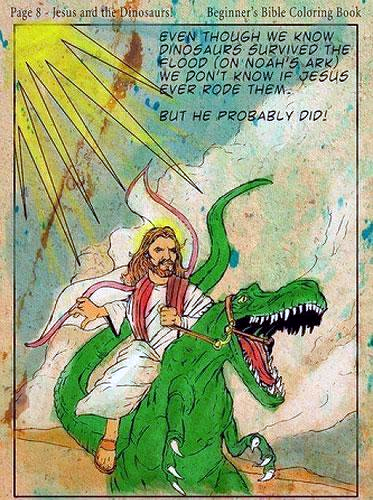
The professor asked me who I was - but I countered by asking him who he was to question God! (I was pretty proud of that one.) Then, using the knowledge I had gained from the 'Answers in Genesis' website, I thoroughly brushed aside all of his arguments for evolution and led the class in singing the old hymn, 'Bringing in the Sheaves.' I even showed the class a picture of Jesus riding a dinosaur to complete my victory.

At this point, the debate was over.

OK, that didn't happen. (Thank goodness.)

Instead, I kept listening. The professor was a nice guy and I assumed he would not bring up religion in a biology class without a good reason. And I was right.

From the hallway I heard him kindly explain that the laboratories were not interested in religion when researching the origins of life. As he pointed out, there are many religions with opposing views of creation, and respecting them as science really doesn't get any work done. However, it was not his intention to challenge anyone's faith or tell anyone if they should believe in God.

The old cliche of the biology teacher opposing Christianity is a favorite in email forwards circa 1999, but that specific type of villainy is not what I saw. I saw a professor respectfully explaining that it was not his goal to push Christianity aside rudely, but to simply focus on the science. I have no problem with that. Reading the Bible doesn't help you understand what's under the microscope. (Although, it may help you understand why it's there.)

Not everyone is comfortable with this, and I understand that, however it is my conviction that whatever is under the microscope was put there by God. Does it appear to reflect evolution? So be it. Does that undermine the Bible? Of course not. If Christianity is true, then nothing in nature could possibly exist in opposition to it. If anything between science and Christianity seems to be in disagreement, I just remember that there is more we have to learn; maybe when we learn more about our world we will see that science and Christianity are not so far apart.

Until that happens, please remember how respectful that biologist was to religion. Fellow Christians, we are to be just as respectful to them if we are to live as Jesus lived.

Wednesday, June 24, 2009

Neanderthal - How Not the be One

Read this. It's the top ten misconceptions about neanderthals.

Why am I asking you to read this? Because most people don't know anything about them. Also, Christians often find themselves in conversations about evolution that include subjects like this.

Someday, when talking about evolution, you might be tempted to say something like, "people were created by God, they didn't evolve from Neanderthals!" But that's only because you didn't read item #9 on the list:

Recent DNA studies have found that the Neanderthals
are a distinct evolutionary line – a line which was ultimately
a dead end as they all died out around 30,000 years ago...


I'm not asking you to buy into every theory regarding Neanderthals and you are perfectly welcome to decide that they never existed - there's nothing wrong with that. The theories could change in ten years for all I know.

But, knowing what is generally believed to be true about these strange hominids will keep you from looking like a fool when the discussion arises. Those who wish to reconcile their faith with the findings of science will also benefit from this because otherwise they would be trying to reconcile their misconceptions - a strategy that can only fail.

Friday, June 12, 2009

When Will the Scientists Get Back to Work?

I love science. I used to read a few science magazines each week and read the latest science/technology news online. (If you're skeptical that a Christian can love science, read this blog entry about me and the Darwinist.)

But I don't follow this stuff much, anymore. My interest is the same but the output from these "science" publications has changed - from discussing science to hating religion.

This morning I wanted to check out the latest in the field of science and headed over to ScienceBlogs.com...and had trouble finding an article about lab work or physical observations of any kind. Not even a word about string theory. Just hate talk.

This article childishly insults the entire state of Texas because of one religious zealot who wants to stop saying "hello". It discusses Michelle Obama, but not science.

This one makes fun of people who love God. (Exactly what scientists ought to be doing.)

Here, we are told that a right-wing extremist was the killer at the Holocaust Museum - even though it was a Bush hating journalism major who disliked Christians.

"I know, you were all hoping we would announce a cure for the plague - but we've just been too busy protesting Vatican I. Maybe next time!"

It was the same when I stopped reading science magazines. Lengthy stories would discuss social issues and preferred politicians but never actually anything new about outer space or biology (except in small articles of one or two paragraphs). I realize that militant Creationists have added to this problem by being rude to the world of science and that sort of thing does need to stop. But, for the sake of intellectual and social advancement I would like to see the scientists putting down the protest signs and picking up their beakers. (Simultaneously, I would like to see Creationist bloggers put down their hate speech and show love to their fellow man.)

Thursday, March 19, 2009

The Southern Baptist Meets the Evolutionist...and Finds Out He's Really OK!

A few weeks ago I was able to attend a lecture by the well known biologist Sean B. Carroll. You may not have heard of him, but in the field of evolutionary development he is Elvis Presley. I got to hang out with him before and after the lecture and was very impressed with him. If I accomplish nothing else in this blog post, I want to establish that I have a great amount of respect for this Darwinian evolutionist. He describes himself as "a kid just trying to have fun" and he is very warm and upbeat in his dealings with people.

He gave us a fantastic description of Darwin and how he developed theories that seemed to decry special creation (as it was understood at the time).

Darwin was sailing near the Galapagos Islands hoping to check out a nearby volcano (he had been trained as a geologist and was also preparing to enter a seminary) when he made his well known observations. While visiting the Galapagos he noticed that the same species on two different islands had developed differently, which was something that, at the time, was not allowed under the theory of special creation. Being sensitive to the religious, Darwin would lightly promote his findings, in conjunction with similar finding of other biologists, without pressing the matter in a way that would offend the church.

While listening to this lecture, something occurred to me. Despite everything I have been taught, there is nothing about this I find unbiblical. I do not believe that God must hold each planet in place; I think He created gravity to do that. I also don't think he had to form each creature by hand, I think it's possible he allowed creatures to evolve as part of the complex biology He placed in them. You don't have to be convinced that it happened this way, but I don't see how it creates any theological problems.

Now, let's get a few things clear:

  • I believe that the Bible is without error...
  • ...that God created man in His image...
  • ...and, that everything in the Bible happened just as it says.
That said, Darwin doesn't bother me. Maybe we should re-think our militant stance against him. Obviously, I cannot explain my entire point of view on Darwin and evolution in a single blog post, but I can ask us to be kind to this scientist, who was always kind to Christians and never set out to debunk any of their beliefs. Let's return the favor and not tarnish his image.

Thursday, January 15, 2009

Did Jesus Ride on a Dinosaur? Oh, my...

Does the Bible say that Jesus rode on a dinosaur?

That question might sound completely ridiculous to some of you, but others among you have heard of this and thought, Wow, those Christians sure are stupid.

And, why shouldn't you think that?


A saddled Triceratops is on display at the Creationist Museum. Why? What does this have to do with Christianity? Wait, it gets better.


Jesus probably rode on a dinosaur? Since when? If Aristotle and other Greeks spent so much time cataloging animals, why didn't they make up a category for the dinosaurs and describe any? If they were around in Jesus' day, why don't we have paintings and descriptions? We have them for every other animal.

OK, now to get my hands really dirty.

Is it possible that man once lived with dinosaurs at some point? I think it's remotely possible in isolated incidents - but that's not saying much . There's a lot we don't know, like why African tribes tell stories of a Brontosaurus, or how a T-Rex managed to have soft tissue in it's bones after 10 million years. Not all of the questions about the universe have been answered.

Is it relevant to my faith? Not really. I don't think being a Christian has much to do with this stuff. Christianity is about my connection to God, not dinosaurs.