Wednesday, November 20, 2013

The First Thanksgiving, or, The First American Protestant Christian Thanksgiving

If you went through elementary school in the United States then you probably know all about The First Thanksgiving.  In 1620, weary Pilgrims set out from the Old World in search of a home: The New World of America.  After a terrible first winter, they established homes, befriended local Indian peoples, and planted their first crops.  By late 1621, the Pilgrims were reaping a bountiful harvest, complete with pumpkins and little hand-traced turkeys decorating the table (at least, that's what I learned).  They invited their Indian neighbors to join in the feast and thank God for the harvest.  The First Thanksgiving.

But it wasn't The First Thanksgiving.

People all over the world had celebrated harvests for centuries, so it wasn't really first.

Indian peoples had been celebrating the fall harvest in America long before the Pilgrims arrived.

Spanish colonists celebrated thanksgiving masses in Florida and Texas for decades before the Pilgrims arrived in Massachusetts.

The Pilgrims weren't even the first Protestants to do this!  That distinction goes to the French Huguenots who held a thanksgiving service and celebration in 1564 near present-day Jacksonville, Florida.

So, what do we call the Pilgrims' feast in 1621?  Robert McKenzie, a professor and chair of the department of history at Wheaton College tongue-in-cheek suggests:


"The First American Protestant Christian Thanksgiving"

Over the last week, I have been reading McKenzie's newest book, The First Thanksgiving: What the Real Story Tells us about Loving God and Learning from History.  It has been fascinating, eye-opening, and challenging to me as a historian, as an American, and as a Christian.

By taking apart this American myth of The First Thanksgiving, he is not trying to ruin the holiday.  It's a great holiday!  We should keep celebrating it, with great thanks!  But McKenzie is calling us not just to thank, but to think.  Think not just about the holiday, but about our myths and assumptions as American Christians when it comes to our past.

What is true?  What purposes do our national myths serve?  Are we remembering stories that are helpful to us, and purposefully forgetting stories that shed light on parts of our history we would like to keep in the dark?

For my part, I will be pondering this over Thanksgiving: What would my life look like if I thought about it as part of a broader context, rather than as just my own?  The Pilgrims were not the first, nor were they alone.  They were part of something bigger than themselves.  If my life belongs not just to me, but to those around me, before me, and after me, then my life will be about more than me.  I will reach out to my neighbors.  I will seek the advice of people older than me.  I will remember the contributions of people different from myself who have made my life possible.  I will be thankful for so much more than Thanksgiving.

NOTE: This blog was wholly inspired by Professor Robert Thomas McKenzie's work.  You can find more in:
- His book: The First Thanksgiving
- His blog: Faith and History: Thinking Christianly about the American Past
- His faculty page at Wheaton College

Monday, November 18, 2013

Tradition is Useless in the Marriage Debate

A local group was accused of "indoctrinating" children with a political bias. They were supposedly visiting schools to tell students about the election process, but parents started to notice that their kids were coming home quoting partisan rhetoric.

When reporters brought this accusation to the groups leaders, they responded with, "We've been doing this outreach program for more than twenty years."

And that was it.

What was that supposed to mean? Am I supposed to trust people just because they've been doing their job for a long time? Unfortunately, it's not unusual for people to reach for tradition when they don't know how to prove their point.

I hear this sort of thing often when people talk about homosexual marriage. One side insists that marriage has traditionally been between a man and a woman, while the other side points out that civilizations in the past have accepted and encouraged gay relationships. Both groups want to have tradition on their side.

For myself, I can't figure out why we're dragging tradition into this. My homeland was set up by rebels who defied cultural and religious traditions to start a new country. As a protestant, my worldview is largely shaped by thinkers who risked their lives to break sacred traditions - some of them involving marriage laws. Since when have I been expected to follow tradition?

Tradition is not sacred, to me, and I think most people feel the same way. Most of the conservatives I know pride themselves on breaking old religious traditions, and the liberals I know usually can't wait to take a "progressive" stance toward society by upsetting cultural norms. However, both of these groups think it's important to be "on the right side of history."

For the record, you'll be hard-pressed to find an older culture that allowed homosexual marriage because, until recent times, the main purpose of marriage was to make children. It used to be a matter of urgency for people to procreate, a town could cease to exist of one generation wasn't fertile enough, but in our modern age of medical science we are able to live longer and populate the globe without even trying. As a result, marriage is something we normally do for our own desires and not because we're running out of employees to work the mill. Marriage has changed since the Roman times of the New Testament. (There's certainly nothing traditional about my childless marriage.)

More on this is an upcoming blog entry, but, for now, I have to ask why both sides of the debate think that they need to be "traditional" when we need to be focused on doing what's right. Am I expected to be a Christian, or a Traditionalist? (They are not the same thing.) Since all of us are so proud of breaking traditions, let's take that out of our arguments and discuss the issue better.

Friday, November 15, 2013

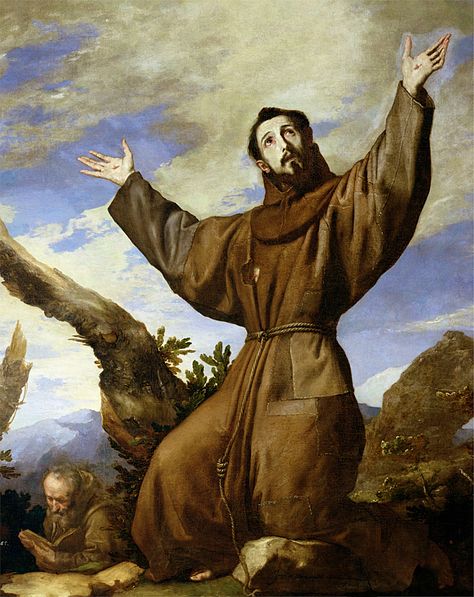
St. Francis and the Things He Didn't Write

Every Fall, when it gets cool enough, I put on my jacket for the first time in many months (it's Texas) and I'm surprised at what I find in the pockets. Sometimes I discover things I've been looking for since the last time it was below 60 degrees outside. On less impressive occasions I find old food. Last week I found a copy of the prayer of St. Francis in the inside pocket of my leather jacket and ever since I've been carrying it around and reading it. Oddly enough, I can't recall where I got it.

I was reminded that in all of my time as a medievalist I've never come across this prayer as a historical artifact. It's recited all over the world, but never once has it come up in a medieval text or a lecture. Why? Because Francis didn't write it. It's actually from the 20th century.


That was a shock to me. And it comes on the heels of a similar realization I had a few weeks ago - Francis also never said "Preach the gospel at all times, and when necessary use words." That quote has been attributed to him for a long time, but it's origins are unclear. We've really exaggerated Francis.

Also, he caught a fish that big.

It goes on.

What about the hymn, 'All Creatures of Our God and King?' (One of my favorites.) Nope. His name appears in the margins, but that's only because the song references something Francis wrote called Canticle of the Sun.

Francis is said to have been the first person to experience the stigmata, but as far as I can tell he never made that claim - others made it for him.

A famous book called Little Flowers of St. Francis sits on my shelf, but it was written more than century after the Saint's death. Poor Francis has been misquoted a great deal.

That doesn't make the prayer any less potent. I pull it out of my coat pocket on the way to the train and read it, every morning, and it provides quite a challenge:

Lord, make me an instrument of Your peace;
Where there is hatred, let me sow love;
Where there is injury, pardon;
Where there is error, truth;
Where there is doubt, faith;
Where there is despair, hope;
Where there is darkness, light;
And where there is sadness, joy.
O Divine Master, Grant that I may not so much seek
To be consoled as to console;
To be understood as to understand;
To be loved as to love.
For it is in giving that we receive;
It is in pardoning that we are pardoned;
And it is in dying that we are born to eternal life.

Wednesday, November 13, 2013

Help Those in Need

Last week, Typhoon Haiyan - possibly the largest cyclone ever recorded - devastated the Philippines. Thousands were killed and millions are homeless in the aftermath. Few events that take place in our lifetime will devastate so many people at once.

So it's time to help. World Vision has done all the work for us, we just need to make a donation. Click here to do your part.

It doesn't have to be expensive. A small amount is fine, because a lot of us giving a little will certainly add up. I know I can do without a few cups of coffee in the next week in order to get help to those in need.