Showing posts with label movies. Show all posts

Monday, August 5, 2013

Thinking through... Summer Blockbusters

I love movies. It's summer, so if you're like me, you've seen so many movies recently it's too hard to remember exactly how many you've seen. Did you know that over the last ten years or so, Hollywood puts out an average of six hundred movies each year. That's almost two movies a day (many, many more if you include Bollywood)! Movies are everywhere, and on that level alone they are important to think about and discuss in our Christian communities as we try to help one another live more like Christ.
But movies aren't only important because they're prevalent. Movies are important because they communicate ideas about what is true. We've always used art as a way of expressing our beliefs about and experiences of reality: what is true about life and what it means to be a person, why is there evil and how can we be saved from it... "Man has always and will continue to express his hope and excitement, as well as his fears and reservations, about life and what it means to be human through the arts. He will seek to express his world through any and all available mediums, and presently that includes film."1
"KHAAANNNN!"
So movies are important not just because they're everywhere, but because they tell us about life and what it means to be human. Normally, in church, when we talk about where our ideas about life and what it means to be a person and how we should live, where do we say those ideas come from? Right, the Bible.
And that's true! But God has given us art too. And we need art and science and nature and each other and the Bible to interpret what is real, what is true. We need all of these things together to help us make sense of life; because sometimes life is a mess. When your friend betrays you and you don't know why. When your parents divorce. When you lose your job. When life isn't bad just uncertain, or confusing... or complicated because two guys like you at the same time or you're not exactly sure which career path to pursue...
I have to thank my friend and colleague Todd Kappelman, professor of philosophy at Dallas Baptist University. I'll be pulling a lot from his lecture "Perspectives on Film: What's in a movie?" Todd notes: "A film is able to convey an enormous range of human experience and emotions. A good filmmaker, script writer, director, producer, or actor can take us to places that we might never be able to see through our everyday experiences." Can you think of some examples? Star Trek. The Hobbit. Even movies like Saving Private Ryan or Braveheart. 
And because movies are able to involve us in situations that are outside of our everyday experiences, but that we can relate to, "[movies] may also show us things about our world that would otherwise remain hidden to the untrained eye." For example, Wall-E. For those of you haven't seen Wall-E, basically humanity destroys all oxygen-producing plant life and has to ship civilization out into outer space. Everyone's on a giant cruise ship in space, lounging in these mobile recliners that take them wherever they want to go and they have these screens that pop up and they can order whatever food they want, and it comes right to them. And they've been living like this in space for years so everyone is super fat. There are a couple of underlying messages in this movie; they're pretty obvious, right? Take care of the Earth our home and discipline yourself in this world of modern convenience. But because these messages are communicated to us, not directly in the world in which we live, but indirectly through a world with robots and space cruise ships, it's a message that's easier to swallow.

The underlying messages of Wall-E are pretty obvious; however, many movies have messages which are much more subtle. And unless we know what to look for and how to look for it we will miss it. We will miss what the movie is really saying behind the special effects and witty dialogue. Often movies communicate ideas about life and reality through symbols; it's like code. The movies don't often just come out waving robot arms saying: "This is the message about life from this movie." So we need to learn how to interpret the code.
Movies have ideas and those ideas come from the women and men who make them. Duh. Right, I know. But we don't always think about it. Every person has a worldview and that worldview is always in a person's art.
My colleague Todd gives us five basic questions to ask when watching movies:
  1. How important is life to the director/writers, etc? Are tough issues dealt with or avoided? "Christian" movies come to mind when I think of this question. Sometimes these movies are really bad about candy-coating life--everything ends nice and neatly and all the bad stuff about life is kind of skipped over or neatly dealt with. This is a disservice because it isn't true to life.
  2. Is there a discernible philosophical position in the film? If so, what is it, and can a case be made for your interpretation? How many of you saw Avatar? I saw it twice. It was awesome in 3D. For a long time now, Hollywood's favorite and most popular worldview has been pantheism.
  3. Is the subject matter of the film portrayed truthfully? Here the goal is to determine if the subject matter is being dealt with in a way that is in agreement with or contrary to the experiences of daily reality. Let me think here... what comes to mind? Um... romantic comedies. Don't get me wrong, I like many romantic comedies, but I also go to those movies with my brain turned on. And it's important we do that because those movies aren't just fun-loving and warm-fuzzy, they also communicate ideas about romance and marriage and dating and sex. And if we go into these movies with our brains turned off, we will begin to subconsciously absorb these false ideas. If I'm not filtering the film with biblical discernment, I can easily begin to expect my love life to be like the movies, which when I say it out loud like that sounds ridiculous. But it happens in subtle ways and more often than we think.
  4. Is there a discernible hostility toward particular values and beliefs? Does the film seek to be offensive for the sake of sensationalism alone? I think a case can be made that The DaVinci Code fits into this category. But you know, hostility toward Christianity is all over, not just movies, but TV too. When Christians are portrayed on the show Criminal Minds for example, they're often extreme fundamentalists who hate gays and repress women. And you know, that's a legitimate complaint against some who call themselves Christians. But when those are the only types of Christians shown time and time again on TV and in the movies, the whole picture isn't being shown. It's being distorted.
  5. Is the film technically well made, written, produced and acted? I confess, Despicable Me 2 was a major disappointment. It was technically well done; I mean, the animation was awesome. But the writing and the plot... boring, really rather unoriginal. Such a let down because the first one was so good!


Now as Christian interpreters, we have three more questions to ask ourselves:
  1. Does the interpretation of reality in this work conform to or fail to conform to Christian doctrine or ethics? Sometimes a movie will match up pretty solidly with the Creation-Fall-Redemption narrative of Scripture. Sometimes a movie will represent the complete opposite ideas about what life is like and what it means to be human. But most of the time, movies present to us ideas that partly conform to Christian doctrine or ethics. Because movies come out of the ideas in the heart and minds of the women and men who create them, and Romans 2 tells us that God has written his truth on the hearts of all people.
  2. If some of the ideas and values are Christian, are they inclusively or exclusively Christian? That is, do these ideas encompass Christianity and other religions or philosophic viewpoints, or do they exclude Christianity from other viewpoints? The case could be made that The Book of Eli presents Christian values in an inclusive way. It's subtle, and if you blinked you might have missed it. The movie isn't about preserving the Word of God. It's about preserving the religious books of the world. And it is no mistake that the Bible was placed right next to the Koran in the library at the end.
  3. If some of the ideas and values in a work are Christian, are they a relatively complete version of the Christian view, or are they a relatively rudimentary version of Christian belief on a given topic? (Like Criminal Minds.)
Finally, a few cautions:
  1. Just because a movie depicts unChristian ethics or values doesn't mean it's bad art. Likewise, just because a movie depicts Christian values doesn't mean it's good art.
  2. Be careful not to allow your personal perspective to dominate the description of a particular work. Try to understand as many other perspectives as you can.
  3. Do not expect a non-Christian to agree with you, arrive at the same conclusions, or completely understand your perspective. At best we can hope to offer a clear and coherent insight into a work and thereby gain an opportunity for a Christian voice to be heard.
Okay. So movies are important. And so is the need for Christian interpretation. If we don't turn on our brains, we will unknowingly begin to believe untruths about life and what it means to be human. Movies are also important because they provide a good, nonthreatening way to talk about truth and worldview---ideas about life and what it means to be human---with our friends and coworkers. So if you like movies as much as I do, I hope you will go to the movies and keep your brain turned.
______________________________________________________________
1. Kappleman, Todd, "15 Perspectives on Film: What's in a Movie?"

Tuesday, October 25, 2011

WITCHES, WIZARDS, AND WISE PARENTING

It's now my second Halloween as a Christian parent. I have yet to get around to forwarding emails about children reading Harry Potter then becoming witches, and I still have yet to pass out my first chocolate-covered New Testament to trick-or-treaters. But my daughter is getting old enough now that I have to start thinking through exactly how I am going to let my daughter interact with alot of themes that Halloween brings to the forefront every year. Will we read books with magic in them as she's growing up? Will we watch movies with wizards, monsters, etc? What sorts of Halloween parties (if any) will we attend as a family? What will I do when I find her playing in her room and she tells me she's pretending to be a witch?

Now these are important questions to me for at least two reasons. First, children process information very differently from adults. So while I can watch a movie about an evil sorcerer or a giant dragon terrorize humanity, my daughter won't be watching those sorts of things until she is much older. Why? Because children have a very hard time processing abstract concepts, symbolism, etc. They also have a hard time distinguishing reality and fiction.


Daddy! That symbolic representation of the
consequences of corporate greed is in my closet again!


But I have a second, larger concern, as well. You see, I believe there really is a spiritual reality, that there are supernatural beings and supernatural power at work in the world. And I believe that how my daughter thinks about these things is important. Now I'm fine with my daughter dressing up as a fairy princess for Halloween, and I have no intention of burning my copies of Lord of the Rings just in case my daughter takes a shining to ole Sauron. But I'm going to expose my daughter to these things in a controlled manner. It's like giving your child a vaccine to protect her against things you don't particularly like. I don't mind my daughter being exposed in controlled doses to false ways of seeing spiritual reality, but I want to be the one administering the vaccine.


Take one overextended metaphor and call me in the morning.


In fact, there are many wonderful stories and movies in our culture that incorporate supernatural or magical themes that can have a very beneficial impact on a child's development. For example, I have no doubt we'll read The Chronicles of Narnia together as my daughter gets older. In addition, there are stories and movies that incorporate supernatural or magical themes in ways that are harmless (maybe even teaching a few life lessons along the way). I've never heard of a child starting to worship Satan after watching Willy Wonka and the Chocolate Factory or Mary Poppins.

But again, for me it goes beyond making sure my daughter is old enough to distinguish real from fake. It's also a matter of there being a real spiritual reality that is being falsely displayed. I'm not saying there is some vast conspiracy involved in the way we portray supernatural things in our culture. Indeed, I think that much of our literature and films are produced not by those trying to create a counter view of spiritual reality, but by those who think no such reality exists!


Since everyone knows there's no such thing as crocodiles,
let's teach children that they are musical vegetarians who only use their sharp teeth to punish bad vegetables.


However, while I know my daughter isn't going to run into fairies, white wizards, and the like, she still may very well encounter spiritual beings and have spiritual experiences over the course of her life. I want her to think correctly about these things. That doesn't mean that we are going to avoid magic and supernatural themes in books and movies. It just means that we are going to be talking about those things as she watches them, and I will be making sure she understands them in light of the spiritual reality that God has created.


Now, honey, what did we learn about eating creepy people's houses?


This is how my wife and I will navigate raising a child in a culture full of magical and supernatural themes. We're certainly not going to avoid these things and pretend they don't exist. We're also not going to de facto villainize everything we don't 100 percent agree with. What we will do is help our daughter navigate this part of our culture, as with every other part of our culture, in a discerning way as we try to help her understand the world as God has made it.

Wednesday, April 6, 2011

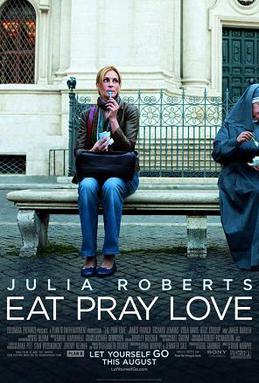
'Eat, Pray, Love' - A Film that Acutally Has Something to Say

Most marriages are strong enough to survive the problems that couples face, but not all of them can withstand the battle over the TV remote control.  Will the man keep a tight reign on the remote and use it to check SportsCenter every ten minutes?  Or will he become a meek prisoner of Glee and Dancing with the Stars?  My wife and I are quite proud of our egalitarian TV watching conduct, and if one of us is sick then that person always gets to choose the program.  When she was ill last week I assumed that we would be checking out a Colin Firth film or a British period piece, but this time it was Eat, Pray, Love starring Julia Roberts.

Since I'm a Christian, you probably would expect me to nitpick the theology and complain that it's not compatible with my faith, but I'm not going to do that because I'd rather focus on what we can learn from the story.  (However, as I expected, the film tries to respect Eastern and Western religions in order to be Universal, but ends up trying to force the mutually exclusive concepts of pantheism and panentheism into the same worldview in order to meet this goal.  I expect no better from Hollywood screenwriters - par for the course, really - but there is still plenty to learn from the movie.)

The main character, Liz, is burned out.  She isn't happy with her life, and she tells everyone that she needs a radical change of some sort.  Her friends are skeptical and tell her that she just needs a vacation or a new outfit or something to occupy her mind until her depression passes.  But Liz knows better - she knows that she is not suffering an affliction of the mind, but one of the soul.  It is spiritual renewal that she seeks, and in the first part of the story she learns that she can't find this through a new home and a new boyfriend.

And this is where the film speaks to us.  I applaud the movie for admitting that there is more to a human being than just the body; we have a spiritual component that must be seen to, and when that part of us is needy we cannot remedy it through physical things.  It is human nature to seek fulfillment in Higher Things, and that is the purpose of Liz's journey.

We don't deny ourselves food when we are hungry - likewise, let us not neglect our souls.  That is the lesson to be learned from Eat, Pray, Love.  It's also filled with eating montages and a scene where two skinny girls pretend to understand what it's like to gain weight and not fit into their (size zero) jeans.  But it also reminds us to look after our spiritual side, and I can respect that.

Wednesday, November 19, 2008

The Stupid Shows I Watch...

Do you understand what it is like to enjoy a show or movie but know that you can't tell anyone, even nerds, that you like it? My friend, Amy, just finished a blog post about her closet shows and I decided to follow suit. Here's my list of shows that I am ashamed to like so much.

Forever Knight - Amy listed this one as well. It's a fantastically corny show about the journey of a Canadian Vampire cop (he works the night shift) who wants to be human, the human woman he loves, and his evil vampire 'father', with whom he has a rather complex relationship (to say the least).


Due South - Yeah, the other show about a pale Canadian cop. This one's about a mounty who gets stationed at the Canadian consulate in Chicago while on the trail of his father's killers and ends up staying in Chicago where his dorkyness is paired with a street smart detective. Very funny show.


Dune - No, not the Dune that the Sci-Fi channel made. This is the one all of the fans hate because it was so different from the book and it doesn't make any sense. I know everyone hates it, but I can't stop watching this strange twisted film. (It does have Patrick Stewart.) One of the weirdest films you will (n)ever see.


1994 Baker Street: Sherlock Holmes Returns! - Yeah, this one is as 'made for TV' as it sounds. I recorded it when I was young and never got tired of its campy adventures. It's fun watching Holmes in modern times, even when it's corny.


Friday the 13th - I'll watch anything with gore and suspense. These films are the best representation of our culture's 'slasher' mythology. (I could go on for hours about the philosophy behind horror movies and the nature of monsters in film and literature, but I won't.)


Breakfast at Tiffany's - The best 'chick flick' ever. It uses romance to open the door to a very deep conversation about the human condition. Here's the best part.

You know what's wrong with you, Miss Whoever-you-are? You're chicken, you've got no guts. You're afraid to stick out your chin and say, "Okay, life's a fact, people do fall in love, people do belong to each other, because that's the only chance anybody's got for real happiness." You call yourself a free spirit, a "wild thing," and you're terrified somebody's gonna stick you in a cage. Well baby, you're already in that cage. You built it yourself. And it's not bounded in the west by Tulip, Texas, or in the east by Somali-land. It's wherever you go. Because no matter where you run, you just end up running into yourself.
[takes out the ring and throws it in Holly's lap]
Here. I've been carrying this thing around for months. I don't want it anymore.


Can you tell me about any films you are ashamed to watch?