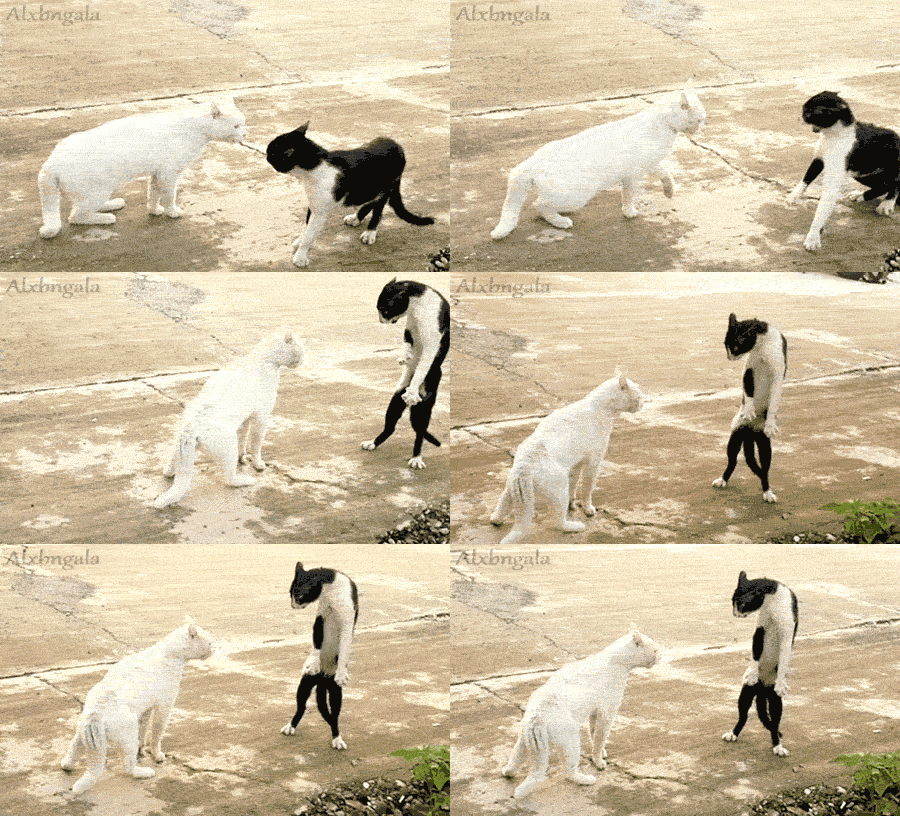
The service is going strong until your pastor says those horrible words: "Now, turn and shake hands with your neighbor."
Oh, no.
The church's introverts sneak out of the sanctuary very covertly.
Maybe this is a good time to get a drink of water.
No one will notice. You can just wait it out.
But what if you come back too early and those extraverts are still in there, waiting for you?
The horror.
What if they get too friendly?
Seriously. They don't get it.
Maybe act really tough and they'll leave you alone.
They might walk past you if you pretend you're reading.
Or if you act like you're in the middle of a religious experience.
Try to blend in with your surroundings.
Or, do what I do - learn an instrument. Band members never have to greet people. Too busy rocking out.
And now you know why the band members at your church are weird. If none of that works, just ask for high fives and wait it out. Greeting time can't last forever. Can it?
I'm slow to take to new music -- especially new Christian music. I've heard the name John Mark McMillan floating around for the last couple of years, but I never bothered to listen. This March, McMillan released Borderland, and I started to see and hear his name even more. After two friends with trusted musical taste both insisted, on the same day, that I give this work a listen, I succumbed and watched this video of Borderland's first single, "First/Last."
I instantly liked it. As a worship leader, I'm always on the look out for songs that work corporately (that is, they are singable, memorable, and true), but that approach old concepts in a unique way. "First/Last" accomplished this goal nicely, so I looked up the rest of the album, expecting to hear more similar worship songs.
What I heard instead was a sonically surprising fusion of rock, pop, folk, and gospel, grounded in McMillan's enjoyably gritty baritone, and lyrics that would more likely appear in a literature class than in Sunday school. All McMillan's songs passed the musical side of my "corporate worship test" with their instant hummability, but the instrumentation -- which starts with contemporary worship's acoustic-guitar-fronted-rock band, but is deepened by lush strings and successful experiments with 80s synth and electronic elements -- would be unlikely in most church worship services. Most unlikely, however, are the beautiful lyrics, that seem to exult in ambiguity, thought-provoking figurative language, and evocative imagery. Take the album's opening invocation, "Holy Ghost:"
Dead in the water
Like lamb to the slaughter
If the wind doesn’t sing her song
And I’m speaking in tongues
Cause I need a Holy Ghost
It's not exactly what you'd hear at church on Pentecost Sunday. Even the album's perfectly singable single, "Future/Past," broadens the Christian vocabulary for speaking about the mysteries of God with lines like, "The constellations are swimming inside The breadth of your desire," before launching into the song's catchy chorus: "You are my first/you are my last/ You are my future and my past..." Here, cliches ordinarily applied to romantic love take on more resonance when sung to a lilting triple meter that, in the chorus's last line, seems to fluctuate and expand, demonstrating musically the mystery of a powerful, benevolent creator who exists beyond the confines of time.
And getting beyond confines is really what this entire album is about. Borderland is an album about the space between spaces, the "already-but-not-yet" of life lived between the fall and the fullness of restoration, when Christ's kingdom has come, but is not yet complete. McMillan luxuriates in the tension of this space, the place "on this side of the thunder" ("Holy Ghost"), "on the brink" ("Love at the End"), where we "see the light of heaven's porch" though we're stuck "outside [the] chain-link fence" ("Borderlands"). McMillan underscores the tension inherent in his theme by dwelling in musical borderlands -- between CCM and Indie-pop; between corporate and individual; between stadium rock and coffeehouse folk; between the strange and the familiar. And while you may never hear more from this album than "Future/Past" in a worship service, Christians and non-Christians alike will enjoy and benefit from spending some time in the musical and spiritual limbo of Borderland.
One of the more interesting tools on the internet is Google's Ngram Viewer. It allows you to search words and phrases through about 500 years of book history. You select your phrase, tell it the time-frame you want, and it will search all the books Google has scanned into the system's repertoire. I decided to put it to the test with some Christian phrases and found a several interesting results.
Going into this I thought I could guess how these would chart, but always ended up wrong. All the charts show a drop in use of Christian terms between about 1930 and 1980. Before and after those years, there are some significant changes also but nothing so apparent.
A few technical notes to add -- I used the category "English" which combines both British and American sources. Also, the Ngram Viewer only goes up to the year 2008 so all of the charts are based off of that year, and 125 years back. I had to shrink down the charts to get them to fit on the blog, so I apologize the years are jumbled at the bottom. I included above each graph the years that are represented.
I hope you gain some insight. Please post in the comments anything you see in these charts.
ON HEAVEN AND HELL:
I find it interesting that "heaven" tracks, for most of this chart, higher than "hell" especially since the word "hell" is often used in other phrases or slang sayings. (For instance the phrase, "go to hell", peaks in the 1930s.) The early 1990s are the only time that "hell" is actually more prevalent than "heaven".
125-year-trend: 1883-2008:
Zoomed-in to 1970-2008:
ON CHURCH AND JESUS:
You can see two things easily from this chart. The Ngram Viewer is case-sensitive, so I entered both "church" and "Church". It makes the results more interesting. The non-capitalized version of church is now much more prominent than it once was, seemingly representing our more casual writing styles and views of church.
The next thing easily seen is that the term "Jesus" is now as prominent as the word "church". (Although, if you combine both forms of capitalization "church" still beats Jesus.) It is hard to see on the chart below but "Jesus" actually was ahead of "church" between 2002 and 2007. This shows a major shift in our overall thinking of how we view Jesus and church interacting with Christianity.
125-year-trend: 1883-2008:
Zoomed-in to 1958-2008:
THE HOLY SPIRIT VS. THE FATHER
On this graph I pit "the Holy Spirit" against "the Father". Before charting this I thought that "the Holy Spirit" would grow continually throughout the 20th century since Pentecostalist revivals started early in the century. Instead we see a decline until about 1940 in both terms and then see some growth. In the 1970s you see "the Holy Spirit" growing faster than "the Father" which, if I had to guess, would attribute to the growth of the Calvary Chapel and Vineyard movement.
125-year-trend: 1883-2008:
Zoomed-in to 1958-2008:
STUDY THE *
Below I've listed charts looking at the phrase "study the *". The asterisk is a wildcard so the system filled the word in on it's own. This chart shows a very interesting change in our collective thought process. Only two terms, "study the effect" and "study the history", appear in all the charts when broken into 25-year categories. Check-out the chart at the bottom comparing those terms with rise and fall of "study the Bible".
On the 1933-1958 and 1958-1983 charts "study the Bible" does not appear at all. On the 1908-1933 chart the phrase starts dropping but then makes a major jump to finish fourth on the 1983-2008 chart.
125-year-trend: 1883-2008:
Zoomed-in to 1883-1908:
Zoomed-in to 1908-1933:
Zoomed-in to 1933-1958:
Zoomed-in to 1958-1983:
Zoomed-in to 1983-2008:
The top terms:
Only two terms, "study the effect" and "study the history", appear in all the charts. Here are those terms charted with "study the Bible" for the whole time period from 1883-2008.
----
Those are all the charts I have for now. Please comment about any trends you catch or why you think some of this happened. I think the current trends of Christianity are very different than what most of us have seen in our lifetimes. It will be interesting to do these same charts in another 25 years!
Sounds scary. But ask yourself if you've ever heard of a "Black Mass" before assuming it's a threat. Does it conjure up ideas of witchcraft or summoning devils? Does the idea of a Satanic Temple make you think of dark robed figures sacrificing animals at Stonehenge?
It shouldn't.
First of all, what's the Black Mass? It's nothing. A lie. The sort of thing a medieval politician would claim was happening behind closed doors in an attempt to give their opponent a bad reputation. For many centuries, the best way to win a court case was to claim that your opponent was involved in witchcraft. It worked well in the Salem Witch Trials, too; no witchcraft was attempted by the accused, but that didn't keep them from being prosecuted and having their land and money given to the bullies who put them on trial.
Supposedly, a person performing the Black Mass would do something hideous to the Eucharist. If Harvard performs a black mass, they aren't going to summon Satan or cut open someone's pet, instead they're going to act out Catholic Mass with some profane, disrespectful twist. It should also be noted that the Black Mass is not a tradition of the Satanic church. It's not anyone's tradition, and it never has been. Anyone who thinks that the Black Mass really happened in the past has fallen for (centuries-old) political propaganda, just like the people who believed that devil worship was going on in Salem.
Second, who are these so-called Satanists? We've talked about this before - Satanism is not devil worship. It's not witchcraft. In fact, Satanists do not believe that Satan exists. Why on earth are they called Satanists? I have no idea, but they certainly win the award for The World's Most Confusingly Named Religion.